
The Palestinian Art of Resistance
Notes from Bethlehem’s Checkpoint 300
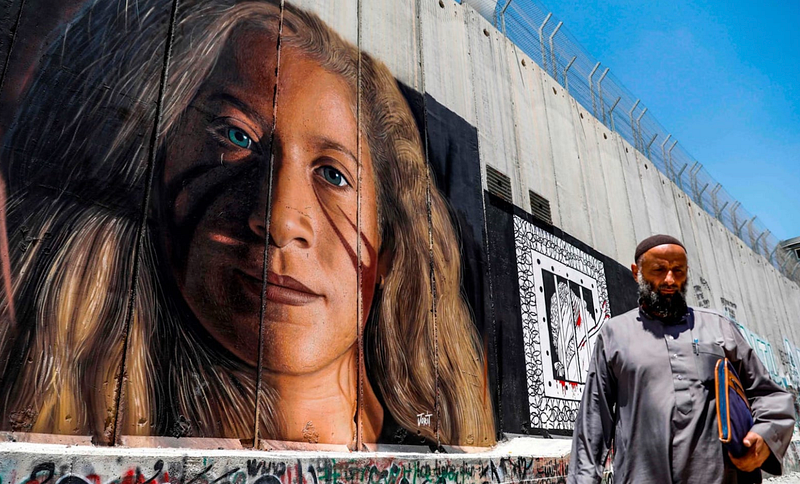
This is a record of my time of living in Bethlehem, near the border with Jerusalem and checkpoint 300, during 2012. The situation has deteriorated since then, but my observations from a decade ago regarding this 75-year-long occupation provide context for what is happening now.
At the edge of Bethlehem, a few blocks from Gilo terminal, past one of the checkpoints where anyone who needs to reach Israel must pass, is a small apartment-its view obstructed by the Barrier. The home was recently built by its Palestinian Christian owner, Adnan, from the money he had saved while working for a foreign company in Jerusalem. His permit had recently expired, though, and he was no longer able to work in Jerusalem. Still, Adnan, who asked that his name not be used in this explosive environment, had worked intensely for decades. He had managed to save enough to build a home not only for himself and his family but also to add a two-bedroom guesthouse. He was now seeking a tenant.
The price of living in Bethlehem is often a commute to Jerusalem. Two decades earlier, the commute would have been easy, for it is a mere 15-minute ride from the Bethlehem border to central Jerusalem. But the recent proliferation of checkpoints has radically obstructed movement within the Occupied Territories, as well as between Israel and the West Bank. Now, the act of crossing the narrow border is counted in terms of hours, not minutes. Random closures, sometimes related to current events, and sometimes without any explanation, often keep the checkpoints closed for days without any advance warning. No one, not even the soldiers who stand guard, knows whether the checkpoints will be open or closed on a given day. Living near the checkpoint slightly eases the commute into Jerusalem for the few Palestinian workers who are able to cross the border, but it is never easy. Of course, the complications for foreigners who cross into Israel pale in comparison to Palestinians, who may be fired if they cannot make it to work on time.
To the northwest of the checkpoint is Gilo, a settlement established in 1973 with a population today of some 40,000, and often informally considered part of greater Jerusalem. Beyond Gilo’s alabaster and limestone terraces is central Jerusalem. Dividing Gilo from the center is the Barrier, referred to locally as the jidar al-fasl al-unsuri (wall of segregation) and by the Israeli state as the hafrada geder (separation fence). The architects of the Barrier argue that it is essential if terrorist attacks are to be prevented.
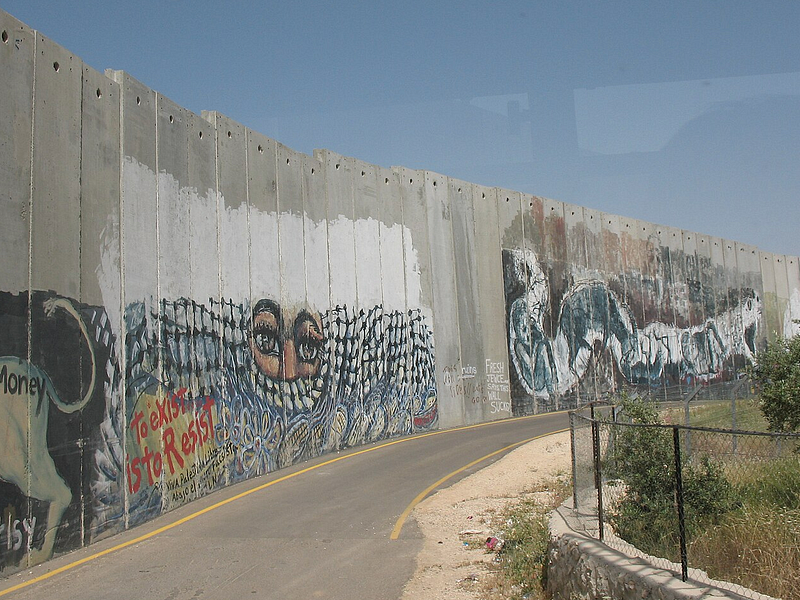
From Bethlehem, it is hard to understand how this structure, made of concrete lined with barbed wire, could be described as a mere fence. Viewed from outside the Occupied Territories, however, the label makes more sense. The wall appears less intimidating from the vantage point of an Israeli road, where it resembles a highway barrier looming in the distance, or a mirage that flickers according to the angle of the sun. When its concrete slabs cut through a backyard, and serve as an excuse to destroy homes in its path, this structure leaves a different impression. For the majority of its route through the Occupied Territories, the Barrier consists of electrified barbed wire and trenches. In other parts, most notably urban centers in the West Bank, such as Qalqilya and Bethlehem, the Barrier consists of concrete slabs 25 feet high, more than twice the average height of the Berlin Wall. In Bethlehem, these concrete slabs slash straight through the heart of this ancient city.
Declared illegal under international law in an advisory opinion issued by the UN’s International Court of Justice in 2004, the Barrier is just over 60 percent complete. In the years since its construction began in 2002, Israel’s Supreme Court has received hundreds of civil lawsuits from Palestinians protesting the path of the Barrier through their land and homes. Occasionally-although not in Bethlehem- the Barrier had to be rerouted to cut less deeply into Palestinians’ houses and backyards. The Barrier is a site of continued contests, not only with respect to how it is defined, but also the path it follows, and especially the images that are painted on it. Alongside the many conflicting agendas surrounding this structure, the Barrier exacerbates the tension within Israel between the judiciary and military over issues pertaining to the occupation.
Already nearly 500 miles long, the Barrier is more than twice the length of the Green Line, which has served as Israel’s internationally recognized border with the West Bank since 1949. Fully 85 percent of the Barrier crosses through, and not merely alongside, Palestinian territory. Even greater than the damage from preventing Palestinian access to Israel is the effect of the Barrier in keeping Palestinians from visiting family and friends, schools, and places of work in neighboring Palestinian cities and villages. And in many instances, the paths closed by the Barrier have deprived Palestinians of their very livelihoods.
ART FORMS
Flourishing along the length of the Barrier is a form of art, commonly known as graffiti. My window looked out onto a mural, comprised of a blank book with salam, the Arabic word for peace, inscribed on it. In the mural, a dove hovers above the word, holding an olive branch in its beak. Between the book and the dove soars a rainbow with clouds on one end and green leaves on the other.
Such hopeful and meticulously crafted art has no guarantee of preservation on a surface where it was almost certain to be washed away, or even wiped out, in the fullness of time. But this mural is only one part of a far broader pattern. On walls, windows, and doors, art in Bethlehem is everywhere. Not many cities are as suffused with art as Bethlehem.
Much of this art was created in response to the enclosure policies that are increasingly suffocating the West Bank. While the Barrier has bisected the region for over a decade, the checkpoints that began to proliferate in the 1990s now number well over 700. The Barrier has proven particularly damaging to Bethlehem’s tourist-based economy. It has diverted tourism to Israeli tour guides and buses, given special access by the Israeli authorities to this territory, even as local Bethlehem residents are refused entry to Israel for such basic needs as work, medical care, and education. Meanwhile, checkpoints sever West Bank villages from each other.
Both checkpoints and the Barrier work in tandem to break the Palestinian economy and to isolate Palestinians from each other and from the world. Such are the conditions where art is being willed into existence in the shadow of and on the very Barrier itself. Yet curiously, much of the art both on the Barrier and on homes near the Barrier touches on themes that appeared to have nothing to do with the occupation. The mural near my window is a case in point. What do a dove, a rainbow, and a book with the word peace inscribed on its blank pages have to do with Palestinian resistance? In fact, by combining political activism with artistic vision, these signs and symbols have a great deal to say about the contemporary interaction between Palestinians and Israelis.
Many of the murals painted by foreign visitors are more straightforward, although never entirely transparent in their meaning. Consider the image just a few blocks away, past the blank book inscribed with peace. A Palestinian girl is frisking an Israeli soldier, the pair painted by the British graffiti artist Banksy in 2007. By casting a small girl in the role of the occupier and a uniformed soldier in the role of the occupied, Banksy’s mural cleverly subverts the victimization narrative that is all too frequently invoked to explain this conflict. The picture makes the point that Palestinians are not in control of their own condition very inversion of power exposing the imbalance between Israelis and Palestinians.
To the right of the frisking scene is a faded building façade, serving as a reminder of the transience of the medium used to compose this art. In block Roman letters, a sign points to Jerusalem, and in Arabic, to Rachel’s Tomb and Bethlehem’s City Center. Sponsored by the Palestinian Authority’s Ministry of Tourism and Attractions, this sign is a holdover of an era long- gone, when tourists flocked to this sacred and prosperous city in search of the sites named on the signpost. At the time, none was obstructed by an immovable wall. As with so much of Bethlehem’s graffiti, this sign does more than offer an example of art imitating life. Here, on this innocuous Bethlehem wall, life has imitated and ironized art.
Although Banksy’s mural, by a foreign visitor to Bethlehem, may not reveal much about the Palestinian experience, it does suggest something important about the relationship between art and politics. The impermanence of this mural, which has been impeccably preserved for several years, is central to its meaning, suggesting the hope that inversions of reality, like the girl frisking a soldier, will not and cannot last forever.
.jpg)
TRAFFIC STOP
Viewed historically, the Barrier is the culmination of a lengthy effort to cut traffic between the West Bank and Israel, as well as within the West Bank. Before the Barrier itself was launched, population movement was controlled exclusively through checkpoints, which were opened in earnest following the Oslo Accords of 1993 and 1995. These created the Palestinian Authority, giving the new government limited control over certain portions of the West Bank. Such early checkpoints were constructed as temporary sites designed to be dismantled following a more permanent peace. Since the 1990s, however, these structures are increasingly, like the Barrier, built of material intended to endure concrete, metal, barbed wire, and stone. Meanwhile, chemical advances allow the art that adorns these walls to be more easily washed away from public memory.
Although as a physical structure, the Barrier is barely 12 years old, its conception dates back to 1995. It was then that Prime Minister Yitzhak Rabin, arguing in favor of “separation as a philosophy” that required “a clear border,” proposed the erection of a physical structure to keep in place borders the Oslo Accords established. Although the Accords are still hailed as a landmark effort in the direction of peace by American policymakers, they are at the source of many of the current problems in the West Bank. One example is the Barrier’s trajectory, which entrenches and expands the fragmentation of the West Bank that was set into motion at Oslo.
According to this system, three-quarters of the West Bank, known as Area C, fell under Israeli control until sovereignty could be handed over to the Palestinian Authority in 1999. Since this transfer of sovereignty never took place, Palestinians remain excluded from the majority of their land and are unable to move between neighboring cities. Under the Oslo Accord, the designation of the three different areas was intended to be a temporary arrangement prior to the establishment of Palestinian sovereignty. One effect of the Barrier is to make these divisions a potentially permanent feature of the Palestinian landscape. That Areas A, B, and C are not contiguous means a barrier built to mark these borders has the effect of breaking up Palestine into a series of enclaves, surrounded on all sides by Jewish settlements.
This process of turning a contiguous territory into a series of fragmented villages was already underway with the debut of the checkpoint regime. The Barrier has considerably advanced the Israeli state’s strategic fragmentation of historic Palestine, which extended from the Mediterranean to the Dead Sea. According to the United Nations Office of the Coordination of Humanitarian Affairs, the Barrier would deprive Palestinians of approximately 10 percent of their remaining land.
When the construction of the Barrier stirred controversy within the international community, the Israeli government responded that it is essential to prevent suicide bombings. The sequence of events, as well as the Barrier’s path, suggest another story. The years following the beginning of the construction of the wall were marked by a reduction in suicide attacks (down from 55 in 2002 to 14 in 2005). This reduction may have had more to do with Hamas’s moratorium on suicide bombings in the West Bank beginning in 2005 than with the wall itself. Furthermore, notwithstanding its 20 miles of concrete, the Barrier in its present state has many gaps. Its walls have also been regularly scaled, not by terrorists, but by Palestinians who enter Israel through these illegal means because they are desperate for work.
The path it follows also casts even further doubt on the narrative of the Barrier as an antidote to terrorism. According to the Israeli human rights organization, B’tselem, the route was based on considerations “completely unrelated to the security of Israeli civilians,” and was instead driven by Israeli politicians’ desire to secure the future expanded borders of the Israeli state. In the case of Bethlehem in particular, the path followed by the Barrier diverges from any plausible goal of guarding against terror. The Barrier wraps directly around Rachel’s Tomb, a sacred site in Judaism and, prior to the wall’s construction, a major source of revenue as a tourist site for the Bethlehem municipality. Unfortunately for Palestinians who happened to reside near Rachel’s Tomb, the occasion of the Barrier’s construction was used to annex this sacred site to Jerusalem, even at the cost of preventing Bethlehem residents from access to the wider world.
Given their close relationship to the Barrier, it is appropriate that some of the most militarized checkpoints, such as Gilo, are covered with art. One particularly striking photograph that combines art on the checkpoint with the place of this art in Palestinian life shows a woman gazing towards Bethlehem from the Gilo checkpoint. To her left is a skillfully drawn male head, his spiked hair arrayed along one side of the open passage-way, his searching eyes peering from the other side. Intentionally or not, the man’s spiked hair evokes what is arguably the most nuanced image along the main section of Barrier near downtown Bethlehem. This image depicts the Statue of Liberty mourning the death of her son. In turn, the Statue of Liberty image encompasses two others Madonna weeping over her crucified son in a postmodern Pieta, and Handhala, a cartoon figure who has symbolized resistance through satire since his creation by the Palestinian political cartoonist Naji al-Ali in 1969.
LIVING IMPACT
The impact of the Barrier, and its art, on Palestinian lives cannot be grasped in isolation from other aspects of the occupation, namely the checkpoints and the ID and permit system. In many respects, the Barrier is only the latest iteration of a process that was initiated with the proliferation of the checkpoint system in the early 1990s, officially with the onset of the Gulf War. During that war, permission to move between Gaza and the West Bank, a right Palestinians had possessed since 1972, was revoked. Prior to 1972, even when conditions were far from ideal, Palestinians did have relative freedom of movement, in the sense that they could travel from Bethlehem to Ramallah to Gaza without needing to pass through dozens of checkpoints.
In the wake of Oslo, the checkpoint system functioned for Israel as a tool of blunt diplomacy. When Israeli negotiators were pleased with Palestinian concessions, more permits would be issued. When the Palestinian Liberation Organization insisted on Palestine’s political autonomy, the number of passes granted to Palestinians was reduced. Yet, in hindsight, such disciplinary tactics represented the good old days, for as many as 200,000 permits were granted every year to workers in the 1990s. This number pales in comparison to the 40,000 permits granted to West Bank Palestinians in 2012, out of a total population of over 2.5 million.
Now that diplomacy is increasingly seen by the Israeli government as offering no solution to its security concerns, the checkpoint has ceased to serve as a tool of diplomacy and has, along with the Barrier, become a means of entrenching the existence of the occupied territories. This transformation is reflected in the changing architecture of the most recent checkpoints, with Gilo’s opening in 2005 as the first such example. Known as terminals, these checkpoints, 10 in all, are significantly larger than their predecessors. Their construction, coinciding with the arrival of the Barrier, follows its path and is clearly built with a long-term perspective. One example of this intention is on the Israeli side of the Barrier passage that reads. “Non-Jews must remain outside.” At the same time, though, there is graffiti that argues for a different future: “Jews and Arabs refuse to be enemies.” Both are indicative of a complex political reality best captured in artistic self-expression.
CHECKPOINTS AS ART
Even here, in the cold and harsh exteriors of the Gilo checkpoint, the impulse to infuse art into the occupation is in evidence. Graffiti and other imagery adorn one of the checkpoint’s watchtowers, adding new textures and colors to the grey concrete.
As with the artists who decorate the Gilo terminal, Palestinians and other activists transform the architecture of occupation into an art of existence through counterintuitive and iconoclastic imagery. Often, the words of historical figures or anonymous slogans are invoked to suggest a sophisticated understanding of the machinery of war and the politics of peace.
The first graffiti is in Spanish and was probably added by a visiting activist. “Porque la Paz no es mas difícil de alcanzar que la guerra,” it reads in dark green. “Because peace is no more difficult to realize than war.” The second is on a section of the Barrier covered with Arabic graffiti, likely added by a local Palestinian. A quotation from Mahatma Gandhi, this graffiti reads: “Victory attained by violence is equal in value to defeat because it is momentary.”
The Israeli side is hardly reluctant to pursue the battle conducted with spray paint. “Seek revenge for the blood spilled,” a tribute to the “eye for an eye” imperative in the Book of Genesis, is scrawled at one point. Even more direct, “Kill the Muslims,” exhorts another spray-painted contribution designed to instigate violence.
Such slogans may seem removed from the daily lives of Palestinians and their everyday struggles, as well as any efforts of Israel to live free of terrorist attacks. Still, their presence in the heart of the West Bank suggests a relation, however tenuous, between the long-term fight for social justice and everyday struggles to survive. When Palestinians invoke such statements, they are envisioning a life, and a future, that cannot be destroyed by the occupation. For Israelis, such graffiti seems to suggest a far less than existential threat.
Waiting at the Gilo checkpoint one afternoon is a doctor and self-proclaimed communist who’d invested his life in fighting for Palestinian liberation. Yet, he insisted, “I’m neither a nationalist nor an Islamist. A communist is someone who cannot be pressured into following other peoples’ rules.” He finds the expressions of transnational solidarity painted on the wall inspiring, though he knows that, by themselves, they could not wipe away the many forms of suffering and degradation that the Barrier had inflicted on his friends and family.
INTRINSIC OPPOSITES
Much of the commentary on the Israeli-Palestinian divide is based on the assumption that both peoples are intrinsically opposed to each other, whether through their culture, religion, language, or genes. Yet it’s striking how much Israelis and Palestinians have in common, though many are often unaware of how much their cultures share. Neither willful ignorance nor coercive cohabitation is likely to lead to mutual understanding. In earlier generations, Palestinian workers would learn Hebrew as a matter of course. Now, they are more likely to learn their neighbor’s language in prison. Among the younger generation of Palestinians, the proportion who understand Hebrew or who are able to visit Israel continues to fall. Equally damaging, Israelis are more likely to encounter Palestinians in militarized contexts of checkpoints. Above all, the Barrier and other architecture of the occupation have kept Palestinians and Israelis divided against each other and against themselves.
The astonishing creativity that has been lavished on the Barrier-the most visible symbol of the Israeli occupation and the most notable stain on the Palestinian landscape-conflicts profoundly with the implication that either Palestinians or Israelis are simply victims of the broken system in which they reside. Palestinians and Israelis can and do respond to what respectively is described as occupation or disputed territory, by among other ways, creating art. Not all the art they create is of enduring value. In many respects, the art that is destined to fade away matters even more than the art that will live forever. Palestinian strategies of creative resistance and Israel’s struggle, surrounded by real or perceived enemies, suggest that for all the damage these fears have wrought, the status quo is not, and can never be, complete.
The works of art that Palestinians have created in connection with the Barrier can certainly be read as expressions of resistance, the Israelis of fear and anger. Each expresses rejection of the terms of how the land has been divided, including its habitual commodification of human life, and its literal and figurative forms of imprisonment.
Yet the artwork that adorns Bethlehem’s Barrier and its checkpoints speaks of another response to the division of these territories that is at least as powerful as the impulse to resist one that is simpler, and also arguably more universally applicable because it is deeply integrated into daily life. This is the impulse to exist, a powerful emotion on both sides of the Barrier.
Palestinians have a word to denote this art of existence. They call it sumud, literally meaning “steadfastness.” Sumud appears in the name of several Palestinian peace organizations. Sumud is symbolized by the olive tree, which stands firm amid climactic upheavals. Sumud is the best way of characterizing the personality of our Palestinian communist doctor who refuses to toe any party line, including those of the nationalists and the Islamists, who are inconsistent with justice for all.
Sumud is freedom, but it is not unconditional, because its attainment is premised on justice for everyone. It is the only solution there will ever be to a conflict that has claimed so many lives that forgiveness is out of the question, sadly on both sides, as reflected in the art mirroring life.
Further reading on Palestinian graffiti & the apartheid wall
A. Toenjes, This Wall speaks: graffiti and transnational networks in Palestine Jerusalem Quarterly (2015).
S. Schwabe, Resistance in representation: the diasporic politics of Club Deportivo Palestino Soccer & Society (2019).
P .Hopper, Pilgrims, Protest Tourists, and Palestinians: Abu Dis, Bethlehem, Dheisheh Camp Humanity & Society (2020).
C. Gagliardi, Palestine Is Not a Drawing Board: Defacing the Street Art on the Israeli Separation Wall. Visual Anthropology (2020).
For more content on Palestine, see