
Poverty and Equal Opportunity
The system of economic deprivation: look closer and see how far down the bottom goes
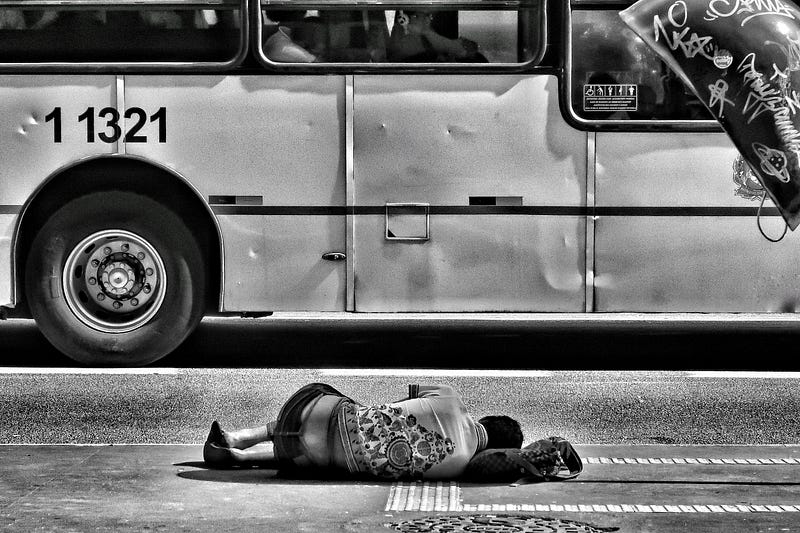
Ending poverty is a modern idea, not widely documented in pre-modern times. Intended to relieve poverty in the United States, Lyndon B. Johnson introduced in the 1960s, the war on poverty by extending social welfare legislation. The program, known as the Great Society, was part of a more extensive legislative reform that Johnson wished would make the United States a more fair and just country. Johnson stated, “Our aim is not only to relieve the symptom of poverty, but to cure it and, above all, to prevent it.”
I carry some residue of having grown up poor
My childhood affects me every day in ways most people may struggle to comprehend, having lived a substantial portion of my formative years below the poverty line.
For me, childhood poverty means becoming obsessed with money as an adult and a voice of doom that plays like a scratched record, infiltrating every corner of my mind. I can never run entirely out of anything — before I use the last face cream or the last container of almond milk, I’ll buy two or three or half a dozen more, making sure that I not only have enough but have excess. Currently, not lacking anything, there’s no logic to my thinking, but in my mind, I am always a step away from starving on the streets, staring at other kids enjoying new clothes and shoes, or seeing them eating meat instead of potatoes.
And now that we are smack in the middle of a global pandemic that is threatening to thrust our economies into freefall, the wounds of poverty are rawer. According to researchers at Columbia University, the number of people below the poverty line has grown by eight million since May.
This year there are countless words to describe the state we are in, yet none is sufficient. We talk in circles to rationalize the unprecedented, use hundreds of adjectives in the search for the right one, but the definition eludes us.
The pandemic that devastated the world affects the health, budget, and the way of thinking of the world population. The impasse between preserving health and preserving the economy has polarized us. The debates in many nations affected by the virus have caused their leaders to review their positions in the face of their citizens’ poverty.
COVID-19 is unprecedented because it is experienced by many globally and instantaneously, unsettling daily work schedules and social activities to education and international trade. Thus far, it has contaminated more than eighty million people across every country globally and led to almost two million deaths. As the world is increasingly realizing, it is the poorest people, from rich and disadvantaged countries alike, who are distressed the most. From vanished jobs, vulnerability to contagion because they live and work in high-risk settings, and lack of access to health care and social fortification.
Constraints get in the way
Poverty doesn’t exist in a vacuum — many people have far too little because a small number have far too much. Wealth inequality is growing to more significant extremes, with about eighty-five people owning more wealth than half of the world’s inhabitants, according to a new report from anti-poverty group Oxfam as of January 2020.
Over the past decade, sociologists and even economists have begun asking questions about culture’s role in many facets of poverty and even explicitly explaining the low-income population’s behavior about cultural factors. As a product of the essential human condition, every act to remedy poor people’s state has the potential to change both the present and the economy’s future.
How to define poverty
Having experienced poverty in childhood means that as an adult, I understand that the circumstances people are born into are never the sum of who they are or what they’re worth. Being impoverished, then, is more than lacking financial means. In a broader perspective, the correct dimensions of poverty are an overall condition of deprivation and deficiency of economic, political, and social resources.
According to Webster’s New Twentieth Century Dictionary, it also means “deficiency in necessary properties or desirable qualities, or a specific quality, etc.”
Politically, the seeming benefits depend on the weight given to poor people, which is contingent on their voting power and ability to organize. The cost of ending poverty through redistribution hinges on how much poverty there is, compared to the resources thought to be existing. No wonder that calls for ending poverty rise to the surface more often when a society’s total resources make it more achievable.
The poor stay poor because doors remain closed
Even in the absence of pandemics, wars, and natural disasters, the poorest people suffer harsher challenges. We tend to judge people and events of the past by the present standards and indict them as being lazy and lacking motivation. Before birth, their mothers are less likely to be given sufficient nutrition and antenatal attention. At birth, their existence is regularly not formally recorded; and as children and adults, they are more likely to be overlooked in official censuses and surveys. If they have limited schooling or speak a minority language, their community may struggle to complete necessary administrative forms, understand laws, and policies.
Covid is a moment of historical importance. I imagine that when we remember the pandemic in years to come, no length of time nor power of exposition will offer us anything other than lost for words. Bringing this talk to a partially satisfactory end is hardly new and not revolutionary, but it will still help to go one step further to see things correctly.
ad by emailing it to a friend or sharing it on Twitter or Facebook. Also, sign on to my website, and I will send you a free chapter of my novel, Stolen Truth. https://henyadrescher.com.
Thank you!