
Post-Covid-Vaccine Long Haulers: An Emerging Concept
Some people develop chronic symptoms like long-Covid after getting the Covid-19 vaccine, but it’s extremely rare.
As an immune system trainer, a vaccine is designed to provoke immune responses, responses that the immune system would mount should it encounters the pathogen the vaccine serves to vaccinate against.
Owing to the sheer complexity of the immune system, a black box not fully decoded to this day, there is more room for mistakes. And anything that can go wrong will go wrong, per Murphy’s law. For example, in autoinflammatory and autoimmune disorders, the innate and adaptive immune systems have gone wrong, mistakenly attacking their host’s cells.
As follows, every once in a blue moon, the immune system might respond wrongly to the Covid-19 vaccine, which I’ll explore in this article.
An obscure post-vaccine chronic condition similar to long-Covid
In an interview back in June 2021, Bruce Patterson, MD, a pathologist who has been working on long-Covid treatment, informed that he had seen 100–200 patients who developed symptomatic and immune profile similarities to long-Covid patients at 3–4 months after Covid-19 vaccination. Dr. Patterson called them the post-vaccination long-haulers.
Last month, in an article titled “In rare cases, coronavirus vaccines may cause Long Covid–like symptoms,” Science reported that researchers at the U.S. National Institue of Health (NIH) — led by Avindra Nath, MD, a neuro-immunologist and clinical director — have collected samples for research from people who developed chronic symptoms after getting the Covid-19 vaccine, regardless of the manufacturer. But it seems to be more common in recipients of DNA or mRNA genetic vaccines.
Science provided two case examples (and presumably has spoken to more):
- Brianne Dressen, a former preschool teacher and rock climber, has been debilitated for months — to the point of being unable to brush teeth — after getting a dose of AstraZeneca’s DNA vaccine.
- Jana Ruhrländer, a microbiology graduate student, got a dose of Moderna’s mRNA vaccine and soon experienced “sensation of internal electric shocks” like Dressen, as well as muscle weakness, intense thirst, and heart rate and blood pressure abnormalities.
Such post-Covid-19 vaccine chronic symptoms are similar to long-Covid, Science noted, with symptoms of fatigue, severe headaches, nerve pain, blood pressure changes, and short-term memory troubles.
How often cases like these occur is unknown. “Online communities can include many thousands of participants, but no one is publicly tracking these cases, which are variable and difficult to diagnose or even categorize,” Science reported. “[But] Nath is convinced they are ‘extremely rare.’”
I have also heard anecdotes of post-Covid-19 vaccine chronic symptoms in some of my mother’s friends, who have got either the DNA or mRNA Covid-19 vaccine. Symptoms I heard were new-onset gastrointestinal, neurological, and musculoskeletal (e.g., fatigue, joint pain, or muscle weakness) symptoms that persist for weeks or months, which doctors were unsure of how to treat.
Notably, chronic (long-term) and acute (short-term) disorders are different. Covid-19 vaccines have been closely associated with several acute disorders that are rare: (i) myocarditis from the mRNA vaccine; (ii) thrombotic thrombocytopenia and Guillain-Barre syndrome from the DNA vaccine; and (iii) Bell’s palsy from the inactivated vaccine.
But the Covid-19 vaccines have not been linked to chronic symptoms like what Dressen and others are experiencing.
Science has also put forward three hypotheses that might explain such post-Covid-19 vaccine chronic symptoms:
- Immune network theory
- Autoantibody production
- Micro-clots
Let’s explore them one by one.
***
1. Immune network theory
In an article published in the New England Journal of Medicine, William J. Murphy, Ph.D., an immunologist and distinguished professor, and Dan L. Longo, MD, a professor of medicine, discussed an autoimmune mechanism that may come from Covid-19 or its vaccine.
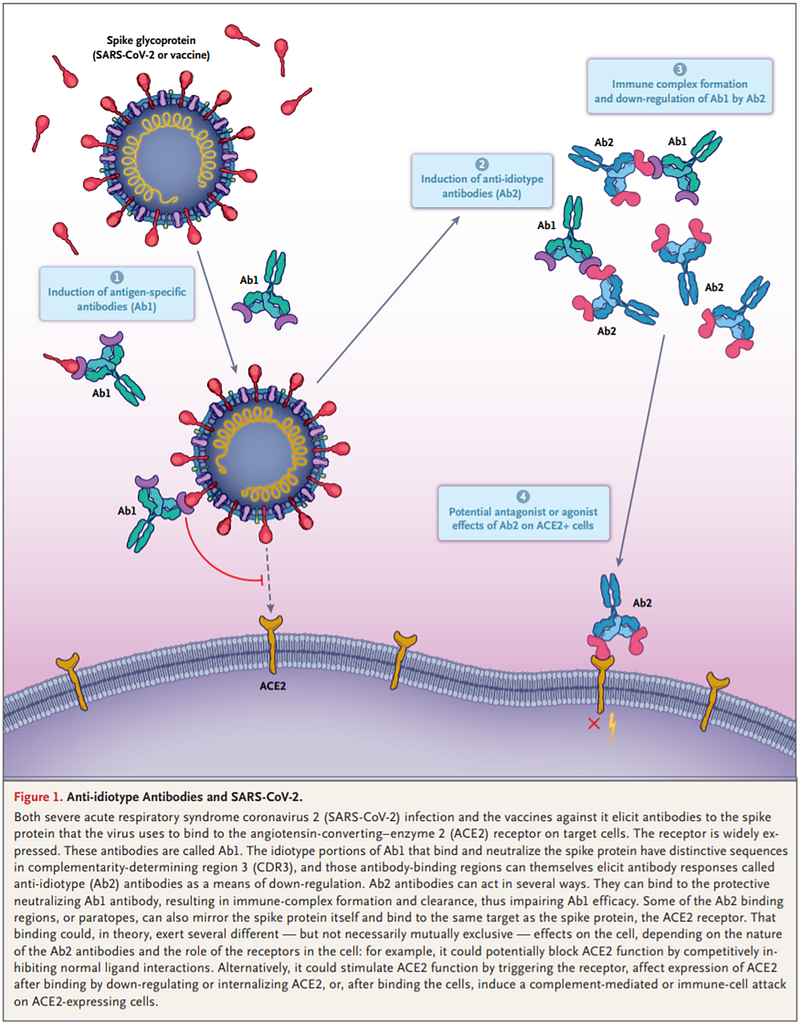
The mechanism is the immune network theory, where the production of antibody #1 (Ab1 that binds to a specific pathogen’s antigen like SARS-CoV-2’s spike protein) also triggers the production of antibody #2 (Ab2 that binds to Ab1 as a means to downregulate it). As follows, Ab2 would have a similar molecular structure as SARS-CoV-2’s spike protein that Ab1 targets. An excess of Ab2 may, thus, function similarly to SARS-CoV-2’s spike protein.
“As a result of this mimicry, Ab2 antibodies also have the potential to bind the same receptor that the original antigen was targeting (Figure 1),” professors Murphy and Longo wrote. “Ab2 antibodies binding to the original receptor on normal cells therefore have the potential to mediate profound effects on the cell that could result in pathologic changes, particularly in the long term — long after the original antigen itself has disappeared.”
The immune network theory has also been demonstrated experimentally to cause autoimmune disorders:
- Infecting mice with coxsackievirus B3 infection induced the production of Ab1 (anti-coxsackievirus), as well as Ab2 (anti-Ab1) antibodies that could bind to heart muscle cells, triggering autoimmune myocarditis.
- Giving rabbits Ab1 (anti-BisQ) antibodies resulted in Ab2 (anti-Ab1 or anti-anti-BisQ) production with a similar structure as BisQ. As BisQ is known to bind to the ACh receptor, the Ab2 antibodies also bound to the ACh receptor, causing myasthenia gravis, a muscle-nerve disorder due to acetylcholine (ACh) neurotransmitter dysfunction.
But the role of Ab2 antibodies in Covid-19 or its vaccine has not been studied due to technical difficulties, according to professors Murphy and Longo.
***
2. Autoantibody production
Autoantibodies are self-reactive antibodies that bind to and react with the host’s own cells or tissues. Autoantibodies are also a known complication of SARS-CoV-2 infection or Covid-19.
For example, a study detected higher levels of autoantibodies in healthcare workers with prior SARS-CoV-2 infection (including asymptomatic cases) compared to pre-pandemic healthy participants. Some of the consistently detected autoantibodies were against thyroid-related, lung-related, blood vessel-related, immune-related, and SARS-CoV-2-interacting (e.g., ACE2) proteins. More concerningly, such autoantibodies were detected even at 6-month after symptomatic Covid-19. More studies have also found similar autoantibody findings in Covid-19 patients.
What triggered these autoantibodies? It could be any protein of SARS-CoV-2, be it the nucleocapsid, open-reading frame, membrane, or spike protein. Spike protein, in particular, is the most immunogenic part of SARS-CoV-2 for adaptive immunity formation, which the current Covid-19 vaccines target.
To hunt for antibody therapies for Covid-19, one study isolated 598 different antibodies that target SARS-CoV-2’s spike protein from recovered Covid-19 patients. After rigorous screening, 18 antibodies were found to neutralize SARS-CoV-2 with high potency. When testing for self-reactivity, however, four of those 18 potent antibodies were self-reactive — autoantibodies — that reacted with cells of the brain, heart, lung, kidney, and colon in mice.
The director of this study, Harald Prüss, MD, a neurology physician and scientist, therefore, noted that spike protein antibodies — even possibly from the vaccine — might cause immunological complications.
Prof. Prüss and his team have, in fact, detected autoantibodies in some patients with post-Covid-19 vaccine symptoms, Science reported.
But while SARS-CoV-2’s spike protein and vaccine’s spike protein are both spike proteins, there are subtle differences. The spike protein the mRNA vaccine, for example, has a double proline mutation that keeps the spike protein anchored on the cell surface in a pre-fusion form that cannot bind to the ACE2 receptor. This modification makes it a safer spike protein than SARS-CoV-2’s, which can cause widespread vascular problems.
***
3. Micro-clots
Microscopic blood clots (micro-clots) have also been found guilty of driving Covid-19 pathology, including long-Covid.
Resia Pretorius, PhD., a distinguished professor in physiology, and colleagues have published a study that detected biomarkers of micro-clots lingering in the bloodstream of long-Covid patients who had Covid-19 six months ago. Such micro-clots were unique as they are resistant to degradation, unlike those found in healthy or diabetic samples. Dr. Pretorius suspects such micro-clots could interfere with oxygen transport and cause long-Covid symptoms.
The spike protein of SARS-CoV-2 could be the culprit of these micro-clots. The spike protein is known to bind to the angiotensin-converting enzyme 2 (ACE2), which causes ACE2 hyperactivation and dysregulates the renin-angiotensin system (RAS) that maintains vascular functions.
As a result, we see widespread vascular issues like blood clots and bleeding in Covid-19 and, very rarely, in recipients of AstraZeneca’s DNA vaccine (and, even more rarely, Johnson & Johnson’s DNA vaccine). Unlike other Covid-19 vaccines, AstraZeneca’s DNA vaccine doesn’t have the double proline mutation to stabilize the spike protein in a pre-fusion form. (Only spike proteins in the post-fusion form can bind to and activate ACE2.)
In fact, vaccine-induced thrombotic (blood clots) thrombocytopenia (low platelets making one prone to bleeding)— VITT — is a legitimate complication of J&J’s and AstraZeneca’s DNA vaccines. It’s why many European countries have limited the use of such DNA vaccines to the older age group only.
But Prof. Pretorius “suspects all COVID-19 vaccines might also sometimes trigger subtler clotting issues,” Science reported, because they are all spike-based. “She says she has preliminary evidence that vaccination can lead to microclots, although in most cases they go unnoticed and quickly disappear — an effect she and a colleague saw in their own blood and that of eight other healthy volunteers, which they sampled after their vaccinations.”
What the existing literature says
Searching PubMed, a biomedical literature database, with the keywords “(covid*[title/abstract] OR sars-cov-2[title/abstract]) AND vaccine[title/abstract] AND (post-vaccine[title/abstract] OR autoimmun*[title/abstract] OR *clot*[title/abstract])" returned 477 papers as of 14 February 2022. As covering every relevant paper would be too extensive, I’ll provide an overview of what has been published in the literature.
There are numerous studies evaluating the safety and effectiveness of Covid-19 vaccines on people with immune disorders, which found no significant safety concerns besides possible weaker antibody responses.
There are also multiple case reports or series of people developing immune or vascular disorders after getting a Covid-19 vaccine. In addition to known ones like myocarditis and VITT, such cases include type 1 diabetes, lupus, arthritis, autoimmune vasculitis, transverse myelitis, neuromyelitis optica, Bell’s palsy, peripheral neuropathy, vestibular neuritis, aplastic and hemolytic anemia, acquired hemophilia A, autoimmune encephalitis, encephalopathy, alopecia, thyroiditis, Graves’ disease, herpes zoster, Sweet syndrome, macrophage activation syndrome, rhabdomyolysis, and autoimmune hepatitis.
But it should be noted that case reports are low-tier scientific evidence that represents the extreme outliers and cannot determine cause-and-effect.
Some of such cases have been termed vaccine-induced autoimmune diseases. But “there are no general criteria for the diagnosis of vaccine-induced autoimmune disease, which has to be evaluated on a case-by-case basis,” immunologists from China stated, urging more research into understanding who is at risk of vaccine-induced autoimmune diseases. “[In] susceptible populations, the risk of vaccine-induced autoimmune diseases should be weighed against the risk of exposure to SARS-CoV-2 infection.”
Others suspect these post-Covid-19 vaccine cases are part of Shoenfeld’s syndrome — also known as autoimmune/inflammatory syndrome induced by adjuvants (ASIA) or post-vaccine autoimmunity — first coined in 2011.
“Reports on autoimmune reactions after vaccination would constitute probably less than 0.01% of all vaccinations performed worldwide, although this rate may be biased by under-reporting,” Yehuda Shoenfeld, MD, a world-leading professor in autoimmune research, and colleagues wrote.
Shoenfeld’s syndrome includes both chronic/acute symptoms (e.g., fatigue, muscle weakness, sleep or cognitive impairments, fever, and dry mouth) and diseases (e.g., arthritis, lupus, type I diabetes, thrombocytopenia, vasculitis, Guillain-Barré syndrome, and demyelinating disorders).
While the true cause is unclear, Shoenfeld’s syndrome is thought to happen from stimulating a sensitive immune system with vaccines or other adjuvants (e.g., cosmetics or silicone breast implants). People with or at risk for autoimmune disorders—such as a family history of autoimmunity, smoking, and hormone dysregulation — may be at risk for Shoenfield’s syndrome.
So, scouring the existing literature doesn’t tell us much about post-Covid-19 vaccine chronic symptoms.
Part of the reason could be that it’s a highly contentious topic. Dr. Nath — who has begun researching post-vaccine chronic symptoms — has submitted a case series of about 30 people with this condition but got rejected from two top medical journals. “Other researchers note the scientific community is uneasy about studying such effects,” Science reported, quoting Prof. Pretorius that “everyone is tiptoeing around it…I’ve talked to a lot of clinicians and researchers at various universities, and they don’t want to touch it.”
What it means going forward
Nevertheless, post-Covid-19 vaccine chronic symptoms is gaining much-needed scientific recognition. Professional scientists like Dr. Nath, Prof. Prüss, Prof. Pretorius, Dr. Patterson, and others have started researching and trying to treat this bewildering condition.
Top authorities (the Food and Drug Administration and European Medicines Agency) and big pharma (Pfizer, Moderna, AstraZeneca, and J&J) have also started paying attention, according to Science:
Science contacted regulators and vaccinemakers about any information they’d gleaned on these side effects. A Pfizer spokesperson wrote, “We can confirm it’s something we’re monitoring.” Moderna, AstraZeneca, and Johnson & Johnson all said they take side effects seriously and share reports they receive with regulators. An FDA spokesperson said the agency “continues to maintain a strong focus on monitoring the safety of the COVID-19 vaccines,” while the European Medicines Agency notes it “is taking steps to use real-world data from clinical practice to monitor the safety and effectiveness of COVID-19 treatments and vaccines.”
But it’s rather disappointing that only now we are having a public discourse about post-Covid-19 vaccine chronic symptoms or post-vaccine long-haulers, when Dr. Patterson voiced this issue back in June 2021.
Why? It could be the fear of contributing to vaccine hesitancy or anti-vaccine narratives. It could also be the unwillingness to see and address what we don’t want to see. At least I, for one, told my mother many months ago that her friends’ post-vaccine chronic symptoms were likely due to non-vaccine factors like pre-existing diseases or diseases that have just been unmasked.
Whatever people like Dressen and others are experiencing after they got the Covid-19 vaccine must be studied to comprehend what is really happening, even if the knowledge gained is unpleasant. We have mass vaccinated most parts of the world, and the stakes are nearly the highest it can be.
Researching such post-vaccine long-haul cases is indeed contentious as it could drive anti-vaccine narratives. Even so, such research is needed to ensure the public that any vaccine-related adverse reactions are properly investigated and, if a link is found, help find ways to treat or prevent the condition.
“We shouldn’t be averse to adverse events,” Prof. Murphy told Science. “Reassuring the public that everything is being done, research-wise, to understand the vaccines is more important than just saying everything is safe.”
Knowing is always better than not knowing. And, in this case of post-Covid-19 vaccine chronic symptoms, it’s worth knowing. Otherwise, the anti-vaccine movement will exploit this opportunity to preach that Covid-19 vaccines are unsafe, and the scientific communities don’t want to research about it.
At this point, we don’t really know a lot about post-Covid-19 vaccine chronic symptoms. We don’t know its precise incidence, risk factors, clinical outcomes, pathophysiology (i.e., biological mechanisms driving the illness), or treatments. We only have hints and speculations for now.
All that said, per Dr. Nath’s speculation, post-Covid-19 vaccine chronic symptoms or long haulers should be very rare — probably at less than 0.01% of vaccinations, per Prof. Shoenfeld’s estimates on Shoenfeld’s syndrome. Such a sporadic occurrence should not override the numerous benefits that vaccines provide, as Science has also concurred.
In Malaysia, we can’t choose which Covid-19 vaccine to get. I am double vaccinated with Sinovac’s inactivated vaccine and boosted with Pfizer’s mRNA vaccine. I’ve got no chronic symptoms or any other rare adverse events. Except for very few exceptions, I also think that vaccination is generally the right choice for obvious reasons I’ll not discuss here.
If you have made it this far, thank you. Subscribe to my Medium email list here. If you want to become a member to get unlimited access to Medium, you can use my referral link, and I will receive a small commission at no extra cost to you. You can also tip me below if you are feeling generous today, and I’ll appreciate it. Paying bills with science writing isn’t easy, so I’ll appreciate any help I can get.


