
A Guide to Positioning Strategy
Positioning: 5 Ways to Stand Out From Your Competitors
How a brand provides value to customers in a unique way.

Positioning is where a brand sits in the hearts and minds of customers.
The associations that consumers hold with the brand reflect its positioning in the market. A brand can control the marketing mix to create a market position, but it really the customer who decides a brand's positioning in its mind.
This blog explores positioning as a marketing strategy.
The relationship between positioning and other essential marketing strategies is discussed, along with five common positioning strategies brands use.
“A position that takes into consideration not only a company’s own strengths and weaknesses, but those of its competitors as well.” (Ries & Trout, 2001)
What Is Positioning?
Firms use positioning to create an image of their product or service in their target customers' minds.
Positioning defines how the brand's offering is unique: how it provides a distinct benefit to customers. Businesses use marketing to communicate their market position to customers and influence their perception of their products or services.
Marketing establishes the brand identity, influencing consumer perceptions of its position in the market relative to competitors' alternatives.
“Positioning is not what you do to a product. Positioning is what you do to the mind of the prospect. That is, you position the product in the mind of the prospect.” (Ries & Trout, 2001)
Before determining its position in the market, a firm should decide on a market segment that it want to target.
This market segment should be profitable — either there are many customers, or it is a niche in the market that presents an opportunity due to a lack of competition. This stage is where positioning comes in.
A business must decide how to make its brand as attractive as possible to the group of customers they want to target. Demographics such as gender, location and age, and criteria based on consumer behaviour define this target market.
Your Unique Selling Proposition
Effectively positioning a product or service gives it a USP (Unique selling proposition).
A USP is an attractive feature or characteristic of a brand’s product or service that differentiates it from similar alternatives.
In a modern marketplace cluttered with so many choices with similar benefits, you want your brand to stand out from the rest.
It becomes more memorable and can have a competitive advantage over alternatives. Your USP is your unique benefit to entice customers to purchase your brand over another.
McDonald's is a notable example of using a USP to help position its brand. They are the world's most widely known fast-food brand and compete with hundreds of other fast-food outlets. They do not try and position themselves as the fastest, cheapest or best tasting.
Instead, their USP is that they are a family-friendly restaurant. Their USP includes the children's menu items, the free toy with a kid's meal, and the playgrounds. They position themselves to target families.
Positioning statement
A USP and positioning statement is similar.
The most significant difference is that a USP is product or service-centric and focuses on what sets your product or service apart from competitors. A business creates its positioning statement after the USP, concentrating on the primary benefit of the product or services to its target market.
Businesses need to ask themselves, "How do I want our brand to be perceived?"
A positioning statement should be no longer than a paragraph, written in a specific way.
- First, the positioning statement describes your target market and their specific needs or goals. Market research will help a business to understand this more intimately.
- Define what category your product or service belongs to and how it meets the needs of consumers. Customers need a reference point to provide context to evaluate a brand's offering.
- What differentiates your product or service from the alternatives? One point of differentiation is best, stating your difference from the customer's perspective. How does your differentiator will help solve the customer's problem or help them achieve their goals?
- Explain why consumers in your target market should believe your brand's claims. Consumers must see credibility in your positioning, so provide evidence to justify your brand's claim in your positioning. Do not just say you are the fastest or best quality, state HOW you are.
“There is a positive relationship between company performance (profitability/efficiency) and well-formulated and clearly-defined positioning activities.” (Kalafatis, Tsogas & Blankson, 2000)
Determining a Positioning Strategy
A successful positioning strategy relies on a deep understanding of the marketplace in which you want to compete.
It identifies how your company is different from the competitors and the conditions and opportunities in the marketplace. A big mistake that many businesses make is assuming that positioning is just a marketing strategy, and it should be one of the foundations of the business strategy.
After all, you cannot position a product as a high-quality offering in your marketing if the product itself cannot back up those claims.
Customers can recognise a clear positioning strategy — they understand whether a brand competes on price or quality.
Positioning must be a cohesive effort between the business strategy and sales and marketing tactics, and it is far more than just a communication strategy.
This integration is the only way the product or service will deliver on customer expectations and the promises of its positioning. Organisations must clearly define their positioning across the value chain. Otherwise, communication loses focus and can become confusing.
There are five main strategies upon which businesses can base their positioning: product characteristics, price, quality/luxury, product use or application, and competition.
Positioning based on product characteristics
Using product characteristics or benefits as a positioning strategy associates your brand with a particular feature beneficial to customers.
For example, in the automobile industry — Toyota's position in the market is reliability, Porsche's position is performance, and Volvo's position is safety.
Brands consistently communicate a unique benefit or characteristic of the product to consumers.
“Volvo owns ‘safety.’ BMW owns ‘driving’…” (Ries & Trout, 2001)
Positioning based on price
Positioning your products or services on price is competitive pricing. Usually, with a pricing positioning strategy, a brand aims to be the cheapest or cheapest market, and value becomes its position.
For example, Supermarket chains often have a house brand with very low-price products in many product categories.
Their lower logistical and distribution costs allow them to price their products lower than the competitors, so price-sensitive buyers will often purchase them without knowing the price because they know it is often the cheapest option.
Brands can also position based on price if they find a market gap at a specific price point. Being the only option in a certain price range becomes your market position. Often brands extend their product lines to fill a gap in the market.
Positioning based on quality or luxury
The price and quality of a product often align, certainly in the consumer's mind, as the high price is often associated with high quality. However, positioning a product based on its high quality or 'luxury' is different from positioning based on price.
Often these brands do not communicate their price point; instead, high quality or prestige is the focal point of communication to create a desire, so customers want the product regardless of the price.
Note that luxury does not always mean better quality; however, customers still believe it is better because of their reputation due to their long-term brand luxury positioning strategies.
For example, a $200,000 Rolls Royce car, the epitome of luxury, is likely to have a lower build quality than a $30,000 Hyundai.
Positioning based on product use or application
Associating your product with a particular usage is another way to position your brand in the market.
For example, meal replacement supplements are helpful to anyone wanting a quick, convenient meal on the go or just lacking time.
There are also meal replacements explicitly designed for people who want high performance in the gym or playing a sport, so they are often high in calories and have added vitamins and minerals.
Other firms create meal replacements for people on a diet, so they are low in calories and would not provide much energy for somebody's workout.
Performance supplements target males, and the diet low-calorie option targets females: both are meal replacements but have different positioning.
Positioning based on the competition
Competitor-based positioning focuses on using the competition as a reference point for differentiation.
Brands highlight a crucial difference their product/service offers in their marketing to make it seem favourable and unique compared to other marketplace options. The product or service becomes unique.
However, brands can also use the competition as a reference point to follow a similar strategy.
Suppose a particular brand has a significant market share. In that case, their positioning strategy must be attractive to many customers. Hence, you convert some of their customers by offering a similar product with similar benefits at the same price point.
Positioning Perceptual Maps
Businesses can create a perceptual map of the positioning of the dominant brands in a marketplace to identify gaps and opportunities in that market.
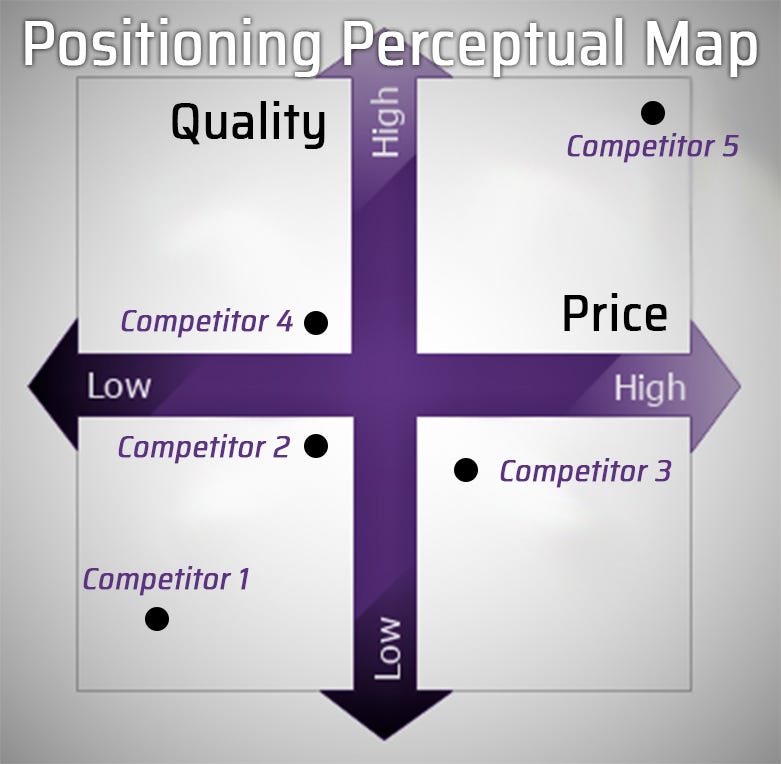
The positioning map compares brands competing in a marketplace by illustrating those brands' consumer perceptions using two key variables.
For example, businesses can apply price and quality for most markets; however, the map should focus on the primary consumer needs or product benefits you want to understand, which will vary depending on the market.
Final Thoughts
In conclusion, your positioning in the market determines where your brand sits relative to competitors and gives your brand a unique identity.
It is essential for brands to have a point of difference and to emphasise it in their marketing.
Without one, you blend in with everything else on the market. Give customers something unique to remember!
This article explained five strategies for businesses to base their positioning on: product characteristics, price, quality/luxury, product use or application, and competition.
I hope you enjoyed this article about brand positioning.
Thanks for reading.
If you liked the content and learnt something new, you might enjoy this article about five theories that all marketers should understand.
Subscribe to be notified when I publish new content.


