
Meet Camille Brunel, French Author and Animal Advocate
An interview about writing as an activist
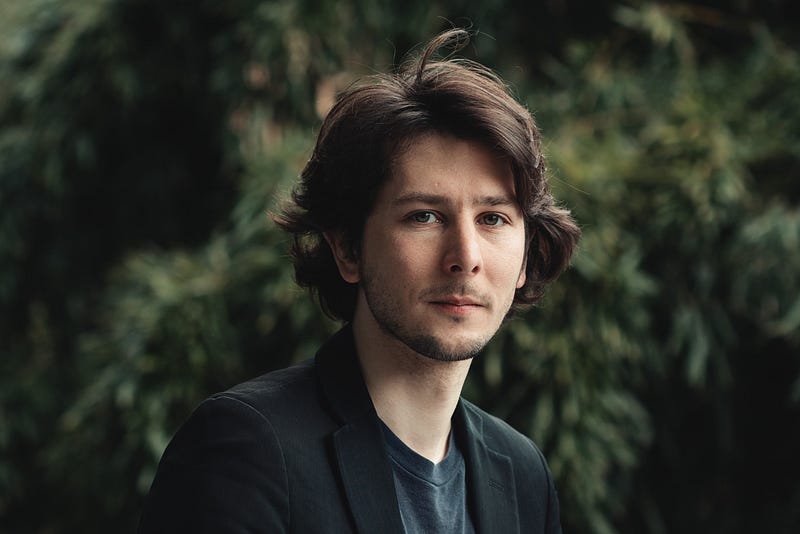
I spoke to Camille about animal advocacy in France, writing as a form of activism, his two new novels and his past professions. The interview was conducted in French — even though he speaks English and hopes to have his books translated shortly.
If you met Camille Brunel at a house party and asked him “What do you do for a living?”, he would likely reply “I’m an author” and “I write about animals.” You might enquire further and find out that he’s a passionate animal advocate who will soon publish his fourth and fifth book. I spoke to him via video call on a sunny afternoon in August and got to know more about his life as a writer dedicated to the behavior and the emotions, the extinction and society’s treatment of animals.
Before telling people that he is a writer, there was a time when Camille would introduce himself as a literature teacher, a cinema critic and a journalist. Like many French citizens, he started working full-time at the young age of 22, teaching French literature in the Parisian suburbs for seven years in total. Everything changed when he stopped eating meat.
“When I went vegetarian in 2014, I decided that it was inadmissible to merely do it in my corner. I loved meat — but not eating it was a necessary sacrifice for the environment and the animals.”
In his cinema critics which he wrote alongside his teaching job, he started analyzing the treatment of animals behind the scenes and how they were displayed on the screen — in his articles and later in his non-fictional book “Le cinéma des animaux” (The Cinema of the Animals) released in 2018.
The straw that broke the camel’s back was when he asked his high school students to write one letter each to the village’s mayor regarding a circus with animals — with good arguments against the usage of animals for entertainment. The mayor didn’t accept the 60 letters handwritten by the students because, as Camille recalls with resignation, “I was told that I hadn’t followed the official protocol.” To have a real impact on the treatment and the perception of animals, he quit teaching and started focusing on writing — “because that’s what I’m good at”.
In 2016, he went vegan. His first novel “La guérilla des animaux” (The Animal Guerrilla) was published in 2018. It’s a book that a reader will hardly put aside due to its breathtaking pace and its radical main character. The protagonist Isaac is a ferocious, radical vegan activist who undertakes an odyssey around the world to save wild animals in their natural habitats, while purposely killing hundreds and thousands of humans he considers harmful to animal wildlife.
The novel which Camille had been writing over several years was a surprising success for him as a relative newcomer: It has been sold almost 2.500 times, much more than he had expected.
Ironically, soon after the publication of his first novel, radical animal activists attacked butcher shops all over France and mostly destroyed shop windows — it was as if the dystopian way in which Camille’s fictional person carries out his activism had, on a smaller scale, become reality.
Regarding the state of our planet, Camille has a pessimist outlook similar to the one of his character Isaac: The mass extinction of animals and plants as well as global warming are alarming him. Nevertheless, the writer remains hopeful that people will realize the magnitude of the global crisis affecting all species. Numerous readers of his first novel have contacted him and told him it inspired them to follow a vegetarian or plant-based diet — or that they have even become activists.
Camille Brunel’s new novel “Les Métamorphoses” (plural of the word metamorphosis) will be published on August 27, amidst the corona pandemic. Guess what it’s about even though it has been written in the summer of 2019: a global pandemic. The female main character Isis observes the gradual transformation of all her human friends and relatives into animals and has to live with it. The French author wanted to show what an unexpected pandemic would do to peoples’ lives and didn’t expect a worldwide pandemic to affect humanity even before the publication of his novel.
“My strategy [as a writer] is to prepare humanity for the worst-case scenario.”
When COVID-19 hit his home country in March of 2020, Camille picked up his manuscript again and included elements from the actual lock-down situation which he experienced.
Another driving force for his literature is to refute the idea that animals obey their instincts more than humans do. “Every animal is a non-human person” was a crucial realization for him. “Every one of them has emotions, feelings, memory and the ability to communicate.”
“I prefer to speak about the animal advocacy movement instead of the vegan movement. […] The word ‘veganism’ makes people think of a lifestyle. To me, animal activism is a matter of justice — combat for equality.”
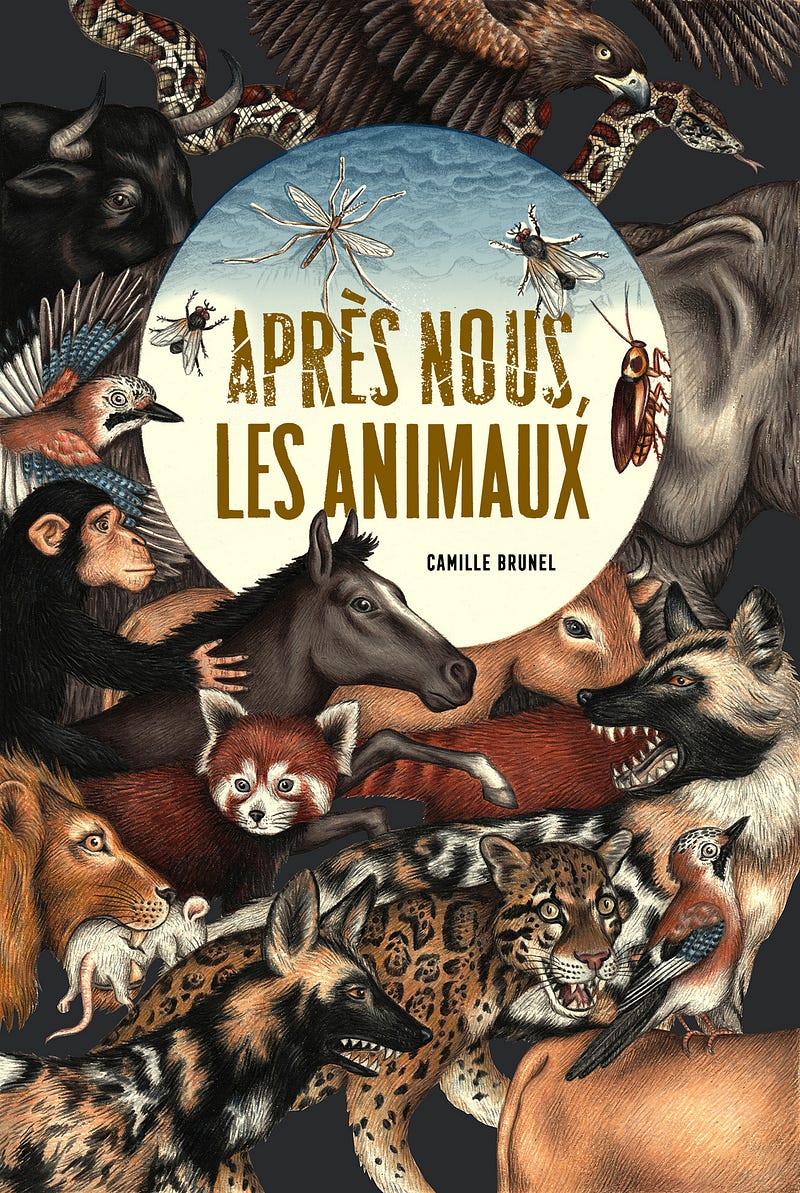
His second publication of the year, planned for September 16, is called “Après nous, les animaux” (After us the animals), a novel for young adults in which all humans have died out. The title refers to the French expression “Après nous, le déluge” (After us the flood) meaning “complete indifference to what may happen when one is gone” (definition from the Oxford Dictionary). The scene is set several decades in the future, in 2086, where the only remaining animals on earth are stranded on the Mexican coast. Camille wanted to depict an imaginary world without humans, in which animals are the focal point of the storyline.
Camille feels like animal advocacy in France is thriving, not only due to the increasing number of vegan products but also due to the varied forms of activism.
First of all, there are French animal welfare activists who want to improve the conditions of farm animals. According to Camille, those are the ones that can influence parliamentarians the most because “they appear friendly and moderate.”
Secondly, there are abolitionists who have a huge influence due to their intelligent tactics — he brings up the French association “L214” as an example, an organization founded in 2008 that films animal farms, does street activism, initiates legal actions against slaughterhouses, etc. “They are on their way to be seen as legitimate by the French society […] and they have an increasing number of adherents”, explains Camille. The group of abolitionists at large includes French academics like the philosopher Corine Pelluchon.
The third group of animal activists in France is the one that is perceived as the most radical in their method of action. Their members have endured several lawsuits in the past few years, which have weakened their structure. One example is “Boucherie Abolition” (Slaughterhouse Abolition): people blocking farms, liberating animals, etc.
Camille is optimist concerning the society as a whole. He believes that France will soon follow pioneer countries like Switzerland, Germany and the UK when it comes to veganism and animal rights.
“The enemies of animal advocacy in France are increasingly weak because the majority of the French society doesn’t support their violent activities anymore — be it bullfighting, hunting or others.”
Camille books are intended as an additional wake-up call for his compatriots.

Speaking of books, the one that made Camille go vegan was “Eating Animals” from 2009 that has become a vegetarian classic and was written by Jonathan Safran Foer. However, his favorite literature on animal rights remains “Zoopolis”, a utopia about animals as non-human individuals in our society dominated by humans; published by Sue Donaldson and Will Kymlicka in 2011.
Camille’s next project is to produce a book about whales, his favorite animals: It will be a praise of the big sea animals. If COVID-19 hadn’t happened, he would have liked to travel to Guadeloupe soon, an island in the Caribbean Ocean that belongs to the French territory and where the euro is used as a currency. “Having some fresh impressions of whales would have been fantastic for my next book— but it won’t be possible this year.” Having encountered whales before, he plans on finishing the new book by the end of the year anyway.
Obliged to stay in France due to international travel restrictions, he expresses his enthusiasm for whales through whale emojis.
For the 34-year-old writer, putting words on paper or on a screen is a form of activism. He’s particularly active on Twitter where he expresses his indignation about activities like hunting: “Yes, I am an angry tweeter sometimes.” He likes to voice his sincere ideas and concerns as well as to participate in debates on social media, even though it might have a downside:
“When you’re an author, it’s good to seem a little mysterious. If you never speak and your book speaks for itself, that’s incredibly powerful. […] Well, I’m incapable of doing that.”
His tweets and Facebook posts are never deprived of a pinch of humor, and he lets the over 3 thousand followers of his Twitter account know: “My books are better than my tweets”.
A source of amusement among others is the fact that many people, including book critics, assume that he is a woman. After all, the first name “Camille” is much more common among females in France. Camille’s reaction? “I am perfectly fine with that — many well-known animal advocates are women!”
The “Holy Grail” for him as a French author would be to have his books translated to English. That way, he could spread the message that animals are sentient beings even further.
© Annika Erika 2020
If you enjoyed this article, you might enjoy these ones too: