
THIS IS US
Poll Worker: ‘I Bought a Gun for Election Day’
Why Election Anxiety Is Making Everyone Crazy — and What to Do About It
“After I signed up to be a poll worker, the first thing I did was buy a gun.”
I am sitting in an outdoor pavilion having a socially distanced lunch when I hear this statement from a woman who is talking to two men several yards away. It is the middle of the week on a warm sunny day just south of Atlanta.
“This is my second weapon” she says. “I bought my first gun earlier this year when I went to work as a census taker. That one is a Glock, but I also have a .38.” She is a grandmotherly African-American who looks to be somewhere between 55 and 65 years old.
“But why would you need a gun for these things?” one of the men with her asks.
“Well with the census, I didn’t want to take no chances. They got a lot of MAGA people up where I live. You gotta drive down quite a few backwoods roads to count some of those folks. And the government won’t let your husband come with you. They make you go in there alone.” From what I can tell, she lives somewhere in the northeastern United States.
“Okay, I understand about the backwoods. But why would you need a gun on Election Day?”
“Cause I don’t want no mess,” she says. “I’ve been seeing all kind of stuff about how the MAGA people are planning to create a fuss about absentee ballots and harassing people while they wait in line. If trouble starts, I plan to be prepared.”
As I listen to this, I remember an article I read in The Atlantic last month. It’s called “The Election That Could Break America,” which seems to validate her concerns.
Then I recall the number of people who responded to a local post on the website for my suburban neighborhood 35 miles north of the city. Dozens of mostly white folk were asking about and commenting on how to get a concealed weapon permit. Some complained about long wait times at the county issuing office. Others on the website said they were afraid of Black Lives Matter and Antifa. They worried that riots in Atlanta could spill over to the suburbs. There were a lot of people talking about this. Just like that poll worker, they want to be prepared.
Meanwhile on October 24, two professors released a report, which says the “political stress indicator” during the 2020 election is spiking — just as it did before the Civil War. According to their statistics, the potential for political violence is high this year, regardless of who wins.
Some people on Twitter immediately complained that negative predictions like this only feed anxiety. Others rebuffed this view, saying this “don’t report the negative” argument matches the thinking of those who believe COVID-19 will go away if we just ignore it. Let us know the potential risks, these people say. At least that way we can be prepared.
Everybody, it seems, is afraid of something. Everyone wants to be prepared.
Nine days before the election, President Trump admitted to 60 Minutes (before walking out on Lesley Stahl) that he’s partly responsible for the current divide but immediately added that he thinks a lot of people are responsible. Then he ticked off his grievances about alleged spying on his 2016 campaign and the terrible things he believes have been done to him since that election.
Neighbors Divided
That same day, I took to the streets for a walk around my neighborhood. It was a beautiful autumn day. The sun had just come out after two days of rain. Leaves of gold flecked with crimson fluttered through the cool storm-chilled air. Their brown ancestors crackled underfoot.
As I approached the home where the president of our homeowners association lives, I couldn’t help but notice the Trump/Pence poster in his front yard. The blue-and-white rectangle with its large block letters seemed out of place among the juniper shrubs and turf squares of their landscaped yard. It stuck out like a jutted chin, all the more jarring because the people who own that house aren’t like that at all.
Across the street and just round the bend of the cul-de-sac, I saw an eight-foot rainbow-striped flag draped from another neighbor’s deck. Liberal slogans were emblazoned across each horizontal color bar. Immigration, pro-choice, Black Lives Matter, etc. Like the Trump-sign owner, this neighbor is also white. He and his wife walk their big fluffy dog past my house, and if they’re not looking down at their phones, they notice me and wave.
In past years when no election loomed, we got together in the cul-de-sac for potluck parties. On Saturday mornings, we sometimes held multi-family garage sales to help pay for lawn care.
Almost no one nowadays seems to remember Paul’s famous dictum in Phillippians. Be Anxious for nothing. Even the Christians seem to have forgotten it.
Why is everyone so edgy? Before you hit me with a slogan or an opinion or point a finger of blame somewhere, let’s begin with a definition.
What Is Anxiety?
At its simplest level according to the Oxford Dictionary, anxiety is a feeling of worry, nervousness, or unease, typically about an imminent event or something with an uncertain outcome.
In other words, it’s about fear of the future. It’s a fear that takes us out of the present and tells us to worry about an event that may never occur. Like all fear, it is: False. Evidence. Appearing. Real.
It tells us to forget that the future never arrives. It asks us to deny that the present is all we have.
You can’t reach out and touch the future. And you can’t reach back and touch the past. All we ever have is the present moment. If we want a different future, doesn’t it make sense to create a different present?
As one of my family members said during a recent Zoom gathering, “Let’s just control the controllable.”
Relax — America Is Not as Polarized as You Think
Speaking to Terry Gross of NPR’s Fresh Air shortly after the 2016 election, best selling author Zadie Smith said this: “I think people are basically good,”
“I don’t believe that great swathes of the population are in some way fundamentally stupid or evil or this, that or the other. I think that different values within people can be preyed upon and brought to the fore, and that responsibility lies in large part with the ring leaders. But I kind of retain an optimism in individual people.”
Thank you, Zadie. I’ll have what you’re having. Because that’s how I see it too. My neighborhood may look divided during a drive-by, but the guy across the street whose race and background are far different from mine regularly hauls out his riding-lawnmower and trims the grass on my end of the street without ever asking for praise or recompense.
To me, that’s a sign of goodness. We may make different choices in this year’s election, but that doesn’t mean he’s a bad man. His ballot is not who he is. Neither is mine.
I seriously doubt that you get asked who you voted for when you reach the Pearly Gates. But they just might ask if you were kind and whether you loved anyone.
If you listen to the ring leaders in politics and on social media, it looks like we’re horribly divided. During this year’s impeachment hearings, for instance, President Trump’s supporters in Congress argued precisely that.
They pulled out a map similar to the one the president also tweeted. It showed all the states that turned red in 2016, which were mostly in the middle of the country and the Deep South. The few patches of blue were primarily located on the East and West coasts.
The president and his supporters argued that the blue areas were comprised of coastal elites with entirely different values from most Americans. That map looked something like this:
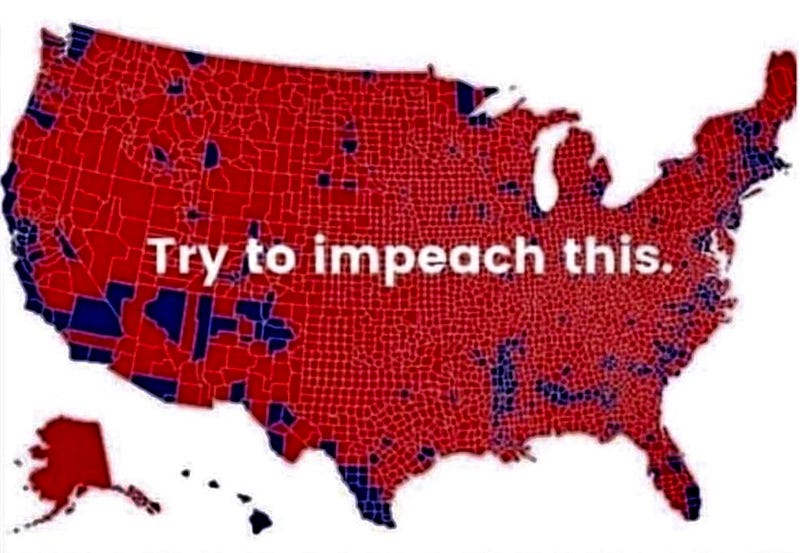
But that’s not what the country’s 2016 voting record looks like at all. That’s just a look at the winner-take-all electoral-college victories. It also neglects to point out that a lot of that red space in the middle of the country is land. It represents sparsely populated rural areas.
Here’s what the nation really looks like:
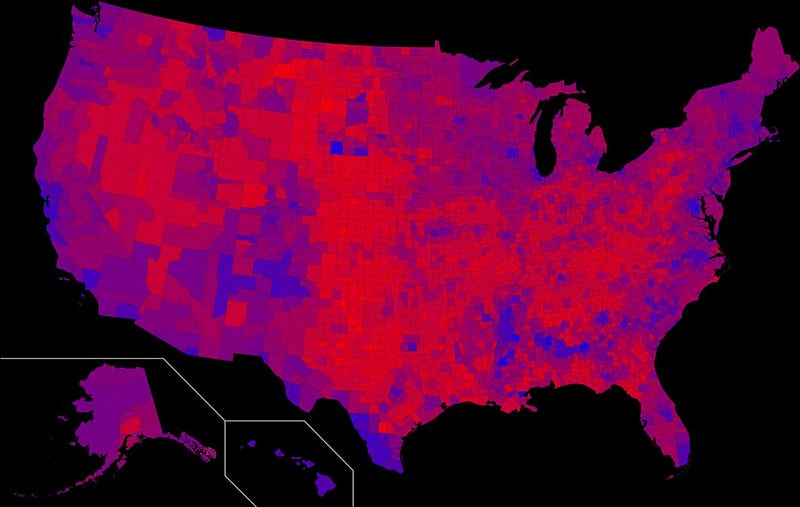
As Zadie Smith astutely pointed out, we have been preyed upon by people whose interests lie in keeping us apart. They want us to believe our neighbors are our enemies. That we have to square off against each other. Buy guns. Shout our beliefs about this or that issue with signs and bumper stickers. When in fact everyone on the “other side” has to breathe and eat and sleep just the same as everyone else.
These “ring leaders” want us to be afraid. To be anxious. To believe that our entire existence depends on whether we’re red or blue.
Like most of the states depicted in the purple map above, many people are a little bit of each. The only way to get to a future worth having is to live in a present that understands that.
What to Do About It
The answer is very simple. Stop. Take a few deep breaths. Ask yourself what you can control, and do your best to control those things. You can vote. You can give your time, talent and financial support to the candidates and issues you care about. You can look at these itemized strategies from Psychology Today and these from well-known psychiatrist Dr. Daniel Amen. But there’s also something else.
You can remember who you really are. You are not your fear. You are not your anxiety. You are much, much more than that. Take a moment to think of someone you love for just a few minutes. Think about how you would like that person to remember you. Be your love, not your politics.
In India there is an ancient term — namaste — that has caught on in some parts of the United States over the past few decades. I once heard the late Ram Dass define it as “I salute the part of you that is divine.”
Last week, I read a piece by Upasana Sharma, which went a little further, offering the best and most poetic definition of namaste I’ve seen in a long time. “The light in me honors the light in you.” The truth and kindness in me honors the truth and kindness in you.
Wouldn’t it be nice if we had a word like that over here? How different might things be if we approached every encounter with that thought in mind? If we did, maybe that poll worker up North wouldn’t feel the need to bring a gun with her on Election Day. Maybe we’d all be giving less thought to guns — and more to roses.
Originally published at https://www.jazprose.com on October 27, 2020.
Thanks for reading. Here are some of my other stories.


