
Life | Pandemic | Travel
Last Boat to the San Juan Islands
How a Dying Woman Became a Lasting Reminder of the Importance of Human Connection
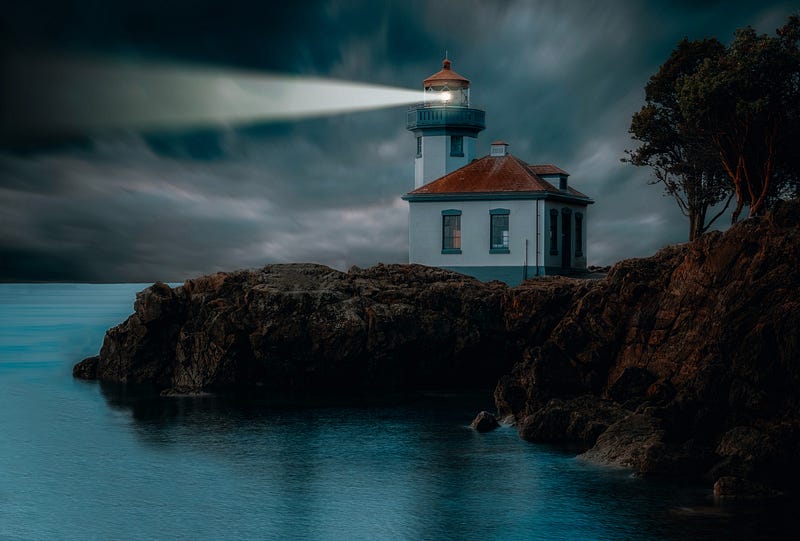
It is one of those nights when the commute between Seattle and my so-called home in the San Juan Islands feels more like punishment than reward. Long day, long drive, long boat ride. I’m working harder than I want at a job I dislike to maintain a bourgeois veneer I don’t even believe in. It is already dark when I reach the ferry landing feeling not so much dead inside as…neutral, on hold.
To get here this evening, I drove north on Interstate 5 from the University of Washington, left the freeway in Mount Vernon, and headed west on Highway 20 till I reached the ferry terminal.
Every now and then, the sky, though overcast, turned blue. A soft light spread from the peek-a-boo sun, its rays fanning out, redefining bridges, barns, and the tall green trees of this mostly rural landscape. I rolled down the window and stuck out my arm, turning my hand this way and that, trying to catch the light.
Sun breaks. That’s what TV weather reporters call them. But I think of them as a passing state of grace. The sudden bursts of light lifted me as they fell upon the long hulls of deep-keeled sailboats gleaming in roadside boatyards on either side of the highway.
Opaque rivers became translucent, sluicing the countryside, threading gold-and-silver light through the northwest blue and green. I pronounced their names aloud — Skykomish, Stillaguamish, Snohomish — a chanted mantra to the Native American past. And a reminder that something of consequence had been lost.
The ferry I must board here tonight holds more than two thousand people and their cars. A white rectangle necklaced with windows, it floats on a black sea under a black sky. Black disappearing into black, and this single white envelope in between.
On Sunday afternoons, there’s still daylight when I head to Seattle for the week. Rested and prepared for what lies ahead, I gaze from the ferry into a fjord — the North Puget Sound ringed with glacial mountains, its surface a mirror pocked with islands. I look upon lazy sailboats and cedar homes whose long wooden docks splay across the water like the fingers of a manicured hand.

But on this dark Friday, there’s none of that. Against the black void of night, the ferry looks as if suspended in midair. There’s something mythical about it too. Its twin smoke stacks jut out like fins; its car deck opens at the dockside ramp like the mouth of a whale. But whether Ahab’s or Jonah’s I cannot tell.
Ten more minutes till boarding. Grateful that I won’t have to wait till morning for the next ferry, I roll down the car window to breathe in the cold salty air. I listen to the cry of sea birds, the splash of water in the night, a dog barking from the back of someone’s truck — and remember the River Styx from my student years.
If I am tempted to feel sorry for myself, something quiet and solid restrains me. Self pity, it whispers, is a waste of time — a trick of mind, the flip side of pride.
Who cares that my plans to live a post-industrial life far from the continent have not panned out? That the editing contracts dried up before I could finish the novel I’d been writing? That the only way to keep from losing my island home is to live three hours away in Seattle five days a week? Who cares?
So I pull the car onto the boat and do my best to cut off whining at the root. Thank God I have a good novel with me. Thank God I’m anonymous.
I open the book — Dostoevsky — and it swallows me whole before the ferry leaves its slip. Maybe this isn’t what the Buddhists mean when they say “self/not-self,” but it will do for now. Within moments it’s as if I no longer exist. I become lost in The Brothers Karamazov — in the character of Alyosha mainly, the youngest brother, the one who wants to live in a monastery and be a saint. So I hardly notice when a teenage boy appears at my elbow, making noises, looking awkward. Eventually I realize it’s me he’s after, so I look up.
He is the spitting image of a young farmhand, hewn so close to type he resembles John-Boy from The Waltons. His pale lumpy face advertises a diet of sugar and grease. Beneath a mop of dark hair, he looks nervous — out on a limb.
I know this look. It was on my face the first time I asked a white girl to dance. The Kerner Commission had just said the US was becoming two separate, unequal societies — one black, the other white — and I was in my pre-political days at the mostly white Catholic college in New York.
At the mixer I was the only Black. And hell, I wanted to dance. So I went over to this pretty young woman, a blonde so ready to boogie her feet rubbed a dent in the floor. Neither my parents back in the South, nor most of the white guys who were my classmates would have approved of this. And I was not eager for the kind of rejection that might have the word nigger attached to it. So when I went up to her, I was out on a limb before I ever opened my mouth. Just like this kid standing at my elbow here on the ferry twenty years later.
“Excuse me, sir,” the kid says. “I was just wondering. See, my girlfriend and her mother and me are sitting over there playing this game, it’s kinda like Monopoly, and we were just wondering if you would like to come play with us.”
It’s the beard, I tell myself. I never should have shaved it. With the beard, nobody comes up to me like this. It makes me look severe, unapproachable, and on the ferry I can sit in peace and read. Without it, I’m as severe looking as Mister Rogers.
The General Manager of the TV station where I worked in San Francisco comes to mind. We were having lunch. He said he was moving me from field reporting to the anchor desk. “Because you don’t scare white people,” he said. Nobody says anything like that when I have a beard.
I look over to where the kid is pointing. A teenage girl sits with an older woman in one of those Naugahyde booths arranged around Formica tabletops. They look up from some kind of board game and smile. I look at the kid again and ask if they really need a fourth hand to play the game.
“Not really,” he says. “We can play with three. We just saw you sitting over here by yourself and kinda wondered if you’d like to come play with us.”
At this I’m touched. When people are unexpectedly kind to me, I want to give something back.
The Brothers Karamazov and Me
I look at my book. This is my first reading of Karamazov, and I’m loving it. Among other things, it has saved me from myself tonight. I want to spend the whole ferry ride — the next ninety minutes — loving it some more.
I want to tell the kid standing next to me that Father Zossima is dying; that Katerina, who loves Dmitri, is about to marry Ivan. That Dmitri, who ought to run off with Katerina while he’s still got the chance, is competing with his father for Grushenka the whore. That a strange little boy, for no apparent reason, has bitten Alyosha’s finger, and it’s bleeding.
“Get away from me, boy,” I want to say. “You bother me.”
Win, Lose, or Draw
But without my beard I’m a pushover. I close the book, cross the aisle, and begin to play Win, Lose, or Draw with John-Boy, whose name turns out to be Brian, his pretty 15-year-old girlfriend, Sarah, and her mother, Anne, an overweight woman with dark circles under her eyes and ill-fitting polyester on her back.
While we play, I suppress a suspicion that these people will soon reveal they are out to save my soul. Or tell me they are not prejudiced against anybody, even though some of their friends are.
It wouldn’t be the first time I’ve been singled out by overzealous Jehovah Witnesses or some other fundamentalist out to catch more people of color for the Cause. One man, who dresses like Henry Fonda in Grapes of Wrath, quizzes me whenever we meet, while his wife waits patiently at his side. A clean, tidy woman whose ten or so children queue up behind her like geese, she seems to have settled on Song of Bernadette for her fashion statement.
They are simple people, who mean well, but they’re so sure they know, it’s oppressive. Especially the interrogations. “Have you accepted Jesus Christ as your personal savior?” the husband wants to know. “Where do you go for public worship?” “Do you know what scripture says about the last things and the Second Coming?”
“Yes,” I answer whenever I see him. “Yes,” goddammit, “yes.” But only to make him go away and leave me alone. I don’t tell him I’ve had four years of comparative theology and sixteen years of Catholic education under my belt. It would only open a new line of discussion about how the Catholics got it wrong because they don’t rely closely enough on the Bible. And I do not want to have a discussion about Wellhausen’s JEPD hypothesis with a man who looks like Mr. Green Jeans from Captain Kangaroo.
As the ferry pushes west across Rosario Strait and further into the night, I learn all kinds of things about Brian, Anne, and Sarah, the trio I have just joined.
For one thing, not one of them can draw worth a damn. But not being able to draw is part of the fun, they tell me. With light-hearted patience, they teach me to play, revealing themselves, like hastily drawn street portraits, in a few quick strokes. Before long they tell me the score: they are returning from a hospital in Seattle where Anne has just been told she’s terminal with cancer.
Beautiful young Sarah, Anne tells me, has dyslexia; she’s “bright as a bunny,” but flunking school because she can’t read. The youngest of Anne’s several children, she helps to care for the eldest son, who is mentally retarded. Anne’s husband, who’s been unemployed for over a year, recently found work in the islands, but its hourly salary of $6.75, practically a pot of gold when his unemployment checks ran out, still keeps them anchored firmly below the poverty line.
To point up how their luck’s been going, Anne says that shortly after her husband started the new job, he finally got accepted for work paying twice as much. But he couldn’t take the better situation because he was already locked into the lower-paying job by contract.
The Christmas Tree Contract
Some contract, I think to myself, remembering days when the one I had in television was derided as a “Christmas Tree Contract” by one news director, angry that his hold over me was limited. But I’d paid good money to have an attorney negotiate that deal. Christmas had nothing to do with it. Anne’s husband was not so lucky.
Though the doctors say Anne is probably going to die within the year, she does not seem upset about it. Surely she could not have passed through those five stages I’ve read about — denial, anger, bargaining, depression, acceptance — in a single afternoon. But she is calm, and I feel afraid.
Funny, she’s the one who’s dying, but I’m the one in denial. No illness that I know of threatens my life. Still I worry. Despite any claims of readiness I have made to the contrary, despite various spiritual exercises and therapies of letting go, I do not want to die. Not now, I say to myself. Not me, not now, not yet.
When the ferry stops at Lopez Island, braking its weigh against a phalanx of pilings, Anne says she will put her retarded child in an institution. She says when Brian turns seventeen, he will marry Sarah and take care of her. Brian and Sarah, who look like they belong in a Disney movie, have already exchanged simple gold wedding bands, which they show off like prizes from a Crackerjacks box.
Queen for a Day
The ferry’s engine, revving up again after Lopez, vibrates the seat like those coin-operated bed-massagers in a Motel 6. But even the boat’s full speed of fourteen knots does not feel fast enough for me. This encounter is beginning to wear like a script from the daytime soaps. Or a TV show my mother used to watch called Queen for a Day.
Victims of misfortune would appear on the program and make a litany of their troubles. After all the sad stories were told, the audience would clap. In the end, the victim with the biggest and loudest applause would be awarded prizes — washing machines, refrigerators, vacuum cleaners — to help release them from suffering. Television as deus ex machina. The divine intervention every sufferer, at one time or another, must surely wish for.
If I were watching all this on television, I’d switch the channel. But Anne is a real life Queen for a Day with Sarah and Brian in a dogged court behind her. I can’t change the channel now. Not without violating some code that runs deeper than religion — now and at the hour of our death, Amen.
Not before hearing that Brian, a natural athlete with a gift for soccer, has had to give up athletics because of hemophilia. “If it was just me, it wouldn’t matter,” he says manfully. “But now I’ve got Sarah to think about.”
That’s the trouble with the ferries. You give up control when you give up your car. It’s like television without the device that makes it tolerable — mute, zap, off. Once you get involved with people on a ferry, there’s no going back until the boat spits you onto land again.
I wonder, after Brian’s last comment, whether my ferry-home companions are not a little bit in love with their misfortune. Secretly thrilled and excited by the magnitude of what’s happening to them. As if the story they’re in, with Death as the leading character, makes their lives larger than they could be without it. If it was just me, it wouldn’t matter, but now I’ve got Sarah to think about.
But in a small, quiet place within myself, a place that sees and understands more than I do, I get the feeling something else is going on here too. It is the realization that these people are the same as me.
They’re pouring out their hearts to a stranger because maybe the people they already know don’t really know them at all. Just like me, they want release from whatever threatens and oppresses them. They are not likely to get it by reading Karamazov. Nor is there likely to be any applause at the end of the ferry ride. No washing machine, no new car, no extra years to live. All they have is a stranger, plucked from the sidelines, willing to play their game and listen.
In a different life, in a different city, in an earlier time, my limited fame would have corrupted this encounter. It would be in the way. I’d know these people were “playing” to me, hoping to be touched — and maybe even healed — by fame’s sun break. I’d feel like a fraud, like a quack dispensing sugar pills disguised as aspirin.
But now, I’m Mister Anonymous, a thousand miles and years away from anyone who might “recognize” me. When the ferry reaches my stop — rural Shaw Island, population 300 — it is time to say goodnight, and Anne, Brian, and Sarah keep thanking me. As if I’ve done something, given something they can never repay. Yet I have given nothing I can think of. I haven’t even been able to recommend a good self-help book. Still when we say the last good-bye, everyone is smiling.
Stepping onto the car deck, I decide that Karamazov, having survived a century without me, will probably keep till tomorrow. It is nippy out. The night air feels like a damp wash cloth against my face. It does not bother me that I have shaved my beard.
Epilogue

I am no longer the man who wrote those words on the morning after that encounter. I no longer commute between Seattle and the San Juan Islands. No longer meet strangers on a ferry. No longer wrestle with those particular demons. At least not in the same way.
But I was glad to be reminded of that chance meeting this morning while going about my business, engaged in this other life in pandemic America. Hidden behind a mask on the other side of the continent. How good it was to meet those ferry riders again, those strangers in the night, after all these years. To be reminded that no man is an island entire of itself; that every man is a piece of the continent, a part of the main, as John Donne tells us.
And to see myself as I was then, steeped in Dostoyevsky, still trying to find my way home.
“We are well advised to keep on nodding terms with the people we used to be, whether we find them attractive company or not. Otherwise they turn up unannounced and surprise us, come hammering on the mind’s door at 4 a.m.” So wrote Joan Didion in her legendary essay collection Slouching toward Bethlehem. It’s a phrase I think about a lot.
The sun was already racing toward noon when I remembered taking that last boat from Anacortes back in the day. Nearly noon, not 4 a.m. And not hammering on the mind’s door, either. But floating gently into view like an angel passing through my room.
© 2020 jazprose.com All Rights Reserved
Originally published at https://www.jazprose.com on October 22, 2020.
Thanks for taking the time to read this piece. If you found anything of interest in it, you might also want to check out my other recent pieces. Please feel free to share your thoughts with me any time. Thanks again!