
2020 Planning sessions
Planning Starts With Learning From the Past
Make the best of your learnings — in chunks of three
No matter if you want to create a yearly marketing plan for a Forbes 500 company or you want to create an editorial calendar for your small business; when it comes to planning, there is magic in using the information you gathered broken down into chunks of three.
So as I am planning my next year — for my writing and for my other freelancing jobs, I sat down and created a framework, consisting of threes that serve as a learning path.
I believe that for good planning you need to understand what you have already accomplished, to acknowledge your successes and learn from your mistakes — if there was any.
When it comes to writing, I don’t believe in mistakes, I believe in improvement.
So to start with, we will talk about three main topics:
- Learn from others
- Learn from yourself
- Learn to take a leap of faith
1. Learn from others
In this part gather the learnings that you have learnt throughout your writing journey — from others. They say that writing is a lonely job, but if there are words, you are never really alone. And you can’t live in a bubble to read your own words only. As a writer, you will need to read as much as you write — if not more. Think about the brain like a sponge, soaking up all the information from the external world, so that you can get access to those creative juices inside it that will find their ways to your screen in the form of words.
The three best tips that you have seen in 2019
There are inspiration and productivity all around you. People are sharing how they work, how they accomplish their successes and you can try them out and you can adopt them. But what are the three most important tips that you have seen this year? Don’t look it up, just think about it. Those that really make a difference will come to mind.
My three most useful tips were:
- The good shit board: to document every win, no matter how small and sticking it on a note so you can see the increasing number of accomplishments to keep you motivated and encouraged.
- The 10 ideas each day: that tells you to write down ten article ideas or article titles each day as a warm-up. And even if 9 out of 10 will be shitty, there will be some material there to work with and it helps you start thinking.
- The ta-da list. This is the back-patting version of the to-do list, where instead of writing what you need to do, you celebrate yourself with what you have done. The to-do list is very useful, but the ta-da list helps you move forward by the simple power of seeing what you have already done.
My planning involves the using of these three tips.
The three best inspirational writers you read in 2019
We all have muses, writer crushes, people we look up to when it comes to writing. Try to identify just three people and take notes about why they are an inspiration for you. It will help you define a direction and it also helps you pinpoint the values that are important for you without actually thinking about the abstraction of value.
My three go-to writers and the reason I am looking up to them:
- Shaunta Grimes is my first choice because she is consistently providing high quality valuable and useful material in the writing topic. I find her articles easy to read and jam-packed with ready-to-use tips and advice. The value she shows me is: USEFULNESS
- John Gorman had a huge inspiration on my writing this year. His very unique and memorable voice, his exceptional thoughts translated into beautifully crafted sentences have been shaping how I think about my own writing. The value he brings is: UNIQUE WRITING VOICE
- Emma Austin is a great writer and a friend and I enjoy each and every piece she writes. But more importantly, she has been an inspiration because she crafted such a perfect brand for herself that it is a joy to watch. The value she delivers: WRITER BRANDING
I don’t only enjoy reading their articles but they also show me a way in where I would like to improve. I’d like to work on my writing voice, my own memorable brand and while doing it I’d like to remain useful. These are great pointers to create my strategy based on my learnings.
The three negative traits you want to avoid
The negative things in our lives are teaching us even better lessons and telling us a lot more about ourselves than sometimes the positives can do. Any negative thing that sticks with you is there for a good reason. Collecting the things that irritate you will help you become the version of yourself that avoids becoming who you don’t want to become as a writer.
The three negative traits that taught me an awful lot:
- Repetitive content. I value originality a lot and I believe that creating new content or recycling and rewriting your older content significantly is the best way to provide value. I am sick of reading about the same stories from the same writer without offering any new perspective.
- Misogyny. I came across misogyny and hatred a lot more than I thought I would on a platform like this. It made me realise where I stand and it made me want to speak up even more.
- Complaining. To complain is a human trait and we all do it. But when it’s done constantly without looking for any solution, it becomes irritating. It shows me that even if I find something that annoys me, I should take action instead of complaining about it for too long.
These are practical values that I believe in. The originality, the openness and tolerance and the positivity even when facing negative events.
2. Learn from yourself
As we are all following our own journey, we need to take into consideration our own progress and we need to celebrate our own victories above anything else. We too often lose sight of how far we have come because we have our eyes on what others have achieved. Focusing on your successes will give you an indication of your best moments and it will also point you in a direction that you can follow without setting the bar too high.
Top three topics
We all have our best topics. Maybe a lot more than three. Maybe just one. But try to come up with three relatively different topics that you worked with and it worked out for you. Why? Because this is showing the areas where you can thrive and you need to take every pointer out there before you get to planning your next year. I took the 20 most viewed topics of my stats and I drew a conclusion from them.
The three best topics that worked for me:
- Narcissism. I wish it wasn’t the best. I wish I didn’t know about it. I wish I didn’t have to write about it. I had an awful lot of experience with it, with a huge amount of learning and I gathered way too much knowledge about the subject. I don’t want to, but I am good at it. This is something to take further.
- Writing. I just started writing this year, yet among my best topics writing is at the top of the list. It seems that I can phrase my own experiences about writing in a way that it becomes relatable for others. I need to stick to it, and I love it anyway, so why not?
- Relationships and sexuality. This is something I am passionate about and my personal essays are the hardest but the best to write. I wouldn’t stop writing about it even if it wasn’t among the best!
NARCISSISM, WRITING and RELATIONSHIPS. You don’t need to like all the topics that worked best for you, you just need to embrace that this is what works. And then work from there. These will be the key topics to include in your next year’s writing strategy.
Your top three articles
It doesn’t matter how you choose your top three articles; if it’s views or reads or fans or claps or your own preference — because even your criterion of choice is indicating something. This is another aspect of what worked.
The top three articles by reads. (I chose reads as a criterion.)
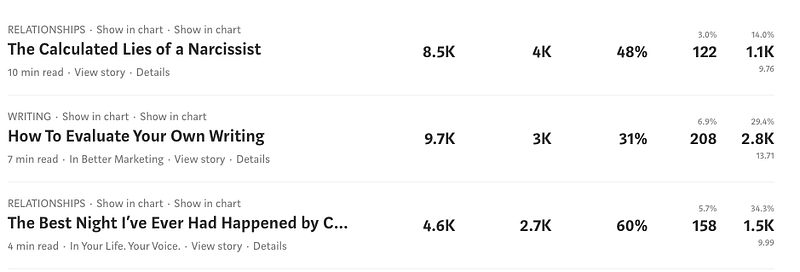
- The Calculated Lies of the Narcissist. This article showcases that my own experience resonates with a lot of people and it is necessary to be RELATABLE.
- How to Evaluate Your Own Writing. This article is based on my past professional experience adapted to writing. My passion meets my knowledge. It is about USEFULNESS.
- The Best Night I’ve Ever Had Happened by Chance. This shows that personal stories and nice writing can get really a lot of traction. It shows me that VULNERABILITY is also necessary.
And here I have another bunch of values that I need to learn from and take further next year. RELATABILITY, USEFULNESS and VULNERABILITY.
Three articles you are most proud of
It’s not always what comes from others’ feedback, it should be also about what makes you proud. Collecting your biggest wins — according to your own standards — is also important, because it helps you pinpoint your future goals. Gather the best pieces that you wrote and draw some conclusions.
The articles I am most proud of:
- My dream was to get into Human Parts, and I did. This was one of the best moments of my year. I remember so clearly when I got the email, I danced a happy dance and I was jumping around in the flat with tears in my eyes. This was the article that made it there. I am proud of it because I believe it is really good writing and even if the topic is heavy it was relatable by lots. My Complicated Abortion.
- I never really got close to going viral, but I was once mentioned in the monthly MPP newsletter by Kawandeep Virdee and within 30 minutes 20 people reached out to me telling me that my article was mentioned. It was mentioned in the words to write by section and it made me especially proud. How to Evaluate Your Own Writing.
- I started to write for Better Marketing in June and I started a column with them in August, about Role Models in personal branding. It is an amazing feeling to have a column to my name and this is my favourite article there, about Becoming as Authentic as Michelle Obama.
They are all important because they have opened doors for me that I didn’t ever think I could even look at. I started to write here in English, terrified that my level of English won’t be enough, but I am pleasantly surprised and by now I do think I belong here.
3. Learn to Take a Leap of Faith
One of the most important things in planning is to have enough courage to dream big. Dreams should be scary. They should be intimidating. They require a leap of faith, and it’s good to think it over what a leap of faith means for you, so you could know which direction to jump.
Three things you always wanted
What is it that you really want, what would success look like if there were no limits? We tend to limit ourselves and we don’t allow us to dream big, because we don’t want to get our hopes up. But getting our hopes up and achieving things have nothing to do with each other. Your hopes are not hindering your success, so go ahead, get your hopes up and then work for it. Rejection can come whether you believe in yourself or not. So you’d better believe in yourself. It’s healthier anyway.
My three big dreams
- Have 20k followers. I have 3k followers in 9 months and it’s growing. I am nowhere near the big writers, but I would love to have a big follower base with loyal followers. I am not thinking about whether the 20k is realistic or not — maybe it is, maybe it isn’t. But dreaming big is not about reality.
- Write a book or an ebook. Or both. Several of both. Okay, so this is my biggest 2020 plan. I want to write a book. A real one. With lots of words on lots of pages — published! I know I have it in me, I need to make it happen. Would anyone read it? Would you? I need to try.
- Be featured on the homepage. This is my vanity dream. I would like to be featured on the Medium homepage and I would like to have an article that goes viral with incredible amounts of claps and views and reads. I will stick around to see it through.
Three things that scare you
It’s very interesting to see what are the things that make you cringe. What are you most afraid of? Why do you think you are so afraid? What does your fear try to teach you? Where are the areas of improvement?
My three scary things
- Fear of taking a break. I am terrified of taking a break. I am scared that if I do I won’t restart it. I am also scared that I will lose momentum, so I keep pushing myself, even when I know it’s time to take a break. It teaches me to reassess my priorities and shift my perspective. I also should give myself enough credit, that I have enough discipline and persistence to keep on writing even after a break.
- Fear of being judged. When you write and you put yourself out there, there is a huge risk that someone will disagree and they will judge you. This is a risk I need to make peace with. It’s terrible as I forget about the 100 positive comments but that one negative will stay with me. I need to care less about people’s opinion — and stop to measure myself according to what others think.
- Fear of not being a real writer. This is so debilitating that it hurts. I struggle to call myself a writer — even when others have no problems with it. I constantly question myself and downplay my accomplishments. I need to accept the fact that just writing already makes me a real writer.
Three things where you need to improve
There is always room for improvement. Especially if you are a beginner like me. I don’t have a degree in writing. English is not my first language. I only started writing this year. I have no track record of publishing. I come from nowhere — so of course, I have a lot to learn and improve. Pinpoint your areas of improvement, limit it to three and start working on those.
My three areas of improvement
- To write more artistic pieces. This is about sticking to my voice. I don’t know how else to call them, so I stick with artistic. When I am thinking about the difference between writing and blogging the difference is not in the quality, but in the topic and the execution. I would like to write more pieces that are writing, not blogging — even though blogging is easier and quicker to do and it works better. But this is my gateway to writing my future book, so I need the practice.
- To write in a more concise way. My writing is quite verbose. Even after editing. I am overusing the adjectives and it gets extra flowery sometimes. It can get pretty, but in a lot of cases, I am afraid it is just filler. I need to write shorter, more concise pieces.
- To improve my writing in terms of fewer mistakes. I am using Grammarly and I have also worked with an editor. I need to work on my ‘comma splices’. They make me crazy. In Hungarian, the sentence fragmentation works differently and it confuses me. It is also related to my writing voice and flowery sentences. I need to find a way to keep my style but become better in terms of length — and of course, comma splices.
Summary
So basically, this is what you need to fill out:
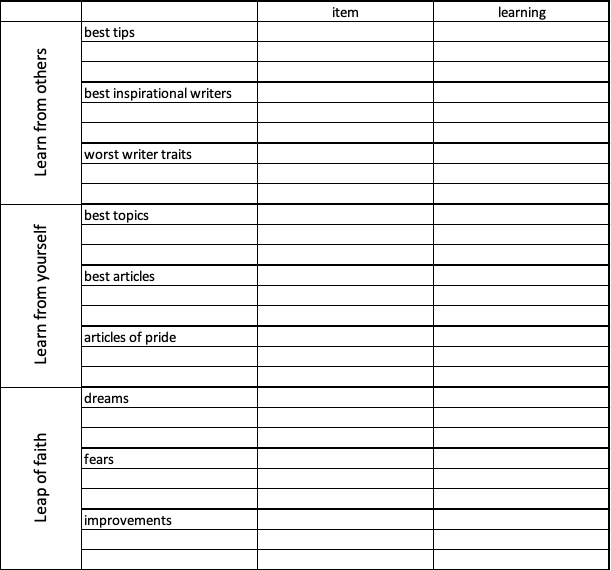
The most important is that you always add the learnings because that’s what makes it really useful. Looking back, taking the time to self-reflect shouldn’t be without a goal of improvement. It’s the learning that will help you move further.
The most noteworthy thing for me is that usefulness, relatability and persistence came up as my most important recurring values. This is going to be the core of how I will adjust myself in the coming year.
And honing my craft, finetuning and improving my writing voice.
These are the values I need to start planning around.
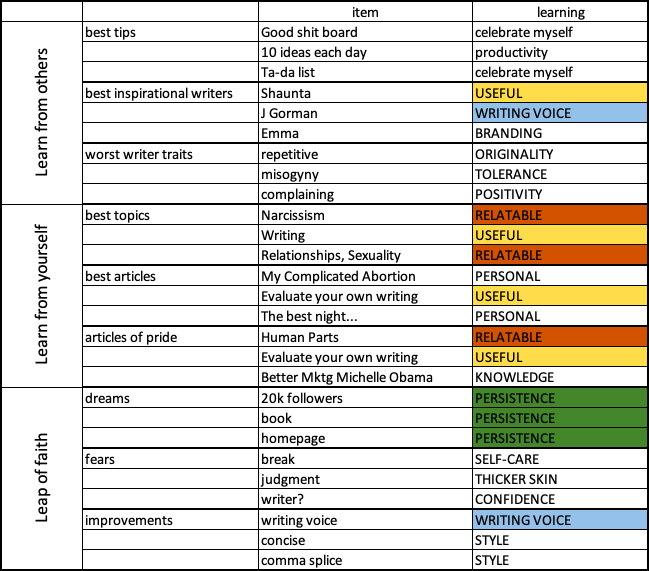
Take a look at your past year. Take some notes. There will be a few things that will stand out. THOSE are the important things.
Hope it helps you. I’ll be back with some further planning tips as I am going along with my own plans.
If you liked this and want some more, follow me on Twitter or IG and sign up for my newsletter.