
How To Evaluate Your Own Writing
What advertising taught me about recognizing good ideas
I used to work in advertising, for the biggest ad agencies in the world, until very recently when I quit and I started a career as a freelancer.
And I miss it. At least some parts of it. As a freelancer, it is difficult to be a one-man show. I miss being part of a team. But more than anything else, I miss the thrill of being around creative people. Because they are amazing. They create! They take an idea and turn it into something more, out of thin air. And this is an incredible experience to watch and assist.
As a strategic planner and an account director, the best part of my job (among a lot of tedious things) was to promote, support, and sell other people’s ideas. Making sense of them, choosing the best fit for the given task.
Although coming up with ideas wasn’t in my job description, selecting and sifting others’ ideas was. As the ultimate goal was to present and sell the best ideas, as a senior team member, it was of utmost importance to be able to judge an idea or execution. It was like a creative editor position.
Now, as a writer, when it comes to crafting and selecting my own work, I am starting to realise that similar principles apply to writing, as in any other creative output.
When I’m evaluating a creative output, now in the form of articles and personal essays, it boils down to the same three things I used to evaluate other creative work:
- Originality of the idea
- Novelty of the approach
- Uniqueness of the execution
If you have a look at the best-performing and award-winning advertising, it is art in its pure form. Advertising is an applied art. It serves its purpose, which, at the end of the day, is related to a brand’s objective. To raise awareness or educate and to sell in some form. Selling doesn’t always mean making money; you need to sell a cause or an opinion too, to obtain followers and supporters.
Looking at the winners of Cannes Lions each year will show you how the best pieces in advertising—regardless of the brand’s objective—apply the aforementioned three factors. The very best use all three or some combination of them, but even being outstanding in one aspect can bring success.
When it comes to writing, it is creative work at its core. With the goal of being read by the readers.
You can read about how to fight your imposter syndrome, how to overcome writer’s block, how to come up with ideas with writing prompts to practice and become more prolific.
But there is another challenge to overcome.
How to select your own ideas so that they could become best-selling pieces (as in most read and appreciated)?
1. Originality of the Idea
This is tough. There is nothing new under the sun. Everything has been said and done before you. Every story, every idea has been already tackled by someone.
This sounds devastating. Who doesn’t want to come up with something original? And who doesn’t get discouraged to see that their original idea was used by hundreds of others?
But!
Just because there are only so many story types … it doesn’t mean that the same basic story cannot be said differently. And this is where storytelling comes in. No one knows the importance of storytelling better than writers.
You can tell your own story. It is original by default, as it is yours. You are the hero of your own story, striving to get better, fighting the villain (that can be a mental illness, your inhibitions, your circumstances, or someone who wronged you). And while the plot of your story won’t necessarily be original, the story will be. And, thanks to the similarity of human patterns, it can resonate with your readers, who will root for you—the hero.
2. Novelty of the approach
Even if the story is not unique, the way you approach it can be unusual, surprising, or even shocking. Writing about sensitive topics, opening up about struggles, or taking an unusual or eye-opening opinion on a subject we’ve all heard a million times can give a unique approach. Telling the truth on questions we don’t usually talk about, be it mental health, abuse, health, or addictions will give that edge that can set your story apart from the rest. Highlighting a unique point in an otherwise commonplace story is also well appreciated. Anything that breaks the usual flow of your readers will stick with them.
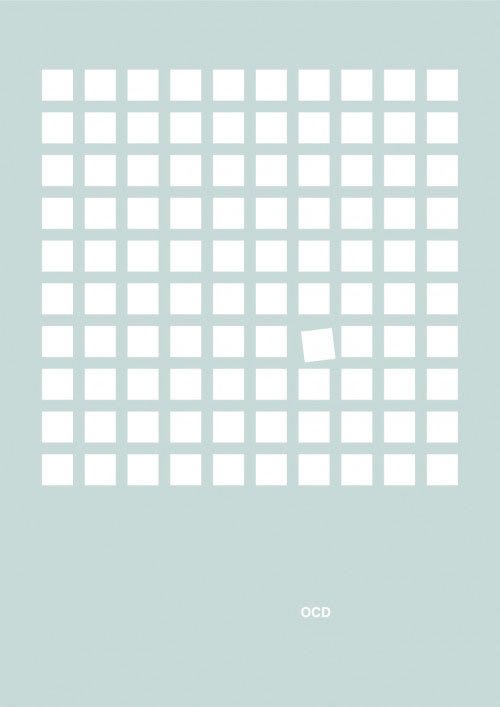
People with OCD — no matter where they are at the scale — will definitely notice it. But you don’t need OCD to notice the unusual. Our brains are wired to get used to patterns, and if that pattern is broken, we notice it immediately.
It’s the same with everything that stands out from the average, and you can use it to your benefit when writing and creating:
It can be a title that’s descriptive but leaves the reader wondering. It can be an image that shows something other than you would expect. It can be the link between two topics that don’t seem to fit together at first glance.
“…creativity has always been about making a connection between two things that normally don’t go together, the joining of seemingly unconnected dots. Forging a pathway in your brain between two unrelated ideas or thoughts entails deviating from the expected and familiar.” Dave Stewart
3. Uniqueness of the Execution
When it comes to writing, it is mainly but not exclusively about your writing voice. This is your biggest asset. This alone can make or break it. You can have an idea that’s been done before, and you can even use an approach that was already used; your differentiation will be how you sew together those magical ingredients: words.
“By words we learn thoughts, and by thoughts we learn life.”- Jean Baptiste Girard
Your choice of words, the rhythm of your sentences, decisions about punctuation, sentence length, etc.—these presents you more than your ideas or your creative approach.
This voice is you. You cannot copy it from someone else because your words and sentences will fall flat, they will lose their power, and you will lose your main value and your credibility.
Exploring others’ voices and styles is great for inspiration. You learn what appeals to you. You can experiment with new ways of saying the same thing as an exercise, but you cannot become someone else overnight. And you shouldn’t.
Your experiences, your expectations, your past, your life events shaped you—they provide you with a reference point within your life. They made you into who you are now, your present raw and vulnerable self, who speaks to your readers if you let it. You can change your narrative, your plot, ideas, structure, wording, anything—but once you found your writing voice, you should only polish it to improve and finetune.
Don’t change it. Don’t start to sound like someone else, no matter how much you appreciate their work. They are them and you are you.
Think about your voice as part of your writer brand. In advertising, the uniqueness that is attributed to a certain brand is usually measured by the question: would you know this ad belongs to x brand, even if the logo wasn’t there?
Similarly, ask this about your own voice: Would you be recognized purely by your style if your name wasn’t written at the bottom of the page?
It’s a long journey for brands. Why would there be a shortcut for writers? But you can get there, especially if you set this as a goal—a true north to follow. Something to guide you in your decisions, in your choice of words, in your editing. Keep asking yourself: does this sound like me? And always choose the direction where it sounds more like you.
Evaluation Process
Without trying to sound too pragmatic about it, think about the evaluation factors as variables in an equation being multiplied.
Idea × Approach × Execution = Creative Output
1. To get to a creative output that is up for evaluation, none can be zero, as then the result will be zero too.
2. You don’t need all of them to be of outstanding value.
3. But you should try to have at least one higher than average.
+1, if ever in doubt, go for making the execution stand out, as in your voice.
At the end of the day, though … equations are great, evaluation factors are cool … but please …
Just write!
Because we do need another of the same type of story that is your story, we want to read your approach, no matter how many similar approaches can be found. And we want to hear how you tell the story — in your own voice.


