
Role Models
Becoming As Authentic as Michelle Obama
The most important personal branding lesson from the most influential woman in the world
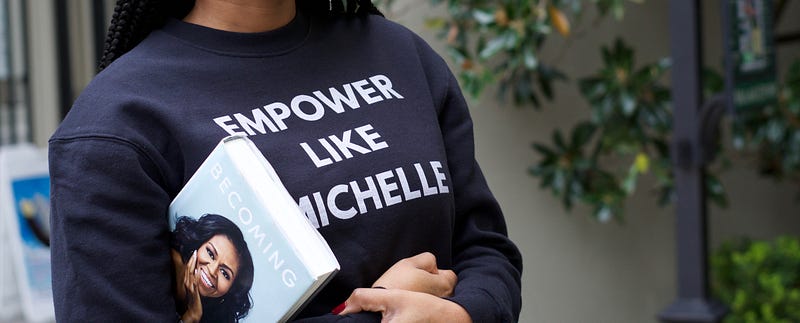
There is not much new to say or write when you decide to dissect someone as prominent as Michelle Obama. Everything has already been said and written about from every aspect. She, as the first African American First Lady, has already been under the scrutiny of thousands of journalists, fans, and haters from every corner of the world. Her life has been an open book for everyone to comment on, analyse, discuss, and judge.
As she puts it in her memoir, “Becoming,” there is a heavy burden that comes with being the first Black anything — as if these two words hold some incredible threatening weight, some mysterious unknown looming above us.
It’s difficult to talk about personal branding and to compare it to any one of us when you want to draw conclusions from someone who has been one of the most powerful, most influential people in the world. She’s armed with consultants and experts in all fields helping her manage the unusual life of being the First Lady of the U.S. Her problems differ from our problems, her steps are carefully planned, her speeches are well-practised. Her personal life is public, her choices affect each of us.
Seemingly, she has everything figured out — and she doesn’t need to do it alone. Her words and actions, even her clothes and hair, have had a lot more weight to them than anyone else in this world. Everything matters when you are Michelle Obama.
Yet there is something genuinely incredible about her, and it has nothing to do with the army of PR specialists, speechwriters, political advisers, and stylists running around her. It has nothing to do with the artificially crafted image, polished to perfection, designed to withstand criticism, hate, mockery, and obsession.
It is her personality that makes her great. And her outstanding ability to cope with all the tumultuous events in her life as a former First Lady.
The Humanity of Brands
Personal branding has been on the rise for quite some time now. It has been recognised that there are some famous or not-so-famous individuals who, for some reason, managed to connect with their audiences better than others. It boiled down to their personal branding, encompassing their appearances, their values, their beliefs, and their different ways of connecting with their viewers, readers, and customers. It has been recognised that some people act as best-performing brands: delivering value, establishing trust, maintaining connections. And with this recognition came the next one: Us people, we need to act as the best-performing brands.
If you look for literature on personal branding, you will see thousands of materials that suggest you create your visual identity, choose a name, have a logo, have a website, get to know your audience, find the right messages, tell the message the right way, and establish and maintain the conversation.
The only problem with this is that this thinking is going in circles.
The most successful brands work because they act like relatable people. Think about branding archetypes that build on our collective consciousness of ancient, universally understood mythic characters. Archetypes represent fundamental human motifs of our collective and individual experience. They resonate with us so much because they evoke deep emotions. They resonate with us because even in the inanimate, we are looking for our own humanity.
Brands evolved from being something useful — to facilitate distinction and showcase quality — to something relatable. Brands that work well are tapping into our human needs, understanding them, displaying them, answering them.
And when we saw how well brands work — by being relatable and human — we started to think about how we could become like brands.
Personal branding is trying to give a framework and guidelines to find ourselves as relatable human beings — it urges us to be authentic and genuine, it forces us to connect, it makes us consider our audiences more than before.
But personal branding is nothing but an advanced awareness of our selves with the help of tried and tested tools to enhance what we already have: our personality.
This is where Michelle Obama is excelling.
It’s her personality that shines through everything she does, says, or shows to the world. It’s her authentic self and genuine character that makes her relatable and accessible.
You could talk about her style, her words, her thoughts, her values in great detail. And it has been done before. These are the elements that make her who she is — invaluable independently of each other, but together constructing a complex, layered, credible personality.
It’s humbling to try to understand the key feature of her character. After all, I’m no better than the rest of the world; I am scrutinising her, analysing, dissecting her moves and choices — with the single intention of giving a glimpse into what I believe to be her biggest asset, and great learning for us all.
Michelle Obama has stayed relatable, authentic, genuine, and accessible throughout the eight years she spent in the White House. She embraced the opportunities that she was given; she mastered perfecting her presence to support both her husband, her family, and the causes that she stands for; she found a way of not making waves but riding them with grace and skill.
Her greatest characteristic has been her capability to adapt. She had thousands of situations where she was at a disadvantage, where she was doubted and questioned, and she rose above them and came out winning.
For a freelancer, influencer, blogger, writer, or entrepreneur of any kind — where your personal brand needs to be perfected so that you can make a valuable connection with your followers and customers — the biggest takeaway from her is to learn how to adapt, how to ride the waves instead of fighting them, how to come out winning from situations and still stay humble.
To adapt means to survive — it’s just as much psychological as it is evolutionary learning. As entrepreneurs, we need to assess new situations day after day. The slow-paced days are long gone. With an abundance of information and opportunities, we also face new threats, new setbacks, and new challenges regularly.
The bliss of having your roadmap figured out only lasts so long before you need to reinvent yourself, to find new ways to connect, and to provide new solutions to ever-increasing expectations. The art is not to meet the expectations but to do so by preserving who you are and what you stand for.
The best-performing brands (including person-centred brands) evolve in a way so that the core values never change significantly. Just as your main personality shouldn’t change, only shift and adapt to new challenges, you need to preserve your values. You need to protect your authenticity and keep your core beliefs. Evolution expects us to adapt — it’s a slow and steady process with lots of tweaks and twists; to keep our credibility, our progress is never a complete makeover. This is what I described as not making waves or going against the waves but riding them in an expert way.
The most iconic moments of Michelle Obama are all showcasing how amazingly she adapts and takes what is offered to make the most of it. She is not pushing herself into the forefront, she is content with the position she is supposed to take. It’s not a competition for her to over-shine anyone. It’s to provide another aspect, to stand for a cause, to offer a breath of fresh air in hectic times.
We knew she was smart. We knew she was classy. We knew she was stylish. She was expected to be. But she also showed several facets of her other skills and interests.
Remember her appearance on “Live with Kelly” and her incredible rope jumping skills? She was in the middle of her Let’s move campaign, advocating for a healthy lifestyle and fighting child obesity. She had zero problems standing on stage fooling around with champion rope-jumping teenagers. She didn’t think it was beyond her to participate in a fun game. She didn’t lose credibility — she was just fun and human. And yes, she screwed it up a few times, but don’t we all? (Can you imagine Hillary or Melania doing this? This is exactly what I mean about relatability.)
Or the Go to College music video, where she was rapping along with rapper Jay Pharoah? She is committed to promoting education, and nothing could stop her from getting into CollegeHumor’s video. She was funny and entertaining and comfortable in her own skin. She had a message, she wanted to say it, and she chose a way that made sure it would be heard. Riding the waves, taking the opportunities.
Appearing on Sesame Street to promote breakfast as the most important meal of the day; dancing Uptown funk; appearing on NCIS; and singing along with James Corden’s carpool karaoke — all just snippets that showcase aspects of her human side.
They are all carefully chosen — no arguments about that, this is what PR experts are for — but what she is best at is taking what’s given and using it to make something better.
She is smart, confident, talented — and she uses her powers to uplift and to involve others.
Do we need to pinpoint what her personal brand is really about? No, because it’s about her real and authentic self. She is showing us what she is really great at, focusing on how she can make others belong. But it wasn’t something constructed and orchestrated — it has always been her. She just had the means to raise her voice, and that she did. And we can be so grateful that she did.
Ultimately, personal branding is about using your own personality, and something that brands you and makes you memorable. It won’t be the colour palette you use on your website — it will be your personality that shines through everything that you say and do. Make sure it’s authentic and likeable — and you can even forget about creating a logo.