
Pintle
Hinges hinge on this small but important piece

Today’s New York Times Spelling Bee letters:
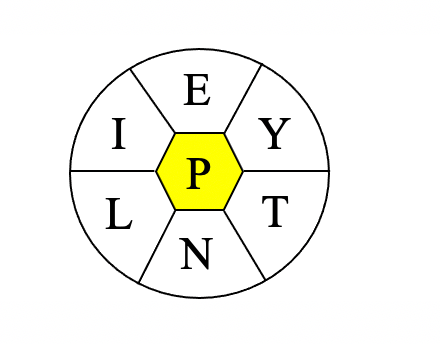
E, I, L, N, T, Y, and center P (all words must include P)
Merriam-Webster says…
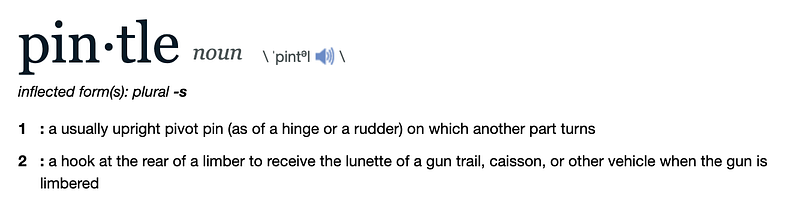
Silly little dictionary! Don’t you know that pintle can’t possibly be a word if the New York Times says it ain’t?
For further fascinating facts, check out the Spelling Bee Master.
What’s your favorite dord* from today’s puzzle?
My Two Cents
What do a blue whale (Balaenoptera musculus) and a blue office chair (Buttok swivelus) have to do with today’s daily dord*? Well, to be honest, the blue whale probably nothing, unless it happened to swallow a pintle. And that would not be totally out of the realm of possibilities, given how we’ve filled our oceans with crap. The office chair, however, uses a pintle or two. Or, in this case, five.
A fishy hinge or a hingey fish?
In order to create some expectation in today’s column, I’ve opted to talk about gudgeons first and pintles afterward. I learned this from the master of suspense himself, Alfred Hitchcock.
According to our friends at Merriam-Webster, Gudgeon comes from the Middle English words gudyon, gogoyne, goione, from Middle French gougon, goujon, from Old French gogon, gojon, perhaps from Late Latin gubia, gulbia, meaning “hollow chisel”. Interestingly, the French word goujon has the same meanings as gudgeon does in English: (1) one half of a hinging connection; (2) a fish.
How can the same word mean such very different things? You should read my explanation about homophones, homographs, and homonyms… as long as you promise to continue reading this article after you’re done.
Since a picture’s worth a gazillion words (that’s a thousand words in today’s dollars), here is an illustration of a gudgeon.
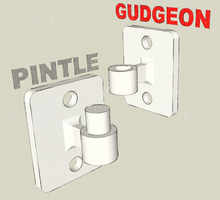
Ooops! I think I ruined the suspense about the pintle… maybe I wasn’t paying close enough attention while Hitchcock was berating me.
In buildings, gudgeon-pintle hinges are used in working shutters, as opposed to those shutters that are just decorative or on vacation. In sailboats, gudgeons are placed at the sternpost to hold the pintles of rudders. And the dictionary also gives this definition of gudgeon: “a notch in carrick bitts to receive a spindle bush”. I have no idea what that means, although it sounds like it could have been plucked out of Fifty Shades of Gray.
Yesterday I discussed two submarines that happened to have the same name as the daily dord* (tullibee), and today — by sheer and extraordinary coincidence — we run into the exact same situation.
Both the USS Gudgeon (SS-211) and USS Gudgeon (SS-567) were submarines named after, well, the gudgeon. Duh! But in this case, the gudgeon was a fish:
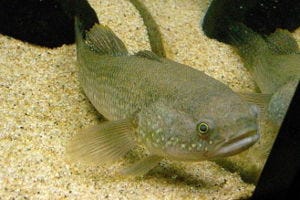
I’m not convinced that’s the best moniker for a war machine, but I’ll admit the Giuris margaritacea above looks more menacing than a hinge.
The USS Gudgeon (SS-211) served with honor in World War II, becoming the first American submarine to sink an enemy warship. She scored 14 confirmed kills, but never came back from her twelfth patrol and was officially presumed lost. The USS Gudgeon (SS-567) was commissioned November 21, 1952, decommissioned over thirty years later, and then leased and eventually sold to Turkey.
A penile hinge or a hingey penis?
That may sound like a clickbait header crafted to keep you scrolling down so I can earn another 13 cents for this article, but the truth is that the word pintle comes from “Middle English pintel pintle, penis, from Old English, penis; akin to Old Frisian & Middle Low German pint penis, Old English pinn pin, peg.”
Which means that the whale in the photo at the top of today’s column does have something in common with the office chair, except the whale’s junk is much bigger than the chair’s.
In case you forgot from when I ruined the surprise in the previous section, here is what a pintle looks like, enlarged for your enjoyment.
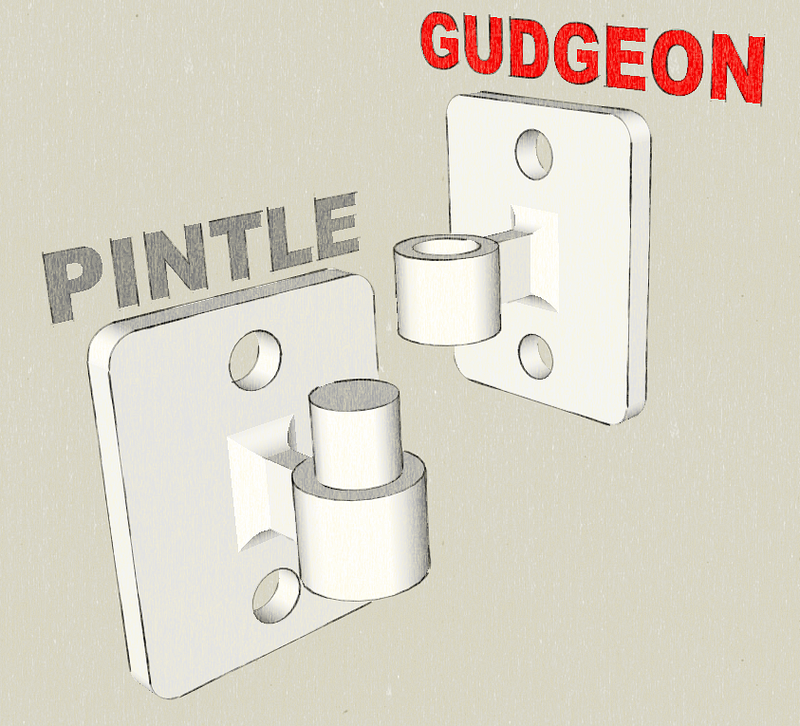
I think the above pintle may have overdosed on Viagra…
I previously mentioned some uses for gudgeon-pintle hinges, but here is a pintle that does not need the help of a gudgeon:
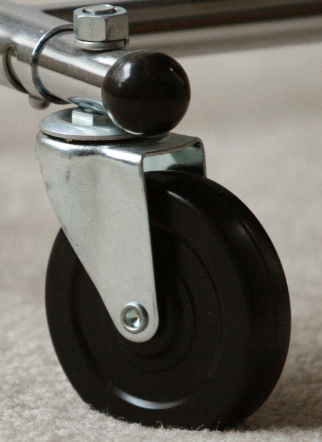
That wheel looks like it has a flat tire, but that may just be an optical illusion due to the thick carpeting. The above is called a caster, or a wheel mounted in a frame in such a way that it can swivel on its own axis. The pintle is not visible, as it has penetrated the horizontal metal rod, its tip hidden by a nut.
Oh boy, things are getting really hot and heavy here!
Anyway, casters (and their pintles) help people train and run in the Office Chair Grand Prix in Japan:
Now you know. Next time a wheel breaks on a swivel chair in your office, you can call the local hardware store and order a replacement caster with a pintle. Or just ask for “the wheelie with a penis thing-y”. Hardware store employees are trained to receive and process such requests.
As for the New York Times, perhaps they found the pintle’s etymological origin offensive, which is why the editors of the Spelling Bee decided that pintle is a dord.*
You can check out my previous entry on another dord* here:
*What the heck is a dord, you ask? Here’s the answer: