
Tullibee
A fish or a submarine? How about both!
Today’s New York Times Spelling Bee letters:
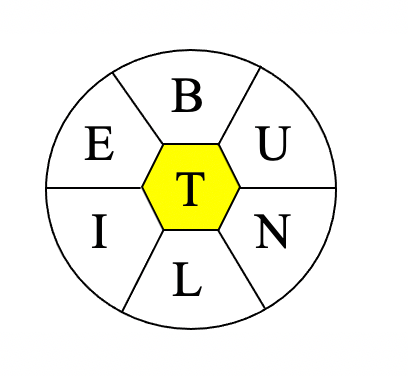
B, E, I, L, N, U, and center T (all words must include T)
Merriam-Webster says…
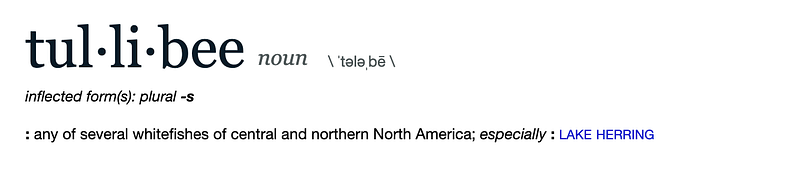
Silly little dictionary! Don’t you know that tullibee can’t possibly be a word if the New York Times says it ain’t?
For further fascinating facts, check out the Spelling Bee Master.
What’s your favorite dord* from today’s puzzle?
My Two Cents
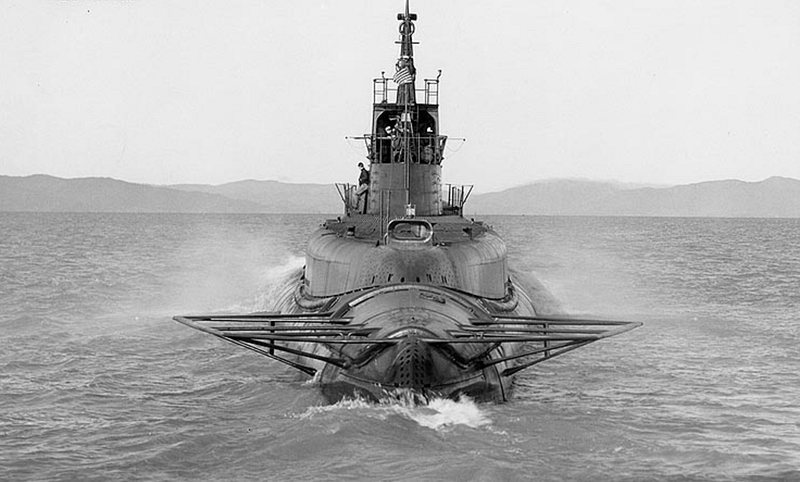
I couldn’t resist using that photo of a submarine once I saw it. I just think the composition is really neat. Plus, it reminded me of Captain Nemo’s Nautilus in the 1954 Walt Disney version of 20,000 Leagues Under the Sea, starring James Mason, Kirk Douglas, and that other guy… oh, yeah, Paul Lukas.
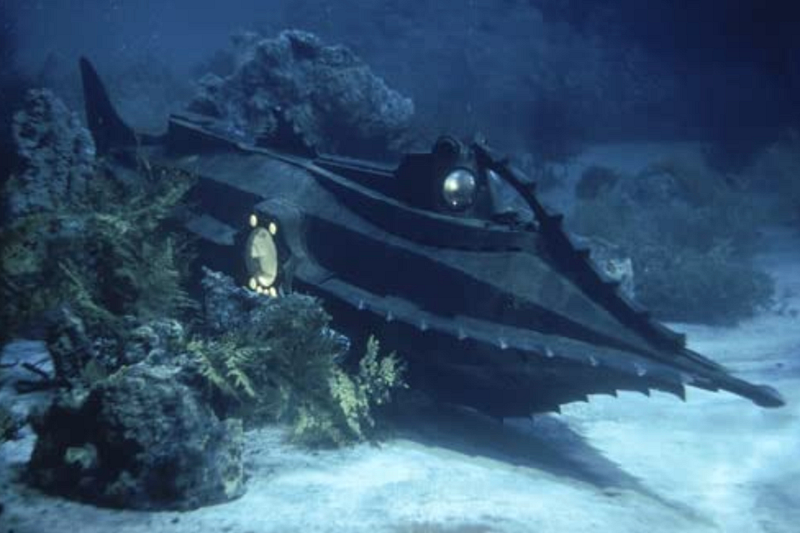
By the way, that front sharp tip of the submarine is believed to have caused Kirk Douglas’s chin dimple:
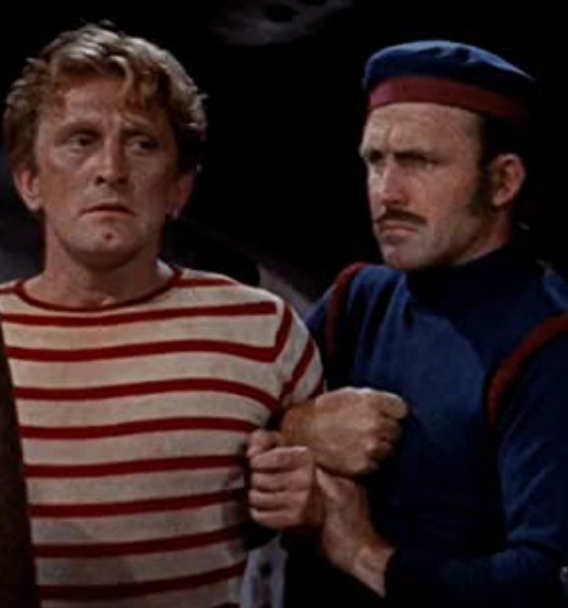
You too would look unhappy if a submarine had just jabbed your face.
One fish, two fish, red fish, whitefish
Coregonus artedi is the official taxonomic name of the tullibee. A fish also known as the cisco, northern cisco, lake herring, or chub. If the idea was to have many aliases so it wouldn’t get caught, well… that idea failed miserably.
Although initially snubbed as a pest in the Great Lakes region, demand for the tullibee began to rise in the early part of the 1800s, when someone realized it was much tastier than its cousin, the lake whitefish — probably a result of clever marketing by the lake whitefish. Today about 300 tons of tullibee are caught on a yearly basis just in Ontario.
The tullibee belongs to the Salmonidae family, and if you guessed that the salmon is also in that family, that’s because you simply subtracted “idae” from Salmonidae. You thought I was impressed? This family also includes trout, chars, and freshwater whitefish. Saltwater whitefish kept distancing themselves and are now estranged from this family.
There is some debate as to whether the species Coregonus artedi is limited to the Great Lakes or includes all the types of tullibee in North America. It’s not a very interesting debate, like, say, the presidential ones the U.S. had in the past two elections, so I won’t get into it.
This fish is usually 11 to 15 inches (28 to 38 cm) long and weighs anywhere from six ounces to two pounds (170 to 900 grams). One of its most curious and surprising qualities is its patience and ability to stay still when posing for portraits:
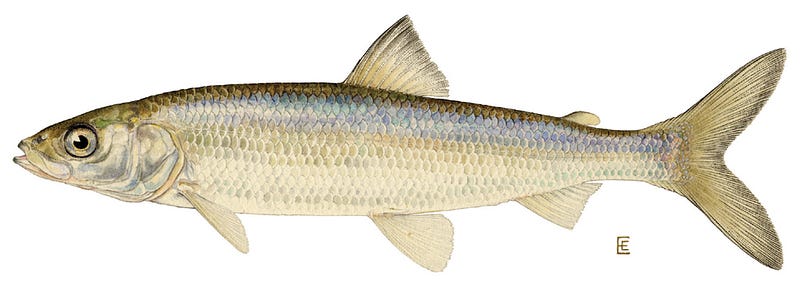
(That Ellen Edmonson had a nifty artistic signature, in my opinion.)
Now, the tullibee has several other cousins aside from the lake whitefish I mentioned earlier. They are known as ciscos, and have some interesting monikers: the bloater, the shortnose cisco, the shortjaw cisco, the blackfin cisco, the deepwater cisco, and the longjaw cisco. These last three are extinct. It’s theorized that overfishing, pollution, and the introduction of invasive species were responsible for the demise of those three species. However, in the case of the longjaw, failure to correct a notable overbite may have led to being excluded from the dating pool. And, well, if you can’t date… you can’t mate.
Two submarines, one name
The name tullibee was chosen not once, but twice by the United States Navy for its submarines. Unfortunately, the first time around it was a disaster.
USS Tullibee (SS-284), was a Gato-class submarine. Being that gato means “cat” in Spanish, it’s odd she was named for a fish. She was commissioned (entered service) on February 15, 1943, with Commander Charles F. Brindupke in command. In July she began her first patrol in the Pacific Ocean, north of New Guinea.
Barely a year after she was commissioned, while on her fourth patrol, the Tullibee made contact with a convoy that included freighters and a destroyer. When she launched two torpedoes at them, one of them ran in a circle and crashed back into her. She sank, with only one man — Gunner’s Mate C.W. Kuykendall — surviving.
That photo of the submarine at the top of today’s column is of the USS Tullibee.
USS Tullibee (SSN-597), on the other hand, served for over 28 years. At 273 feet long and 2,640 tons displacement, the USS Tullibee was the smallest nuclear-powered attack submarine in the country’s submarine fleet. During her service she submerged and surfaced over 700 times and traveled the equivalent of the distance from the Earth to the Moon and halfway back. (It’s rumored that the other half back was done through a wormhole, but this is classified military information.)
This Tullibee was decommissioned on June 25, 1988. One of its fairwater planes (the tower-like structure on the topside), also known as a fin, was used in a permanent art installation at Magnuson Park on the shore of Lake Washington in Seattle. You can find out more about it here:
That’s it for tullibee today. All that’s left is my usual rant: despite being the name of a Great Lake fish and two submarines, the editors of the Spelling Bee were not impressed and decreed that tullibee is a dord.*
You can check out my previous entry on another dord* here:
*What the heck is a dord, you ask? Here’s the answer: