avatarFaisal Khan

Free AI web copilot to create summaries, insights and extended knowledge, download it at here

1352

Abstract

n away from the sun and the properties of collisionless plasmas. The team at UW-Madison Physics department set out to decode the “<b>Parker spiral</b>” — named after the astrophysicist, Eugene Parker, who introduced the solar wind theory in 1958.</p><p id="0fcb">The solar model was created in the lab by putting a magnet in the center of the big red ball to replicate the magnetic field of the sun in a 3-meter-wide (10 feet) aluminum vacuum chamber. The researchers then pumped helium inside the chamber to ionize the gas to produce plasma. Eventually, an electric current is passed through the ball. Combined with the magnetic field, the electric current caused the created plasma to spin.</p><p id="f7ac" type="7">“[Our] effort was trying to … confirm or refute the theoretical derivation for the solar wind and heliospheric magnetic field that Parker figured out in 1958.” UW Team</p><p id="5c28">The experiment was able to produce blobs of plasma ejected by the solar wind, producing the same effect as the real Sun. This miniature model of the Sun would be used to verify Parker’s theory and solve the enigma behind this phenomenon.</p><p id="ea54">Complete findings of the project were published in <a href="https://www.nature.com/articles/s41567-019-0592-7">Nature Physics</a> journal on July 29th.</p><h2 id="0209">Email 📭| Twitter📜 | Linked

Options

In 📑| StockTwits 📉 | Telegram 🔗</h2><div id="cce1" class="link-block"> <a href="https://readmedium.com/chameleon-theory-may-solve-the-enigma-of-black-holes-dark-energy-8cd2152fe9f4"> <div> <div> <h2>Chameleon Theory may solve the enigma of Black holes & Dark Energy</h2> <div><h3>It provides an alternative view to the Theory of General Relativity and how Gravity works</h3></div> <div><p>medium.com</p></div> </div> <div> <div style="background-image: url(https://miro.readmedium.com/v2/resize:fit:320/0*lKW3Po9soyqkmUf7.jpg)"></div> </div> </div> </a> </div><div id="3f00" class="link-block"> <a href="https://readmedium.com/how-many-exoplanets-have-we-discovered-so-far-d38aa93b60ee"> <div> <div> <h2>How many exoplanets have we discovered so far?</h2> <div><h3>The number crossed 4,000 in June!</h3></div> <div><p>medium.com</p></div> </div> <div> <div style="background-image: url(https://miro.readmedium.com/v2/resize:fit:320/0*sjiFwzpv4TgqUNKf)"></div> </div> </div> </a> </div></article></body>

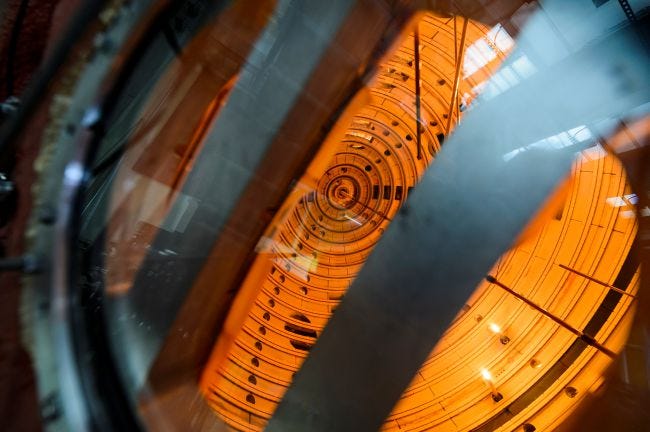
(Credit: UW-Madison)

Physicists have created a “Mini-Sun”

Decoding the mystery behind “Parker spiral” & Solar winds

The “Big Red Ball” has been in the making since 2012. The project was initiated to study how solar winds and the ejection of plasma from the real Sun works. The mini-sun has been created with its own powerful electromagnetic field & super-hot plasma, by researchers at the University of Wisconsin-Madison.

Our Sun is a molten ball of plasma — a mix of positively & negatively charged particles existing at every high temperature. The surface alone can get as hot as 5,600 Celsius (or 10,000 Fahrenheit) whereas the core can reach up to 15 million C (or 27 million F).

The satellites have regularly observed plasma ejections from the surface of the sun — the source of these so-called “plasma burps" has remained a mystery. But no spaceship has been able to get close enough to study the phenomenon in detail.

Researchers are also looking for answers on the solar wind’s acceleration away from the sun and the properties of collisionless plasmas. The team at UW-Madison Physics department set out to decode the “Parker spiral” — named after the astrophysicist, Eugene Parker, who introduced the solar wind theory in 1958.

The solar model was created in the lab by putting a magnet in the center of the big red ball to replicate the magnetic field of the sun in a 3-meter-wide (10 feet) aluminum vacuum chamber. The researchers then pumped helium inside the chamber to ionize the gas to produce plasma. Eventually, an electric current is passed through the ball. Combined with the magnetic field, the electric current caused the created plasma to spin.

“[Our] effort was trying to … confirm or refute the theoretical derivation for the solar wind and heliospheric magnetic field that Parker figured out in 1958.” UW Team

The experiment was able to produce blobs of plasma ejected by the solar wind, producing the same effect as the real Sun. This miniature model of the Sun would be used to verify Parker’s theory and solve the enigma behind this phenomenon.

Complete findings of the project were published in Nature Physics journal on July 29th.

Email 📭| Twitter📜 | LinkedIn 📑| StockTwits 📉 | Telegram 🔗

Science
Technology
Space
Future
Astronomy
Recommended from ReadMedium