avatarFaisal Khan

Free AI web copilot to create summaries, insights and extended knowledge, download it at here

1674

Abstract

ure id="586b"> <div> <div> <img class="ratio" src="http://placehold.it/16x9"> <iframe class="" src="https://cdn.embedly.com/widgets/media.html?src=https%3A%2F%2Fwww.youtube.com%2Fembed%2FaiFD_LBx2nM%3Ffeature%3Doembed&amp;display_name=YouTube&amp;url=https%3A%2F%2Fwww.youtube.com%2Fwatch%3Fv%3DaiFD_LBx2nM&amp;image=https%3A%2F%2Fi.ytimg.com%2Fvi%2FaiFD_LBx2nM%2Fhqdefault.jpg&amp;key=a19fcc184b9711e1b4764040d3dc5c07&amp;type=text%2Fhtml&amp;schema=youtube" allowfullscreen="" frameborder="0" height="480" width="854"> </div> </div> </figure></iframe></div></div></figure><p id="d570">Kepler went out of commission last year but the pace of discovery is not slowing down, as it gets replaced by other satellites & space telescopes like NASA’s <a href="https://heasarc.gsfc.nasa.gov/docs/tess/">Transiting Exoplanet Survey Satellite (TESS)</a>, which is going to continue the mission in the transitory period before <a href="https://www.jwst.nasa.gov/">James Webb Space Telescope</a> takes Kepler’s spot in 2021. In fact, <a href="http://sci.esa.int/cheops/">European Characterizing Exoplanets Satellite (CHEOPS)</a> is all set to launch later in the year with the mandate to spot exoplanets.</p><p id="5929">TESS has actually added a feather in its cap by spotting the smallest exoplanet ever — dubbed as L 98–59b, the planet is slightly bigger than Mars along with two other planets orbiting a cool star which is 35 light-years away.</p><p id="3d15">The advanced technology of both CHEOPS & James Webb telescope will go a step further from the simple detection of exoplan

Options

ets to determine whether these planets can support life. Alien life & Earth 2.0 might become a reality sooner than you think.</p><h2 id="2be6">Email📭| Twitter📜 | LinkedIn📑| StockTwits📉 | Telegram🔗</h2><div id="b94c" class="link-block"> <a href="https://readmedium.com/will-these-13-cybersecurity-unicorns-help-tackle-the-mounting-challenge-fa965ae1e843"> <div> <div> <h2>Will these 13 Cybersecurity Unicorns help tackle the mounting Challenge?</h2> <div><h3>The Role of these well-funded private companies takes the center stage as the data breaches become more prevalent</h3></div> <div><p>medium.com</p></div> </div> <div> <div style="background-image: url(https://miro.readmedium.com/v2/resize:fit:320/0*h7mgKBHgWM9SBzzp.jpg)"></div> </div> </div> </a> </div><div id="0f55" class="link-block"> <a href="https://readmedium.com/tech-diaries-neuralink-ready-to-test-the-brain-computer-interface-bci-a34f67c4bc64"> <div> <div> <h2>Tech Diaries: Neuralink ready to test the Brain-computer Interface (BCI)</h2> <div><h3>Chinese safe alternative to CRISPR, First Long-range solar-powered Car, Tiny Robots & Qudits</h3></div> <div><p>medium.com</p></div> </div> <div> <div style="background-image: url(https://miro.readmedium.com/v2/resize:fit:320/0*KxFnoW1-wVAg76Ye.jpg)"></div> </div> </div> </a> </div></article></body>

How many Exoplanets have we discovered so far?

The number crossed 4,000 in June!

For as long as humans have walked the face of the Earth, we have looked up in the sky & wondered whether we are alone in the Universe or if there are other Worlds like ours. Are we the only intelligent life form or are there other ones like us out there? These burning questions have led us on a path to discovery, where we have been looking for other habitable planets called Exoplanets.

The breakthrough came in 1992 when radio astronomers Aleksander Wolszczan and Dale Frail announced the discovery of two planets orbiting the pulsar PSR 1257+12. Ever since that first discovery, hundreds of these celestial bodies have been added to the NASA Exoplanet Archive, which has details of all the discoveries. To date, there have been 4025 confirmed exoplanet discoveries.

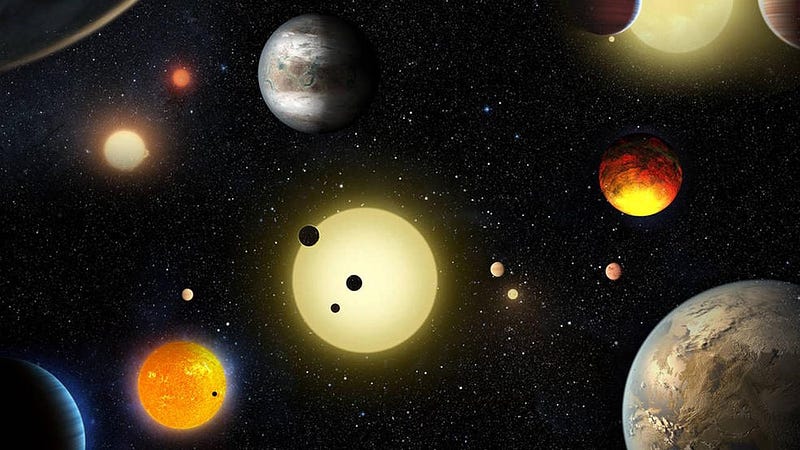
As the technique to identify such planets got refined over the years, the inventory of such planets began to get bigger. The biggest leap, however, came when Kepler Space Telescope went online in 2009. That’s when we really saw exponential growth in the discovery of exoplanets. To put all these planets in a map, NASA has recently released an impressive video visualization of Alien Worlds in collaboration with System Sounds, a science outreach project (shown below).

Kepler went out of commission last year but the pace of discovery is not slowing down, as it gets replaced by other satellites & space telescopes like NASA’s Transiting Exoplanet Survey Satellite (TESS), which is going to continue the mission in the transitory period before James Webb Space Telescope takes Kepler’s spot in 2021. In fact, European Characterizing Exoplanets Satellite (CHEOPS) is all set to launch later in the year with the mandate to spot exoplanets.

TESS has actually added a feather in its cap by spotting the smallest exoplanet ever — dubbed as L 98–59b, the planet is slightly bigger than Mars along with two other planets orbiting a cool star which is 35 light-years away.

The advanced technology of both CHEOPS & James Webb telescope will go a step further from the simple detection of exoplanets to determine whether these planets can support life. Alien life & Earth 2.0 might become a reality sooner than you think.

Email📭| Twitter📜 | LinkedIn📑| StockTwits📉 | Telegram🔗

Astronomy
Science
Future
Technology
Artiificial Intelligence
Recommended from ReadMedium