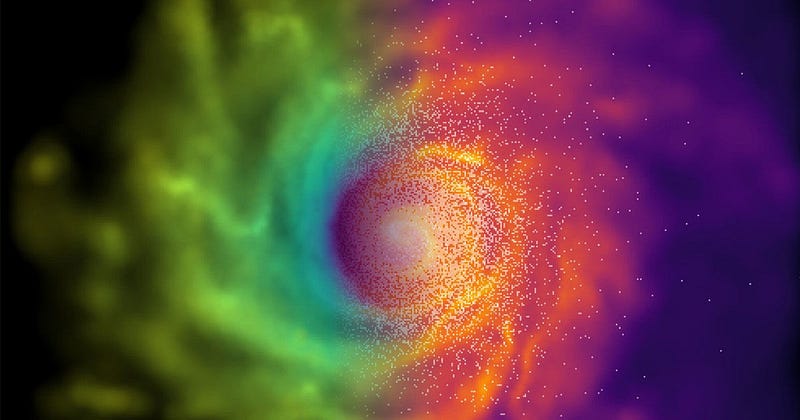
Chameleon Theory may solve the enigma of Black holes & Dark energy
It provides an alternative view to the Theory of General Relativity and how Gravity works
The 100-year-old Theory of General Relativity by Einstein has provided the foundational concept of how gravity works and how galaxies formed over time. Modern cosmology and space research is based on this theory. Physicists at Durham University, UK have now proposed an alternative model for gravity — f(R)-gravity dubbed as Chameleon Theory.
Despite making amazing discoveries for the past couple of decades — charting the depths of the universe, looking for exoplanets & better understanding of our Solar system, there are still mysteries which we have still been unable to explain with the traditional laws of Physics. Some of these include Black holes sitting at the center of galaxies, dark energy & dark matter.
For people who are not Science buffs — matter only makes up about 5% of the total mass of the universe. This includes all the stars, planets, moons and all other celestial bodies. Almost 70% consists of a mysterious repulsive force to gravity called dark energy, while the remaining consists of an invisible dark substance called dark matter. The chameleon theory expects to take a stab at explaining the properties of the mysterious dark energy.
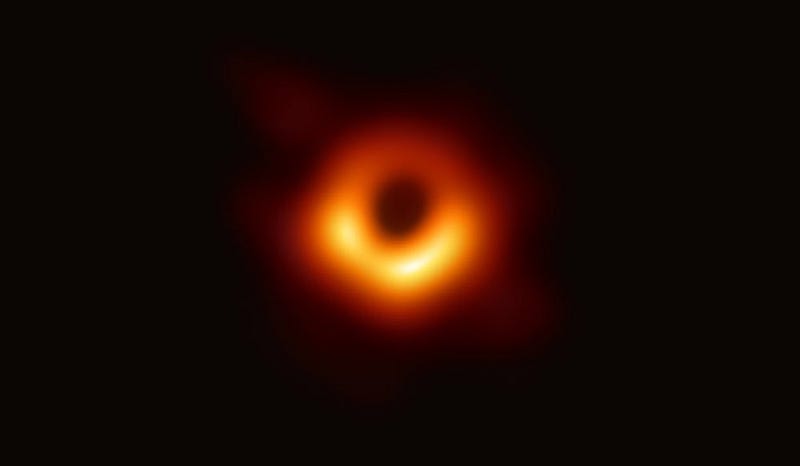
Recently in April, the first real achievement for the Scientific community came in the form of the capturing of the event horizon of a supermassive black hole in M87 galaxy. Until now, scientists had only predicted the existence of such a phenomenon (based on general relativity) where the gravitational pull was so immense that even the light could not escape it.
And now we can see the proof, thanks to the Event Horizon Telescope (EHT) formed by an international coalition of scientists. The image provides proof that light has been bent by the black holes around its edges (event horizon), thus providing credence to the century-old foundational theories of Physics.
The Chameleon theory differs from Theory of general relativity in the sense that while the latter assumes of a gravitational constant that acts as the binding force between two celestial bodies, the former allows the gravity to vary to see if it produces the same results. Also in general relativity, the dark energy which is pushing the universe apart is treated as a constant, Supercomputer simulations of the Chameleon Theory treat this force as a variable too.
Researchers have also looked at the effects of varying gravity in the chameleon theory on the supermassive black holes. These black holes are central to the formation of galaxies — by swallowing surrounding matter & burning the gas to produce heat and material which are the building blocks of the galaxies. The simulations confirmed that the galaxies were still able to form with altered gravity.
With the theoretical calculations from the Chameleon Theory replicating the success of the General relativity Galaxies formation, it’s time now to put this theory to the practical test. The Durham researchers will test their findings through observations using the Square Kilometre Array (SKA) telescope, based in Australia and South Africa, which is due to begin observations in 2020.