
Visualizing the Global Economy in 6 Infographics
These numbers can change drastically with the reigniting of the Trade War by President Trump
Mr. 10% was at it again — President Trump got to his ‘Twitter-best’ announcing that the U.S would introduce a 10% tariff on $300B of not-yet-tariffed Chinese imports from Sept. 1 throwing the financial markets in a tailspin. Apart from the long term ramifications, this has greatly escalated a trade war which was seeing a period of a lull with the continuing talks between the two economic powers.
Knee jerk reaction included an 8% dive in the Oil prices, Treasury yields falling below 2%, China’s currency Yuan dropping to 2019 low & Dow Jones closing down 280 points.
The timing of the tweet was interesting too, as it came right after one day of the FOMC rate hike which was less than dovish and came more as a precautionary measure against trade risks than the start of another easying cycle. Perhaps by doing this Trump has raised the stake for the Feds to continue the rate-cutting cycle.
The rate move by the Feds ired President Trump as he had been expecting to use Central Bank’s monetary policy to fight the trade war against China. He is also running out of patience with the Chinese, blaming them for the breakdown of the earlier deal. China, on the other hand, has reaffirmed its stand that it doesn’t want a trade war, but it’s not going to shy away from one either.
With that in mind & how things can change drastically for the Global economy, let’s review the current state of the global economy with the help of some insightful infographics.
International Trade:
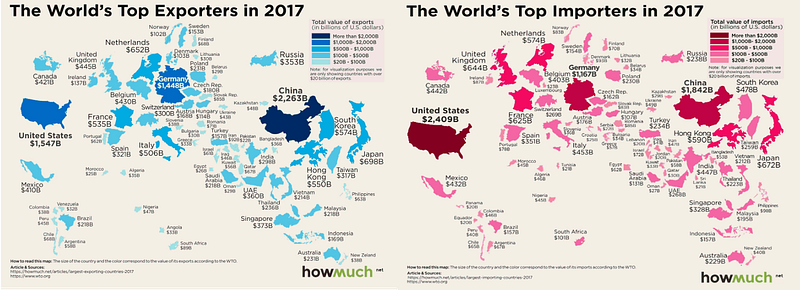
The tussle between the two biggest trading partners in the World is certain to disrupt the trade flows across the Globe. It’s no surprise China is the biggest exporter of goods to the World ($2,263 billion), followed by the U.S and Germany with $1,547 billion & $1,447 billion worth of exports.
The U.S is also the biggest importer of goods ($2,409 billion) followed by China & Germany ($1842 & $1167 billion respectively). Countries dependent on tariffed imports will likely end up paying higher amounts. This will result in an increase in the price of finished goods for the consumer.
Not only is this trade war going to act as a major drag on trade flows between the two countries, but the contagion effect is also going to engulf other countries as well. The U.S is locking horns with EU on the issue of subsidies to their aviation giants Boeing & Airbus respectively. America has already threated to impose tariffs on EU cars, food & alcohol products if the issue is not resolved to its liking.
On the far east side, Japan is imposing restrictions on it ally South Korea by removing it from a while list which allows for minimum export controls. This will curb the transfer of high-tech materials to S. Korea. This erupted from the dispute over compensation for wartime forced laborers. Apparently, trade tariffs are becoming the favored new economic weapon.
Foreign Exchange Reserves:
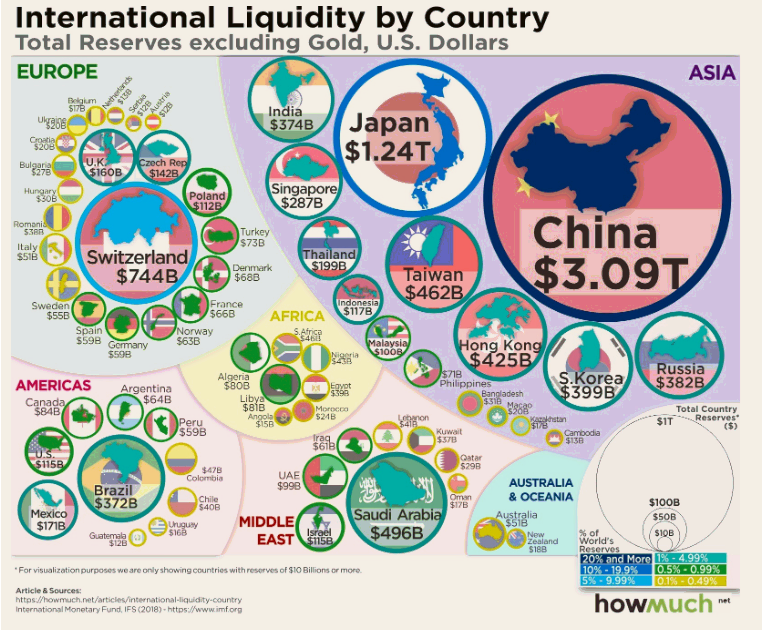
Foreign exchange market (Forex) trades about $5 trillion every day. It is by far the biggest and most liquid market of the World. Compare this to the Equities which only trade $200 billion a day. China has the biggest liquidity reserves with $3.09 trillion in hand. High volumes of the trade by the second-largest country forces them to maintain ample liquidity.
The other trend is that while developing countries prefer to have large reserves in the form of the US bonds, developed countries tend to keep the precious yellow metal as their reserve.
Not having enough currency reserves can create its own risk as Gold is not a very liquid asset. China is uniquely placed in this category followed by Japan & Switzerland with massive amounts of currency reserves. China can easily manipulate the value of the US dollar by flooding the market with US bonds. This has become a real possibility with the ongoing trade war.
Gold for Developed countries:
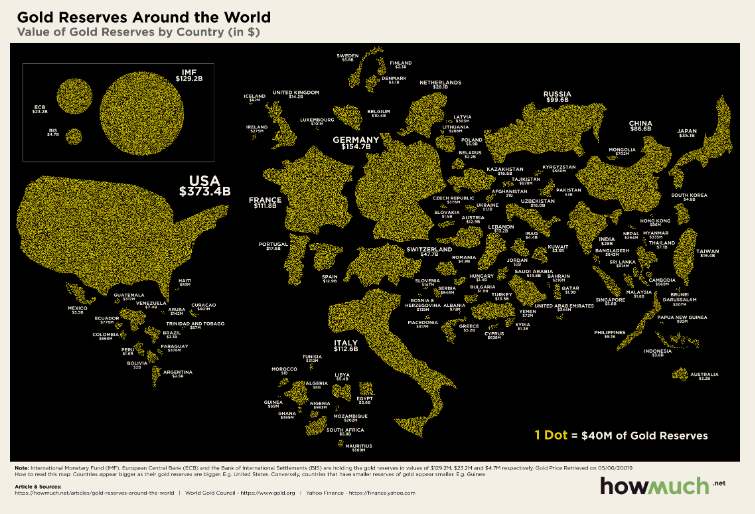
Talking about Gold, the precious commodity has traditionally been used as a hedge against risk and is more favored as the liquidity reserves in developed countries. The United States is the biggest holder of the commodity valued at $373.4 billion. The U.S relies less on foreign currency reserves since most of the transactions around the World take place in the US dollar. Similar scenarios persist for other developed countries as well.
The Oil Bust:
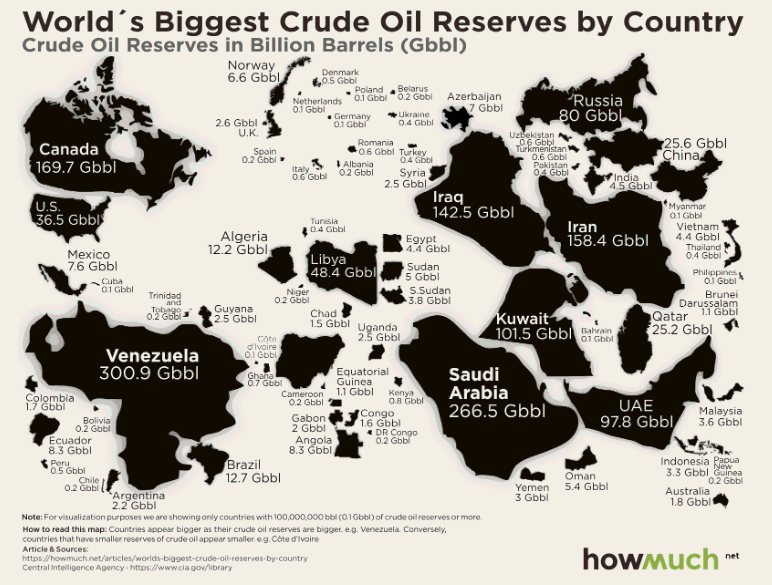
There is a handful of countries which have been blessed with the abundance of Oil. These countries are almost entirely dependent on the export of this commodity to grow and sustain their economies. With a push towards renewables brought about by Climate change issues & technological innovation, these countries need to shift their economies away from Crude exports.
Most of the Middle East, Russia, Canada, Nigeria, Libya & Venezuela are some of the biggest producers of Oil. Problem is Crude prices have plummeted from about $140 a decade ago to mid $50s at the time of writing putting pressure on these commodity export-driven economies.
While diverse economies like the U.S & Canada may be able to sustain their economies moving away from Oil exports, others like Saudia Arabia, Venezuela & Russia are feeling the pinch. On top of that global economic slowdown caused by a trade war would put further pressure on these countries with declining demand for the commodity.
Brexit Effect:
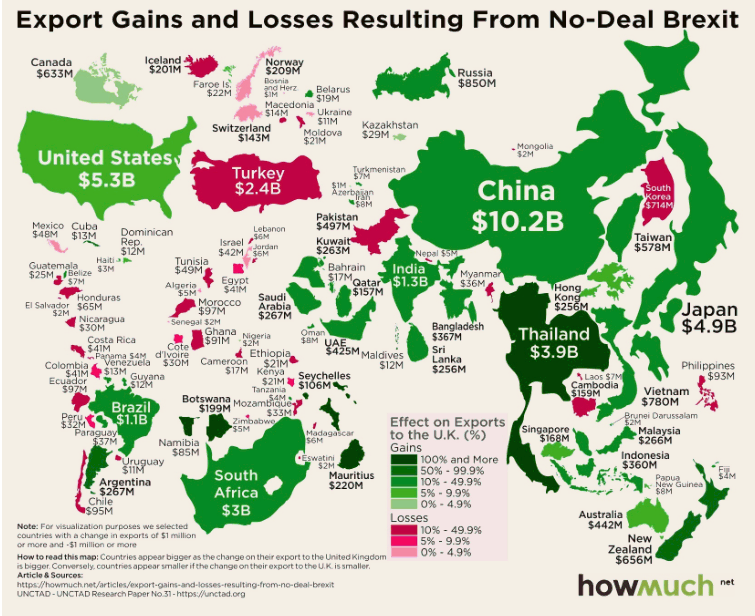
And finally the effect of trade on a black swan event like Brexit. At the end of the day, it is a zero-sum game. The loss of one country will be the gain of another one. In this case, it is almost certain that the UK is going to crash out of the EU without a Brexit deal. Export powerhouses like the U.S. China, Thailand, and Japan will replace the vacuum left by current key exporting partners like Turkey, South Korea, Pakistan and a handful of others.
Economies have greatly evolved over the last 100–150 years with a shift from an agricultural base to manufacturing and now to the Services sector. Trade of goods might not be the all-important factor as the services have taken hold in the more advanced economies. Yet we can’t dismiss trade entirely.
The dynamics of the globalized economy are changing — While trade might be insignificant to one economy, it can be the lifeline of another. While the U.S can afford to move away from fossil fuels, imagine what the Oil exports mean for countries like Saudia Arabia & Venezuela.