
Peepul
Being one of the oldest trees in the world still wasn’t enough…for the Spelling Bee
Today’s New York Times Spelling Bee letters:
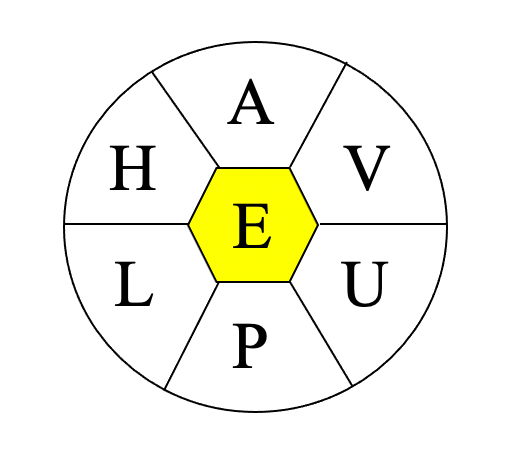
A, H, L, P, U, V, and center E (all words must include E)
Merriam-Webster says…
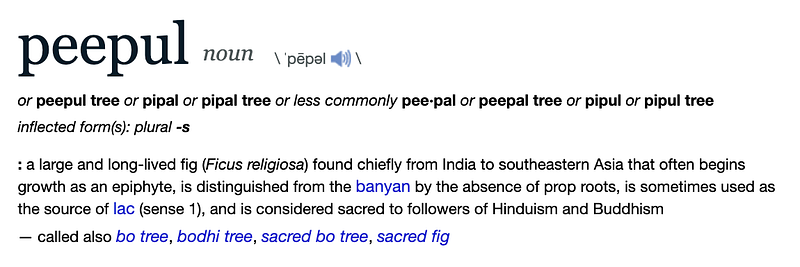
Silly little dictionary! Don’t you know peepul can’t possibly be a word if the New York Times says it ain’t?
For further fascinating facts, check out the Spelling Bee Master.
What’s your favorite dord* from today’s puzzle?
My Two Cents
Could it be that the Spelling Bee thinks peepul is an odd and obscure variation of “people”? We’ve mentioned before how fickle it can be when it comes to this subject.
By the way, both peepul and people are pronounced the same, according to our friends at Merriam-Webster. In fact, the pronunciation is closer to the spelling of the former than the latter.
Religious fig
The scientific name of the peepul tree is Ficus religiosa, which translates as “sacred fig”. English borrowed the word from the Hindi pīpal, itself from Sanskrit pippala. I’m not sure if the Sanskrit word has another meaning, although I did find a few characters in epic history of Hinduism with that name. One of them was a warrior. But again, I have no idea if the tree was named for the warrior or vice versa.
The tree is also known as the pipal, pipul, Bodhi or Bo tree. (The last two names, however, are used in reference to a specific tree; more about that later.) It can easily be distinguished from the banyan, as you can see here:
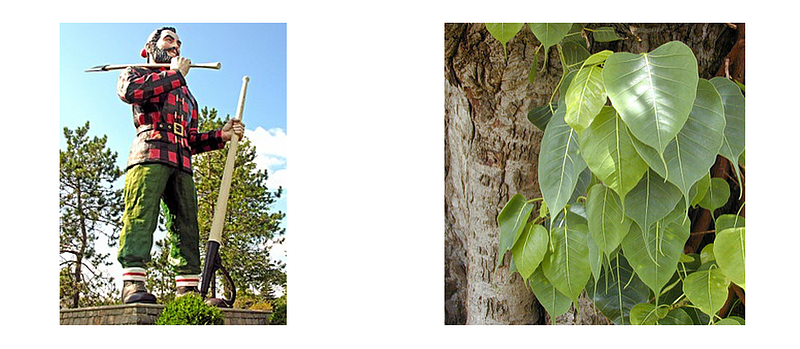
Oh, that silly Iva Reztok, always mixing things up! The image on the left is a Bunyan, of course, not a banyan.
Both peepuls and banyans are figs and begin life as epiphytes. The dictionary explains that an epiphyte is “a plant that derives its moisture and nutrients from the air and rain and grows usually on another plant”. In colloquial terms they are known as “strangler trees”! You can read more about these murderous plants here and help me earn another 13 cents today. I thank you in advance…
Don’t worry, our dear peepul is no tree killer. It only begins life lightly strangling other fellow trees, but later changes its mind and switches to penetrating and splitting the stem of the supporting plant with its roots. Oh… wait a second!
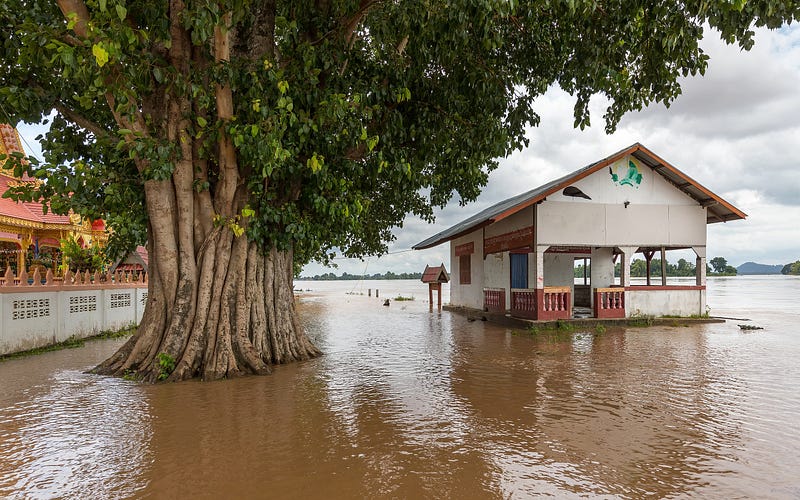
The peepul tree can grow in a variety of climates and altitudes, although it is native to the Indian subcontinent. It’s a semi-evergreen tree that can grow almost 100 feet tall (30 meters) and reach a diameter of almost 10 feet (3 meters). Here is one next to a house for comparison.
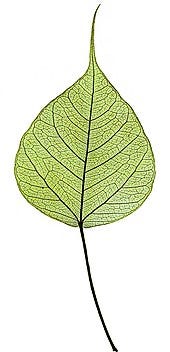
The leaves have a distinctive heart shape, as you can see from the photo placed next to Paul Bunyan’s statue. The shape is not as clear in the nature printing below, but it’s a pretty picture, so I used it.
The peepul has religious significance in the dharmic religions of Hinduism, Buddhism and Jainism. Which brings us to…
Tree of awakening
That is the literal meaning of “Bhodi tree”. The original Bo tree was located in the eastern state of Bihar, in India. It was under this tree that Siddhartha Gautama, the Buddha, achieved enlightenment, or Bhodi, around 2,600 years ago. (There are several Buddhist terms for enlightenment, Bhodi translating roughly as “knowledge or wisdom, or awakened intellect”. Another term is moksha, also known as vimoksha, vimukti, and mukti. This refers to the lack of a permanent essence, and the release from mundane hindrances.)
The photo below shows a sculpture of the Buddha meditating under the original Mahabodhi tree, as the tree is known.
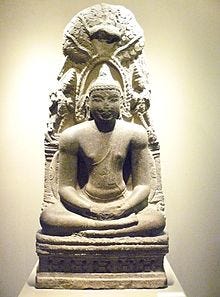
This event is celebrated on December 8th, with many Buddhists making a pilgrimage to the Mahabodhi tree at the Mahabodhi Temple in Bodh Gaya, the religious site in the state of Bihar. The temple is on the UNESCO’s World Heritage List. As their web site explains:
“The Mahabodhi Temple Complex is one of the four holy sites related to the life of the Lord Buddha, and particularly to the attainment of Enlightenment. The first temple was built by Emperor Asoka in the 3rd century B.C., and the present temple dates from the 5th or 6th centuries. It is one of the earliest Buddhist temples built entirely in brick, still standing in India, from the late Gupta period… The most important of the sacred places is the giant Bodhi Tree, to the west of the main temple, a supposed direct descendant of the original Bodhi Tree under which Buddha spent his First Week and had his enlightment.[sic]”
Notice the phrase “supposed direct descendant”. That is because the original tree was destroyed and replaced several times, apparently. However, the southern branch was taken by a Buddhist nun some two or three hundred years after the Buddha attained parinirvana and passed away. The nun was sent on a mission by Emperor Asoka to travel from India to Sri Lanka and present this branch of the peepul to Devanampiya Tissa, one of the earliest kings of Sri Lanka whose reign was notable for the arrival of Buddhism.
The branch was planted in 288 BC, and the tree that grew from it known as the Jaya Sri Maha Bodhi. The sacred city where it grows is also on the UNESCO World Heritage List.
Below is a photo collage showing the tree before 1913 on the left, alongside a more recent picture on the right.
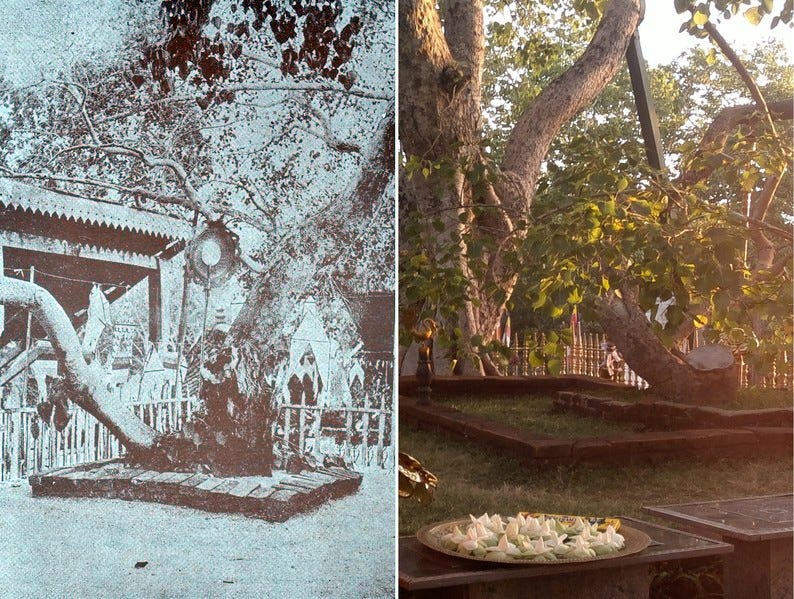
Now here is factoid that may blow your mind: the Jaya Sri Maha Bodhi is the oldest living human-planted tree in the world with a known planting date. This has been certified by The Guinness Book of World Records as well as the Rocky Mountain Ring Research project:
RMTRR OLDLIST
OLDLIST, a database of old trees OldList is a database of ancient trees.
www.rmtrr.org
And here is the list (perhaps incomplete) of the oldest trees on record. Double asterisks indicate the tree is dead. The Jaya Sri Maha Bodhi is highlighted in blue.
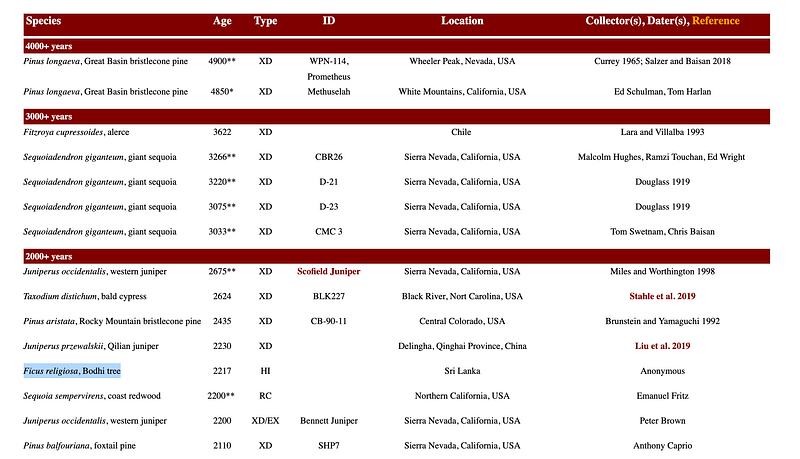
Yeah, that’s right. The oldest living tree on the planet is more than 4,800 years old! Appropriately, it has been Methuselah. It’s a Great Basin bristlecone pine (Pinus longaeva) that spends its time in the White Mountains of Inyo County, in eastern California.
In a 2016 article about the tree, the New York Times posted a photo of a different bristlecone pine because “officials at Inyo National Forest declined to provide a photo of the roughly 4,847-year-old tree, to deter anyone from finding and hurting it.”
To honor that ––but mainly to avoid posting a photo that could get me in copyright trouble, or could lead to the death of dear old Methuselah–– I will follow the guidelines of the forest officials and copy and paste a random public domain picture of a bristlecone pine.
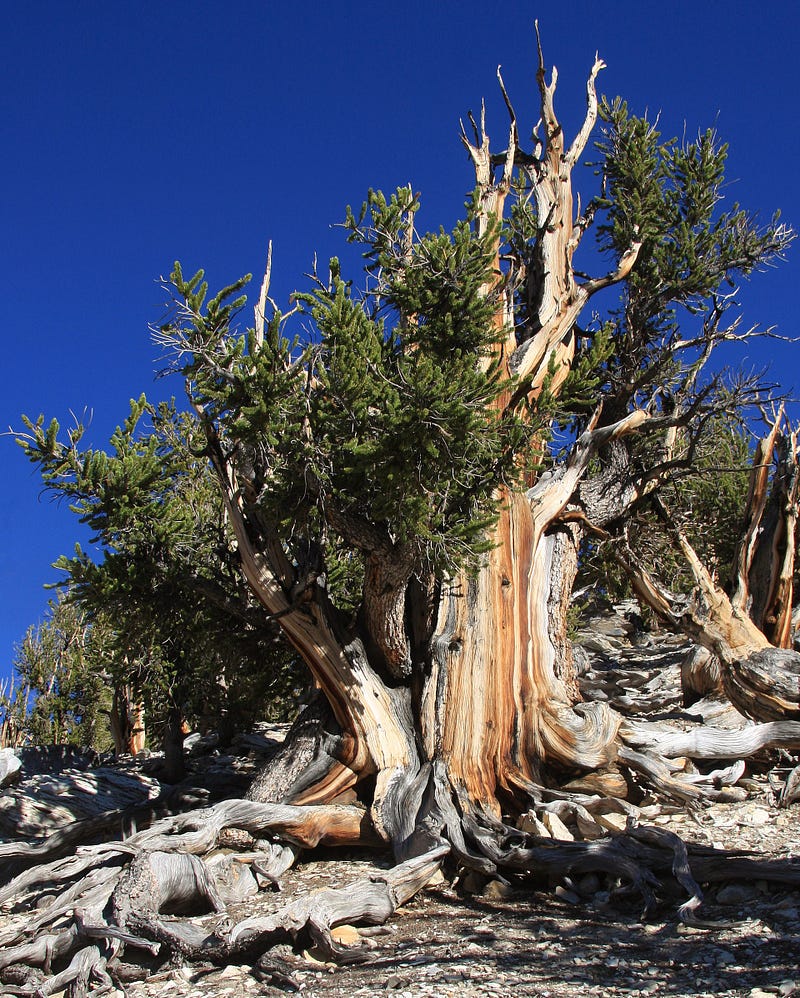
That photo is a nice way to end today’s column and usher in the beginning of the weekend.
And yet, despite the importance of the peepul in three religions, or about 1.67 billion people… the editors of the Spelling Bee decided that the word peepul is a dord*.
You can check out my previous entry on another dord* here:
*What the heck is a dord, you ask? Here’s the answer: