
Multitool
The Spelling Bee should have accepted the hyphenless version of this word
Today’s New York Times Spelling Bee letters:
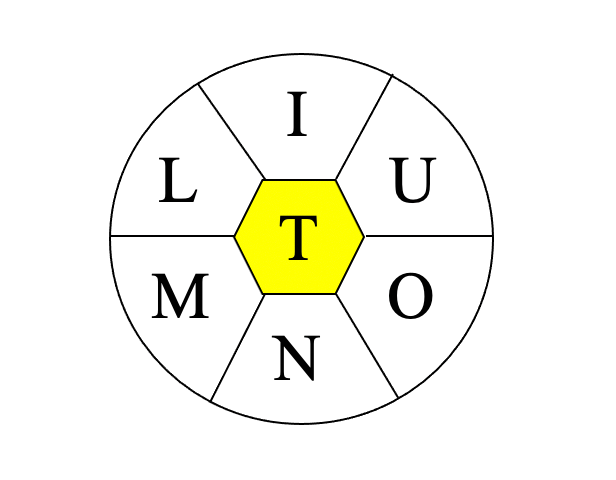
I, L, M, N, O, U, and center T (all words must include T)
Merriam-Webster says…
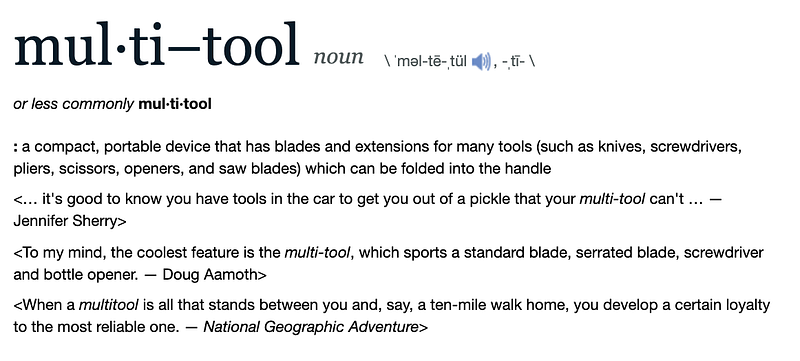
Silly little dictionary! Don’t you know multitool can’t possibly be a word if the New York Times says it ain’t?
For further fascinating facts, check out the Spelling Bee Master.
What’s your favorite dord* from today’s puzzle?
My Two Cents
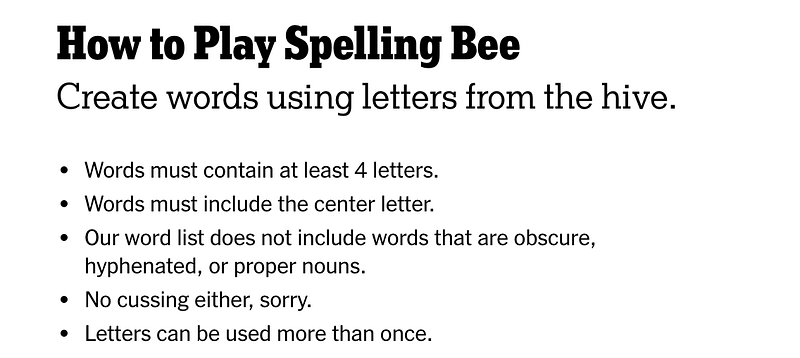
Yes, I get it. Multi-tool is spelled with a hyphen as the dictionary’s main form of the entry, and hyphenated words are not allowed by the Spelling Bee. It’s part of their third official rule:
Merriam-Webster gives two example sentences, one with the hyphenated version, one without.

National Geographic Adventure is an online magazine of the parent company, and if an unhyphenated multitool is good enough for them, it’s good enough for me.
But wait, there’s more!
Yesterday the Spelling Bee letters were C, D, E, K, N, U, and center H. And here is the list of accepted answers (the highlighted words are the pangrams, or words spelled using all seven letters):
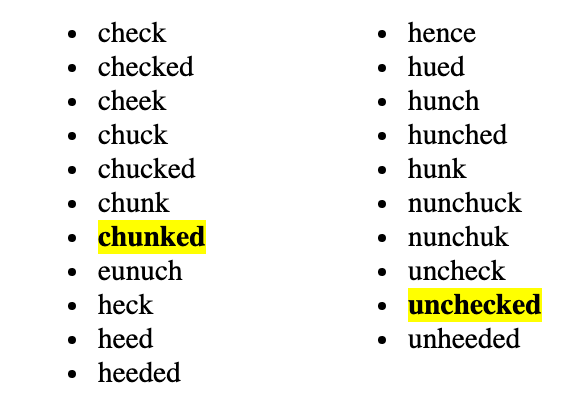
You’ll notice one word that seems to repeat itself: nunchuck.
And no, it does not mean to “toss a woman belonging to a religious order”, although that would be a fun definition, don’t you think? Notice what the dictionary entry for nunchuck shows:
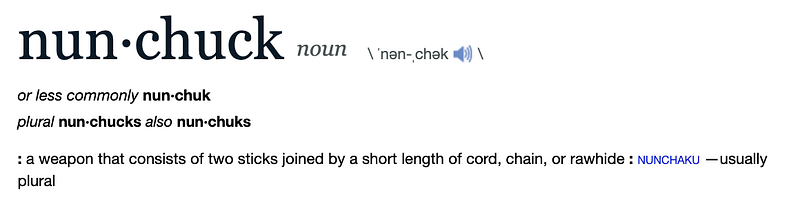
Nunchuk is the “less commonly” version of nunchuck, yet the Spelling Bee accepted it. So why not accept the “less commonly” version of multi-tool? Why, oh why indeed!
Jack of all tools
Remember that old meme about how all the different electronic gadgets people had in the 1980s and 1990s now fit in your tiny smartphone? Here’s a refresher:
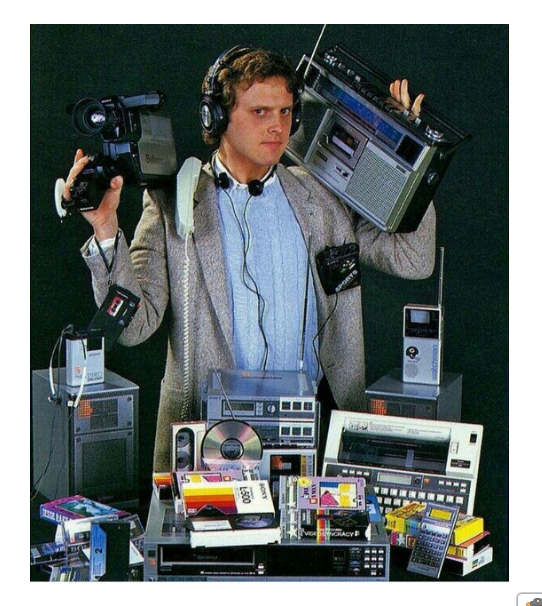
No wonder this dude is so angry; that stuff weighs a ton!
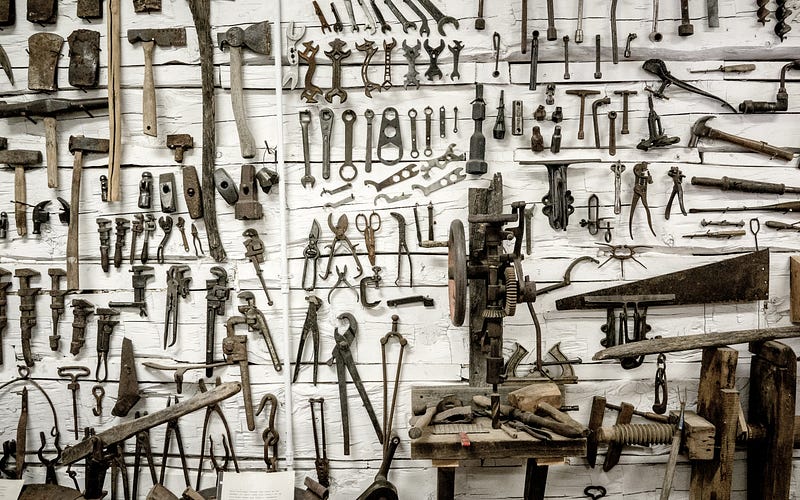
Well, would you believe that all those tools in the photo at the top of today’s column can also fit in your pocket? No? Well, neither do I. But some multitools do come pretty close.
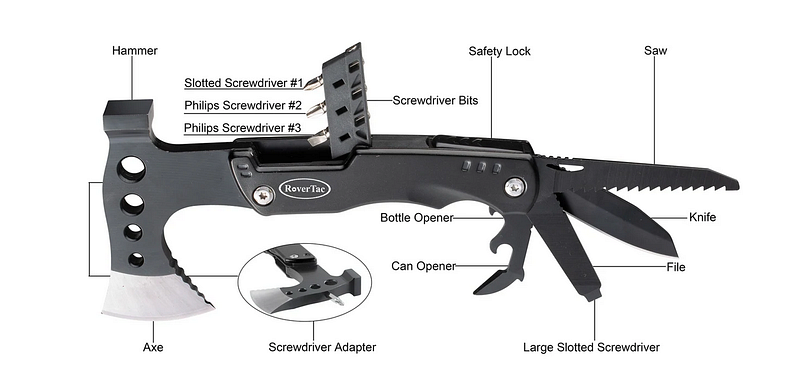
At almost seven inches in length, the above implement is great for camping, but may not be the most portable and convenient multitool for carrying around on a daily basis. There are a few other options, of course:
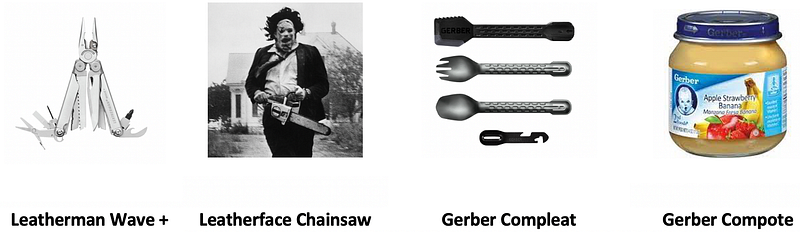
Oh, that Iva Reztok… always getting carried away with his random word associations!
Here’s a not-so-interesting factoid that will make no difference in your life: model Cindy Crawford was not the original Gerber baby (it was Ann Turner Cook). However, in 1998 Crawford married former model-turned-businessman Rande Gerber. They have two kids. Which means that, technically-speaking, at one point Cindy Crawford had a Gerber baby.
Perhaps the most famous multitools of all are the Swiss Army Knives, traditionally made by two different companies, Wenger and Victorinox. As you can clearly see, they craft very, very different products:
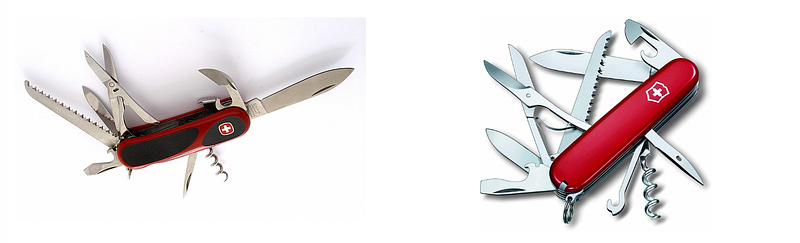
Eagle-eyed multitool connoisseurs will immediately spot the big difference: the photo on the left has a slightly darker background tint. Also, the Swiss cross is encases in a rounded square: the symbol used by Wenger. The knife one on the right, of course, was made by Victorinox.
Not that this distinction matters anymore.
Merrrrrge
Wenger was founded as Paul Boechat & Cie in 1893 in the Canton of Jura, the youngest of the 26 Swiss cantons. Since each canton provides a different function in Switzerland, one could say that the entire country is a Swiss Army knife of sorts. Very meta of the Swiss to do this in desperate attempt to sell more multitools. Don’t believe me? You can check it out at justmadethatup.com.
Boechat et al received a contract from the Swiss army to, well, make knives for them. In 1897 the company hired Theodore Wenger, who repaid the favor by renaming the company Wenger several years later. Also, he made some awesome business decision, apparently.
That was not enough for the Swiss army, however. In 1908 it decided to split its knife contract with another company, Victorinox, a company founded in 1883 by the workshop of Karl Elsener in the German-speaking canton of Schwyz. Elsenser had patented what was later dubbed as the “Original Swiss Army Knife” in 1897. But it took him another decade to convince the army to adopt his multitool as ordnance.
In 1909 Elsener’s mom died, so he did what any grieving businessman would do: rename his company “Victoria” in her honor. That was also the year in which he decided to add the Swiss coat of arms as a company logo. In 1921, Elsener was so impressed with the stainless steel his company was using that he did what any lovestruck businessman would do: he renamed his company “Victorinox”, a blend of “Victoria” and “inox”, an abbreviation for acier inoxydable, the French term for stainless steel.
Swiss Army knives became especially popular after Word War II, when the term “Swiss Army Knife” also became very popular (what an unbelievable coincidence!). According to pizzini.at, between 1945–1949 tons of Victorinox pocket knives were sold to the PX shops of the US Army, Navy, and Air Force. American soldiers had trouble pronouncing the word “Offiziersmesser” (which I think means “this word is officially very messy, don’t pronounce it”), so they what any American does when faced with such a challenge: they renamed it. The easiest choice was “Swiss Army Knife”, being that it was Swiss, the soldiers were using it in the army, and it was a knife.
Wenger and Victorinox cornered the market for decades when it came to Swiss-made multitools. However, after September 11, 2001, airport restrictions severely hampered Wenger’s sales and the company floundered. This despite the fact that they had begun selling watches more than two decades earlier.
So Victorinox did what any competing business would do: they bought the competition, namely, Wenger, in 2005. At first Wenger operated semi-independently and even came out with new products, but in 2013 Wenger and Victorinox announced that the separate knife brands were going to be merged into one. Guess what they decided to call it? Victoringer? Wenrinox?Nope. Just Victorinox.
To add insult to injury, in 2016 Victorinox had Wenger changed its slogan to “A Swiss Company Since 1893” from “Maker of the genuine Swiss Army Knife” (which was used for decades).
However, Wenger still beats Victorinox when it comes to one thing: size (not that size matters, right?). The Wenger Giant was officially awarded the distinction of “most multifunctional penknife” by the Guinness Book Of World Records in 2012.
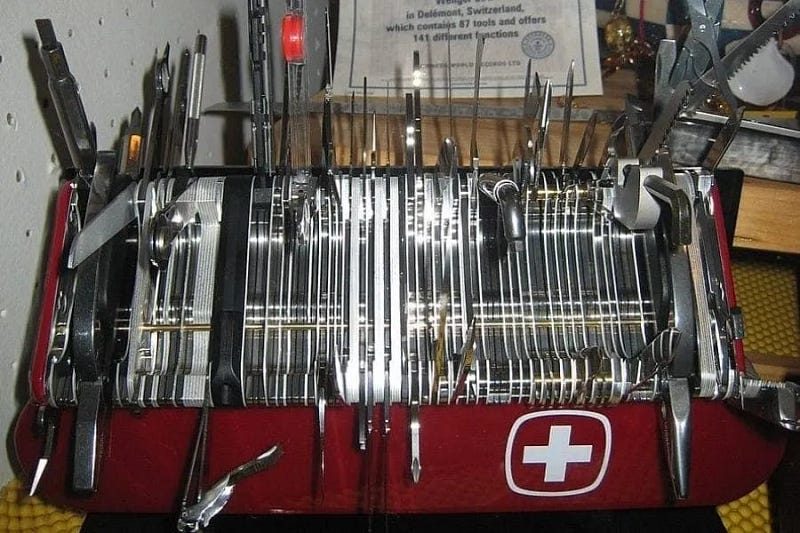
Take that, Victorinox!
Despite the rich history of multitools and their brands––such as Wenger, Victorinox, Leatherman, and Gerber––and the fact that Cindy Crawford was not the original Gerber Baby… the editors of the Spelling Bee decided that the word multitool is a dord*.
You can check out my previous entry on another dord* here:
*What the heck is a dord, you ask? Here’s the answer: