
AMERICAN GOVERNMENT AND THE DISARRAY IN THE HOUSE
Peak MAGA? Dysfunction in the House
Part Two: Jim Jordan, Mike Johnson, and the Republican Caucus
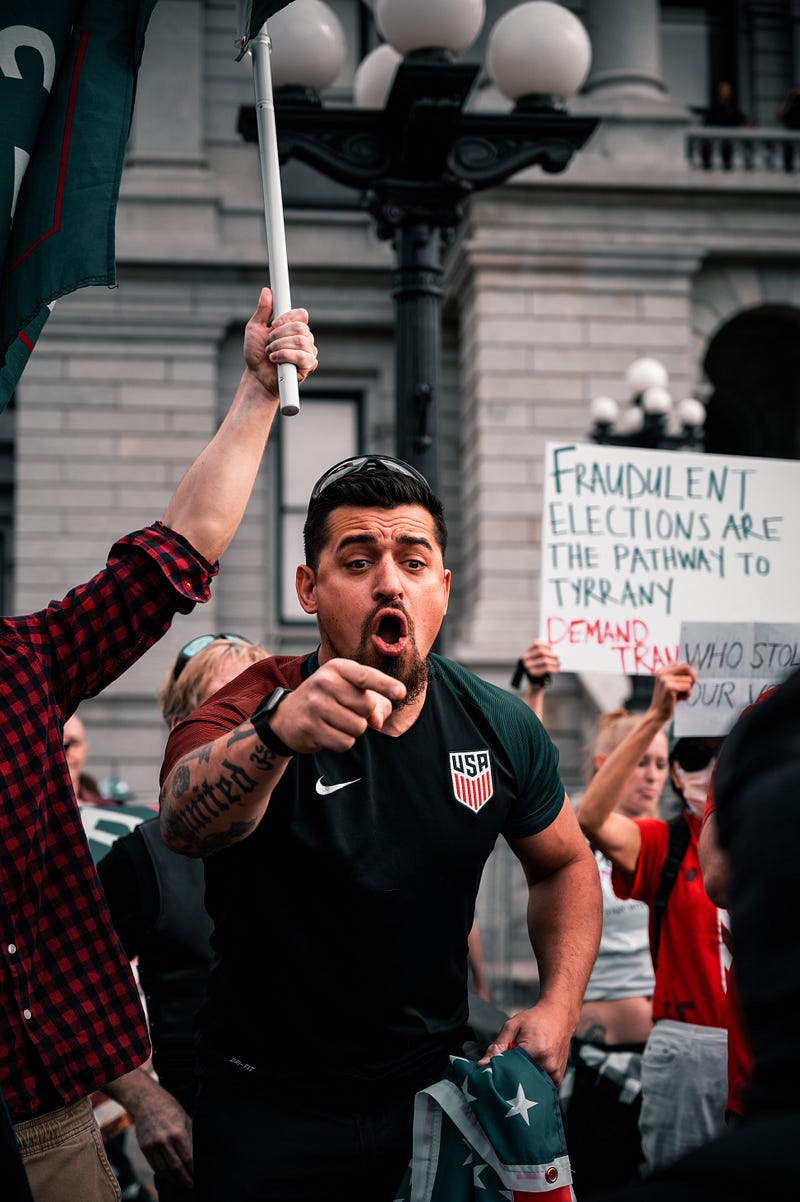
The evidence continues to accumulate that the Trump movement and the Republican Party are in failure mode. Although there will always be a place for a Conservative party in American politics, the collapse of Donald Trump and the extremist MAGA movement is so extensive that this year is likely to go down in history as the high-water mark of Trumpism, with nothing waiting in the wings to replace it. Republicans — real Republicans, not MAGAts — have been pushed too far already, and they are beginning to fight back. They are looking for a path to save their Party, rescue the institutions of government, and save American democracy. They have several options that can meet their need. Which path they will choose remains open. But Trump and the worst of the extremists have peaked. Next comes the collapse.
Note: a “high-water mark” is where things get as bad as they get. The MAGA Party is succeeding, on several dimensions, to a degree we haven’t seen since the rise of the Fascist German-American Bund movement in the United States in the years before World War II.


Father Charles Coughlin, like Tucker Carlson today, hosted one of the most popular radio programs of the late 1930s. After initially endorsing FDR, Coughlin’s radio program and newspaper denounced Roosevelt, the “big banks”, and “the Jews”.
The German-American Bund was founded in 1936. Its members were issued Nazi uniforms and attended military-style training camps. Claiming George Washington was America’s “first fascist,” the Bund’s “high-water mark” was a rally at Madison Square Garden in February 1939, where some 20,000 people attended, listening to speakers denouncing President Roosevelt as “Frank D. Rosenfeld”, calling his New Deal the “Jew Deal”, and attacking a Bolshevik-Jewish American elite. The rally ended with violence between protesters and Bund “storm-troopers”. But by the end of that year, America’s top fascist, the leader of the Bund, was investigated by the city of New York and found to be embezzling Bund funds for his use. He was arrested, his citizenship was revoked, and he was deported. When he returned after the war, he was arrested and imprisoned.
Today’s Bund, clothed in Christian Nationalism and holding influential roles in the Republican Party, has placed one of its own as third in line to the presidency. The success of these people is undeniable, and there has always been an element in America hostile to democratic government. Yet, like the Bund of the 1930s, their high-water mark is already showing signs of its eventual demise. Many of its successes have been due to the fears and short-sightedness of its opposition. Now, the danger is visible to all. MAGA extremism’s proponents are under attack within and without. Its leading spokesperson is under inditement ninety-one times, facing the loss of his paper fortune and imprisonment for life. The Republican Party has witnessed the emergence of National Conservatives (Natcoms) and Freedom Conservatives (Freecoms), each with their statement of principles, each dedicated to its opposition to the other, and both critical of Trump. In part, because Republicans fear their money will be allocated to support people with whom they disagree, the GOP’s donations have dropped so low that the party’s cash on hand is at its lowest level since February 2015.
A lot can happen between now and November 2024. Now that the MAGA movement has peaked, it will be interesting to watch how fast it can fall.
There is a place in American politics for real conservatives. They have been in disarray due to the attack of the MAGAts. But they are not gone, and as the MAGAts slide back into their holes (and prison cells), I hope they can get their act together. If they don’t, we may see a progressive overreaction as American politics swings in the opposite direction. But for these essays, I’ll focus on the collapse and the emerging divisions of the Republican Party.
The accumulating evidence is too much for a single essay. It includes (but is not limited to):
- The surrender of Sydney Powell
- The failures of Jim Jordan, Mike Johnson, and the Republican Caucus
- The collapse of the Trump business empire
- The muzzling of Donald Trump
- The revolt of the institutionalists in the Republican Party
- The prosecution of the January 6th insurrectionists
- The imminent imprisonment of Donald Trump
- The lack of a viable alternative to lead the Trump Cult
- The emerging blocs contending in the conservative movement
To make the narrative easier to follow, I will focus on each of these in separate essays. In part two, I focus on the failure of Jim Jordan and the Republican caucus to fill the chair of the Speaker of the House of Representatives before settling on the election of the relatively unknown Mike Johnson.
Why do we need a Speaker of the House?
On a structural level, the problem is appropriations and accounting. Under the Antideficiency Act (passed in 1884 and amended in 1950), federal agencies cannot spend or obligate the expenditure of any money without the approval of an appropriations bill (or similar act) from both Houses of Congress. If Congress fails to enact the required twelve annual appropriation bills, federal agencies must cease all non-essential functions until that happens. If Congress enacts some but not all of the twelve appropriations bills, the agencies without appropriations shut down.
Appropriations bills begin in the House of Representatives.
The Speaker of the House has always been one of the most powerful positions in the American government. Under the US Constitution, he serves as third in line of succession if the President and Vice President can’t perform their duties. He approves committee assignments. He determines which bills come to the floor for debate or a vote. Whether Sam Rayburn, “Tip” O’Neill, Newt Gingrich, Dennis Hastert, or Nancy Pelosi, for decades, the word of the Speaker was law. For a member of the House to cross, the Speaker was political suicide.
These institutional powers have led House members to slowly chip away at the Speaker’s authority. A skilled and talented Speaker, like Nancy Pelosi, could accomplish her goals even as the formal rules reduced her statutory power. Hard work, personal reputation, and attention to detail made Pelosi one of the most successful Speakers in recent history. The current House minority leader, Representative Hakeem Jeffries of New York, was elected by acclimation by his caucus. His skill in keeping his party united in the recent vote to remove McCarthy, and the following Republican circus shows that he also has the talent to work within the rules and be a successful Speaker.
But some Republicans have come to see the Speaker of the House not as the leader of the House or even the leader of their caucus but as their servant. Some even have suggested that filling the role of Speaker is no longer necessary, a position contrary to the Constitution and common sense.
What is the problem?
On the more immediate level, this is a problem of political posturing and a failure to command. The Republican Party in the House is cursed with a faction that is less interested in the job of governing than they are in appealing to their most angry, MAGA-oriented voters and contributors. The work of governing is less important to them than their Political Action Committees, auditioning for jobs as commentators on Fox News and submitting bills with no chance of passage as a kind of “virtue signaling” to their most demented constituents.
Other Republicans admit this. During the circus of a transition to a new Speaker, House Foreign Affairs Committee Chairman Michael McCaul (R-Tex.) said that what Republicans were doing was not just embarrassing but also “so dangerous.”
The world’s on fire. This is so dangerous, what we’re doing. And most importantly, it’s embarrassing because it empowers and emboldens our adversaries like [Chinese President] Chairman Xi [Jinping] who says, you know, democracy doesn’t work. — Michael McFaul (2023)
Representative Don Bacon (R-Neb.) said “We’re not a governing body.” Rep. Nicole Malliotakis (R-N.Y.) described the Speakership struggle as “a bad episode of ‘Veep,’ and it’s turning into ‘House of Cards.’” “It is an embarrassment,” added Rep. Carlos A. Gimenez (R-Fla.). When Jake Tapper of CNN compared the GOP infighting to high school, Rep. Steve Womack (R-Ark.) said that gave his party too much credit.
That’s kind of offensive to high school people, because it’s really junior high stuff. I mean, look, we get wrapped around the axle on a lot of nonsensical things. But, yes, the world is burning around us. We’re fiddling. We don’t have a strategy. — Steve Womack (2023)
While many of these critics come from the institutionalist wing of the GOP, the most colorful description came from a Republican on the other side. It was from Rep. Eli Crane (R-Ariz.), one of eight Republicans who voted to oust McCarthy.
I don’t think a lot of people here in this conference actually give a shit what the American people want. — Eli Crane (2023)
The crazies are, at minimum, an influential and committed minority in the Republican caucus. Kevin McCarthy was a very ambitious man. To gain the gavel he made a deal with the worst of his caucus that was unsustainable.
When Joe Biden won the 2020 U.S. presidential election, McCarthy supported Donald Trump’s debunked claims of voter fraud and participated in efforts to overturn the results. After the U.S. Capitol was stormed during the electoral vote count, in a fit of sanity, McCarthy reversed his previous comments on voter fraud and blamed Trump for the riot. Then, in a typical case of self-serving pragmatism, in 2022, he reversed again and publicly reconciled with Trump.
The goal of McCarthy’s political life had always been to be the Speaker of the House while his party dominated that chamber. To do this, he required a majority vote of his caucus after the Republicans came into the majority of the House in the midterm election of 2022. Despite the expectations of a “red wave” to sweep the House and Senate in 2022, Democrats continued to hold the Senate, and Republicans held a bare majority in the House (222 seats won, compared to the 218 required for a majority). This meant McCarthy needed 112 Republican votes from his caucus to run for the job, and therefore, a small minority could hold up his confirmation. And this meant he needed the support of the rigidly-disciplined forty-five members of the House “Freedom Caucus”, led by Scott Perry (who is among those who petitioned Donald Trump for a pardon after the violence of January 6th, a tacit admission of guilt in helping to set it up).
The Freedom Caucus began in January 2015 as a group of very conservative Republicans who declared that their criterion for new members in the group would be opposition to John Boehner as Speaker of the House and willingness to vote against or thwart him on legislation that the group opposed. Boehmer had already sparred with those House Republicans in 2013 over their willingness to shut down the government in pursuit of goals such as repealing the Affordable Care Act. This caucus, once it was formalized, was central to the resignation of Boehner in September 2015 and the ensuing leadership battle for the new speaker.
After Boehner resigned as speaker, Kevin McCarthy, the House majority leader, was initially the lead contender to succeed him, but the Freedom Caucus withheld its support. McCarthy, as is typical for him, withdrew from the race. In October Paul Ryan announced that his bid for the Speaker was contingent on an official endorsement by the Freedom Caucus. While the group could not reach the 80% approval needed to give an official endorsement, on October 21, 2015, it announced that the Freedom Caucus had reached a supermajority support for Ryan, who then succeeded Boehner as Speaker.
Boehmer, a conservative Republican himself, is probably best placed to describe the goals of the Freedom Caucus:
They can’t tell you what they’re for. They can tell you everything they’re against. They’re anarchists. They want total chaos. Tear it all down and start over. That’s where their mindset is. — John Boehmer (2017)
Another senior Republican has described the Freedom Caucus as “lemmings with suicide vests”. They, like Donald Trump, have no practical plan to govern. They are nihilists. They are authoritarian. They are not interested in governing. This was true even before the rise of Trump. Now, they have become cultists in the cult of Trump.
Jordan's failure
No member of the House Freedom Caucus had ever come close to winning the Speakership. Jim Jordan’s bid was the first attempt. It came too close for comfort, but it failed. His failure revealed that the MAGA faction of Congressional Republicans is more broadly acceptable to the mainstream than had been believed.
Jim Jordan never managed to pass one bill through Congress in sixteen years. Not one. He hasn’t managed to name a post office. He built his reputation as a noisy obstructionist. As one columnist observed during his run for Speaker, “He’s supposed to shepherd legislation? I’m not sure he’s ever read any.” On the first vote for Speaker, twenty Republicans voted against him. Jordan and the fanatics then went into a full-court press. Rep. Thomas Massie, a Jordan ally, said that the holdouts would be put through a “meat grinder” of pressure and cave by the end of the week. It devolved into death threats against Republicans who opposed Jordan. One member’s wife slept with a loaded gun by her side out of fear for her life. Another Republican, whose family began receiving death threats, announced he would never support “a bully” and the threats were “unacceptable, unforgivable, and will never be tolerated.” Jim Jordan was a step too far, even for conservative Republicans.
The first nominee approved by the Republican caucus had been Steve Scalese, a senior member of the leadership and friend of Speaker McCarthy. Scalise defeated Mr. Jordan in the secret ballot Republican House conference vote, 113–99. But note that result gave Mr. Jordan almost 45 percent of the conference.
- After Mr. Scalise withdrew, Mr. Jordan won 124 votes in the Republican House conference vote against Austin Scott, enough to earn his party’s nomination for speaker. That’s about 55 percent of Republicans.
- In another secret ballot test, 152 members indicated they would vote for Mr. Jordan for speaker on the floor, while 55 said they would vote against him. That’s about 70 percent of Republicans.
- In the public vote on the House floor, Mr. Jordan won 200 votes on the first ballot for speaker. That’s about 90 percent of Republicans, though his support declined in subsequent votes.
- Finally, Mr. Jordan received just 86 votes in a secret ballot test of whether he should remain the party’s candidate for Speaker. Sliding among his peers, Jordan brought an end to his bid. That’s less than 40 percent of House Republicans.
None of these votes offer a perfect measure of House Republicans. Alone, each is an incomplete account, shaped by different questions posed to Republican members under varying circumstances and even different rules. But together, they offer a picture of how Republicans responded to the Jordan candidacy.
The votes suggest that nearly half of congressional Republicans are sympathetic to Mr. Jordan and the ultra-conservative right-wing, putting anti-establishment outsiders within striking distance of becoming the predominant faction in the House Republican conference. It suggested that the party’s extreme right-wing could, under circumstances not too different from those at that time, make a serious bid for House leadership — and win.
They also show how far the Republican Party had shifted from the political center. One political scientist has described the GOP as approaching “here there be dragons” land. As Professor Lee Drutman has observed,
Here’s what’s distinct about this moment, based on the best metrics we have.
1. Congress is more polarized than ever.
2. The Republican Party is more far-right than ever.
3. The share of House districts that are truly competitive is tinier than ever (less than 10 percent).
4. The share of House districts splitting their tickets hit a 100-year low in 2020 (fewer than 4 percent).
5. Partisan margins in the House are uniquely narrow.
6. The dimensionality of voting in the House has collapsed into a single dimension.
7. The Republican Party is growing more internally divided.
To close observers of politics, none of these findings may be that surprising. But I hope by seeing them all together, we can appreciate how unusual this moment is — and just how far we’ve sailed away from the “normal” patterns.
My simple takeaway is: We’re not going back. — Lee Drutman (2023)
When McCarthy fell, Rep. Marjorie Taylor Greene had endorsed bringing in Trump to do the job. The presidential candidate shot that down while endorsing Mr. Jordon. The next serious candidate, Majority Whip Tom Emmer, was attacked by Trump and fell by the wayside.
Other candidates emerged. One was GOP Conference Vice Chair Mike Johnson, an attorney and former talk show host. Serving his fourth term and on the House Judiciary Committee, he had supported Jordan’s speakership bid. Now Johnson sent a letter to his colleagues:
We all agree the urgency of this hour demands a specific plan and bold, decisive action. It also demands a leader who will humble himself each day before Almighty God, selflessly serve the full membership of this body, and fight ceaselessly for our core conservative principles and policies. — Mike Johnson (2023)
Mike Johnson was not a member of the Freedom Caucus. However, he was an ally. He went out of his way to court their support, and after meeting its members, they pronounced him “excellent”, “a true conservative”, and “a breath of fresh air”.
The Freedom Caucus needed a fanatic without the optics of a Jim Jordan, a “who?” to slide unnoticed, unvetted, as a compromise candidate. Jordan, backed by Trump, was too extreme. Mike Johnson met their need.


Besides, they still had the deal McCarthy had agreed to to win the Speakership. The next Speaker would be just as vulnerable as the last one.
How did Johnson win?
For simplicity, let’s use the votes surrounding Jim Jordon before his withdrawal to break House Republicans into four groups.
- The extremist right (40 percent): Until his failure was assured, around 40 percent of Republicans in the House backed Mr. Jordan at every point. They backed him against a mainstream conservative leader like Mr. Scalise, and they supported him even after his bid on the floor was clearly doomed. That makes the committed ultra-right-wing nearly half of the GOP in the House. He won the support of these Republicans time and again, even in secret ballot tests and even after his bid was stymied on the House floor. In all likelihood, this was earnest support for someone once derided as a “legislative terrorist” by Speaker John Boehner.
- The Jordan-accepting rank and file (~ 25%): Jordan won additional support from a group of conservative members who preferred Mr. Scalise but ultimately gave Jordan a chance to lead the House. This group backed Mr. Jordan in a secret ballot vote, so it’s reasonable to suppose that their backing was genuine, even if he wasn’t their first choice. These rank-and-file conservatives are not as flashy as the Freedom Caucus, but they hold the balance of power in the House Republican conference. And while they may not necessarily always like anti-establishment insurgents — they preferred Mr. Scalise, after all — their acceptance of ultraconservative tactics in the Trump era, including voting against certifying the 2020 election, has been decisive in defining the character of the congressional Republican caucus as a whole.
- The Jordan-acquiescent rank and file (~ 25%): Unlike the rank-and-file members who willingly accepted Mr. Jordan after the downfall of Mr. Scalise, these Republicans struggled to come around to the idea of it. They didn’t want him. Many said on the floor that they wouldn’t vote for him. But in the end, they did it anyway. Many did so out of a desire to help unify the party. Others might have acquiesced out of fear of Mr. Trump or conservative activists who “browbeat” spineless Republicans by mobilizing conservative media and activists to demand that they fall in line. Many more moderates joined the “acquiescent rank and file” than joined the dissenters. Most moderates did vote for Mr. Jordan as Speaker. So did most members of the Problem Solvers caucus. A majority of Republicans from competitive districts also voted for Mr. Jordan. Even the two Republicans who voted to impeach Mr. Trump after Jan. 6 but managed to survive election challenges voted for Mr. Jordan.
- The Jordan dissenters (~ 10%): Some were so repulsed by the optics of Jim Jordon in the Speaker’s chair that they resisted all pressure. To the end of the process, 20 to 25 Republicans opposed Mr. Jordan on the floor of the House — in public. As a result of these public votes, this is the group we understand the best. But it’s a complicated group. On average, they’re among the least conservative Republicans, around the 10th percentile among House Republicans as rated by DW-NOMINATE — a measure of member ideology based on voting behavior. They also tended to be from competitive districts, with the typical dissenter hailing from a district that Mr. Trump won by about seven points, compared with about 25 points for non-dissenters. Yet a quarter of the dissenters had already endorsed Trump for president in 2024. A similar number of dissenters voted against certifying the 2020 election result while still opposing Mr. Jordan. None of the Jordan opposition voted to impeach Mr. Trump after Jan. 6. This is not a group of Never Trump moderates. These are the institutionalists. They feared that giving the Speakership to a “bomb-throwing” nihilist would undermine the image of the House and the Republican Party.
Why did Johnson win when Jordon couldn’t?
Mike Johnson is, in a word, dull.
The dissenters were enough to bring Mr. Jordan down, but they were not enough to prevent the party’s most conservative faction from winning power in Congress. Remember, for many of Jordan’s die-hard opposition, their disgust was not based on ideology but on their opinion of the man.
Mike Johnson, while in some ways more extreme than Jordon, has cultivated an image far less jarring. If anything, Johnson has worked to create the image of the anti-Jim Jordan. He did not seek out opportunities to get his face before the cameras of Fox or the microphones of right-wing radio. He did not promote himself.
As the struggle wore on, the final choice was based more than anything else on the discipline of the fanatics and the exhaustion of the institutionalists. Little time was taken to vet the candidates' credentials. If they had, this is what they would have found:
- Johnson had condemned a “dark and depraved” American culture” that “almost seems irredeemable” in a prayer call the October before he rose to everyone’s attention. As evidence, he pointed to the decline of church attendance to below fifty percent, an all-time low, and a poll where a quarter of high school students identified as “something other than straight.” Johnson concluded, “We’re losing the country.” The idea that the country had grown beyond him and his prejudices never occurred to him.
- In the same conversation, Johnson said, “The only question is: Is God going to allow our nation to enter a time of judgment for our collective sins? Or is he going to give us one more chance to restore the foundations and return to him?” He added: “We need to turn to him. We need a revival.” The only hope was “supernatural intervention”.
- While he was careful to condemn the January 6th assault on the Capitol, Johnson recruited Republicans to overturn the 2020 election and was a key architect of the legal challenge. Over sixty Republican Representatives signed a letter to support the initiative after Johnson told them it had the blessing of Mr. Trump and he was “anxiously awaiting” to see who would defend him.
- For decades, Johnson had condemned same-sex relationships and marriage. “Experts project that homosexual marriage is the dark harbinger of chaos and sexual anarchy that could doom even the strongest republic,” he wrote in a local newspaper in 2004.
- His views on abortion and other social issues have been described by some of his fellow Republicans as frozen where the GOP was in the 1990s and where the country was in the 1950s.
- His wife, a licensed pastoral counselor, has made similar remarks about L.G.B.T.Q youth on a religious and political podcast the couple co-hosted until the month before Johnson rose to the Speakership. When pressed on the issue by Sean Hannity, Johnson has tried to distance himself from his comments without repudiating them.
- An evangelical Christian, Johnson has argued that “teachers, professors, administrators, and left-wing media” were waging an effort to force gender transitions among young people. He has a 100 percent approval rating from both Louisiana and National Right-to-Life organizations.
- Johnson’s finances are so hidden that they may be in violation of Federal law. He has reported no assets, no securities, no trades, no qualifying bank accounts.
- Johnson played a leading role in Trump’s efforts to overturn the 2020 election, helping to push a lawsuit to overturn the results in four key states and offering legal arguments for members of Congress to invalidate the results.
- Johnson claims Congress has a “moral and constitutional duty” to balance the budget, lower federal spending, and enact permanent tax reductions. While he was willing to suspend the debt ceiling as negotiated by Speaker McCarthy and President Biden, he voted against the stopgap spending bill McCarthy passed with Democratic support to prevent a government shutdown.
- Johnson has called climate science into question and consistently voted against climate change and clean energy legislation. Last year, oil and gas companies provided Mr. Johnson with more contributions than from any other industry.
- With a 92 percent rating from the NRA, Johnson has co-sponsored legislation to allow concealed carry permits to operate in other states, as well as to permit firearms sales across state lines.
- The only area where Johnson rates more than a fraction on civil rights is regarding religious liberties — and then, only for Christians. On questions of religious liberty, Johnson, the attorney, always worked on the side of Christians. When any other religion (or group) was involved, Johnson sided with the government.
- Johnson’s rise in Louisiana politics grew from his work in the anti-abortion movement. It was his work against a Louisiana abortion clinic that thrust Johnson into the limelight and, from there, into the House.
- Johnson is a Christian Nationalist, like many “Flag and Faith Conservatives,” the core element of Donald Trump supporters. Flag and faith conservatives see the political contest in the United States as a battle between good and evil. They will tolerate any crime by their leaders but one — compromise with the “Satanic” opposition (Democrats, socialists, gays, academics, “experts”, women who desire autonomy over their own body, people who support civil rights for everyone — not just white male Christians). These are the people the Trumpists are “virtue signaling” towards by advocating policies that have no chance of majority support. Johnson is not that inflexible, but he speaks their language.
- Johnson is a committed warrior in the culture wars. From defending mandatory prayer in school to making abortion increasingly difficult to find, he has fought a long war of attrition against the modern world. He believes the culture war is a war of attrition, and he expects to win.
Mike Johnson meets reality.
In true Freedom Caucus style, Johnson began by passing bills that had no chance of passing the Senate: linking emergency aid to Israel with cuts to the IRS, refusing to fund aid to Ukraine, ignoring Biden’s proposals for humanitarian assistance, linking necessary spending to extreme proposals for border enforcement.
But when the question became whether or not to keep the government functioning, Johnson’s rhetoric gave way before the fact that he was not willing to close the American government and that his partners in the budget process were a Democratic President and a Democrat-led Senate. Johnson’s proposal, passed during his “honeymoon phase” in the House, was a two-tier bill keeping four Federal agencies open through mid-January while the others would operate through the beginning of February. It wasn’t a real solution to the funding problem, but the Continuing Resolution (CR) funded the government at current levels and was “devoid of harmful cuts and free of extreme right-wing policy riders.” It was passed by gaining enough votes among the Democrats to overcome opposition in the Republican caucus — the same ploy that cost Kevin McCarthy his job.
Perhaps it goes without saying that the House Freedom Caucus hates it. In a statement after it passed, the Freedom Caucus wrote it “contains no spending reductions, no border security, and not a single meaningful win for the American people.” Johnson replied that the compromise was necessary to keep the troops paid.
I want to cut spending right now, and I would like to put policy riders on this. But when you have a three vote majority, as we do right now, we don’t have the votes to be able to advance that. What we need to do is avoid a government shutdown. Why? Because that would unduly harm the American people. — Mike Johnson (2023)
Johnson is still on the bubble, but for the moment, the Freedom Caucus is willing to let things slide. Whether that will remain true in February remains to be seen. Anger is rising in Congress.
And now that Representative George Santos has been ejected from the House, his seat remains empty until a special election in March that will likely return the district from Blue to Red. The Republican majority has grown smaller. The Freedom Caucus is losing its patience. And by their admission, these people prefer chaos to compromise. Larry Sabato, political scientist and expert on American national politics, has described his take on current events:
I’ve long thought that a party’s drift to the ideological extreme would inevitably be stopped and reversed to a certain degree by big defeats that force party voters to come to terms with pragmatic reality. These days, I’m starting to believe that Republicans moving headlong to the right may just give in to the inertia of motion and continue their lunge toward extremism until they can no longer win an overall majority. I’m not convinced of this yet, but the G.O.P. has put the idea on the table. — Larry Sabato (2023)
Conclusion
The experience of the MAGAt-led House of Representatives suggests that these are people unwilling (or unable) to live in the modern world. Rather than face the complexities of the third decade of the twenty-first century and the inevitable challenges to come, they have chosen to cling to ignorance, act selfishly, and take instructions from a mistranslated guidebook rooted in the bronze age. They’re losers, and that fact is becoming increasingly obvious to all who care to live together in a civil society. Unless the “revival” they refer to allows them to live in the modern world, they have no hope of playing a role in it.