
Participating in Forest Good Governance
17/01/2019 Hanoi, Vietnam
“Today is an opportunity to give transparency and fairness on the topic of forest monitoring in Vietnam.”
This was the goal of the 2nd Forest Governance Monitoring Forum, as introduced by M. Pham Van Tan representative of the Vietnam Union of Science and Technology Associations (VUSTA).
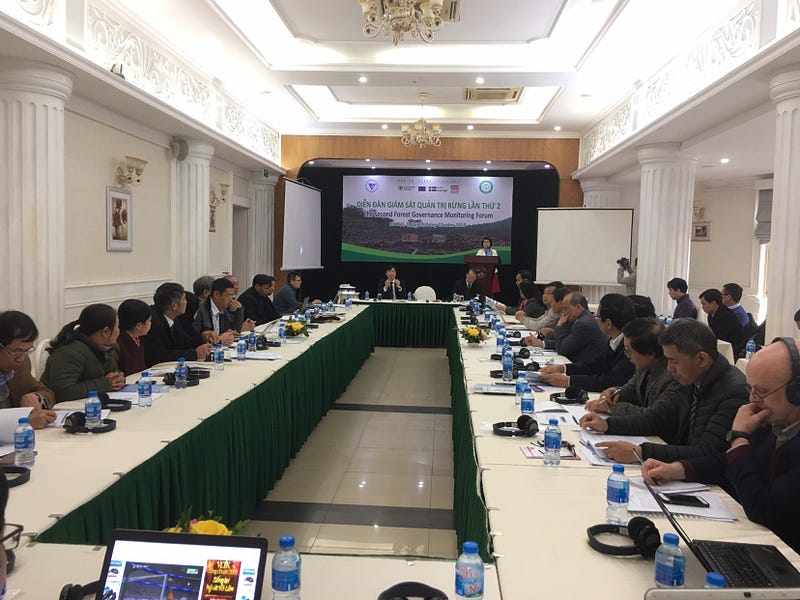
Vietnam is currently preparing the implementation of the Voluntary Partnership Agreement (VPA) signed with the European Union (EU) last October in Belgium. This agreement ensures the legality of the timber placed on the European market and aims at reducing illegal logging to conserve the tropical forest.
The VPA is a 300-page policy text which took over eight years to write. Now that Vietnam and the EU agreed on the VPA content, Vietnam must implement its promises. This means that the VPA must be institutionalized and integrated in the Vietnamese forestry law. Vietnam is relatively free to implement the VPA as they wish. Still, the country must follow some guidelines drawn by the EU.
During her speech, Ms Nguyen Tuong Van from the Vietnam administration of forestry highlighted some important point of the VPA. She emphasized on the commitment made by Vietnam to create an independent monitoring system assessing the VPA social, economic and environmental effects. In the VPA, Vietnam also committed to bring the voices of various stakeholders, like NGOs, forestry association, businesses and local communities to design an independent monitoring system.
This system should ensure that the VPA benefits the Vietnamese forest industry and contributes to the conservation of the forest.
Ms Nguyen Tuong Van pointed at the importance for monitors to be independent from any government agencies or private businesses. In addition, independent monitors must follow a common guideline and framework to evaluate businesses. They must visit various sites along the supply chain, get information and report it to decision makers. Independent monitors have a big power because they can access key databases of the government and report a business’ bad practices.
Independent monitors are a keystone player in the monitoring system. Any stakeholder of the forestry sector such as NGOs, businesses, forest communities, can provide them feedback or send them complaints about forest bad management. If an enterprise is not respecting the VPA, it can be denounced and receive sanctions. Of course, sources of information and denouncement are protected and stay anonymous.
After her speech, several questions were raised by the audience. On the one hand, there was a misunderstanding about who were the stakeholders and their role in monitoring the VPA. On the other, there was a worry about the short time available (5 years) to write a legal common monitoring framework including all the views of stakeholders.
Ms Nguyen Tuong Van answered by highlighting the long period necessary to write the VPA with the proper wording both in Vietnamese and English. For example, the word “civil society” could not be included in the Vietnamese version of the VPA. Stakeholder is also a difficult word to translate from English to Vietnamese. In the VPA, stakeholders are defined as all actors of the forest sector like environmental NGOs, government agencies, private timber companies, forest communities, etc.
For the implementation of the VPA, consultation workshops will be organized to exchange with different stakeholders. Every comment will be considered to ensure a wide participation in the transcription of the VPA in the Vietnamese law. Certain categories of stakeholders will be prioritized because it is not possible to train everybody in the first years.
Before leaving the floor, Ms Nguyen Tuong Van called for the cooperation and assistance of all stakeholders in the room reminding them that they put themselves in high pressure and that time was flying away. They still had to write many circulars and decrees during this year. Therefore, every partner should stand side by side to push the VPA forward.
The monitoring of the VPA must starts with a baseline assessment of the timber sector. The baseline monitoring included surveys of the timber industry to know its state and later measure the effects of the VPA on the sector. Two speakers presented their research at the meeting, M. Nguyen Thanh Hien from Sustainable Rural Development (SRD) who conducted a baseline assessment on plantation households and small timber enterprises, and M. Truong Quang Hoang who surveyed micro, small and medium timber enterprises.
M. Nguyen Thanh Hien carried the research on three social economic areas: livelihood, ease of business, and market opportunity. He started his research by selecting 4 districts with each belonging to one different Vietnamese province (i.e., Phu Tho, Nghe An, Quang Nam and Binh Dinh).
He found that the area of production per household in these provinces was relatively small, inferior to 1 ha in 3 provinces and larger than 2 ha only in Nghe An. The forest timber reserve in these provinces was about 65 m3/ha. Most households had large diameter timber; for example, in Phu Tho and Quang Nam almost 100% of the household had large diameter timber. In the four provinces, about 30% of household income was derived from the forest.
The study also showed that female employees often worked on a shorter term than men and had a lower income. However, these differences were explained by a difference in role in the company. For a same job, they would have a similar income.
Concerning the regulation on forest exploitation, the survey gave heterogenous results with 80% of producers in Quang Nam complying but none in Nghe An. Regulation on origin of timber and taxes were more often respected with about 80% of producers across the four provinces fully complying. Insurance and labor regulations were less respected with only 30% of enterprises complying.
M. Nguyen Thanh Hien explained that business owners were afraid to meet the government authority to carry out administrative duties and comply with regulations. He also highlighted that many workers were not willing to sign a contract and benefit from insurance because of taxes.
40% of household well-knew the traders to whom they sell their timber production, and less than 30% well-knew the destination of their timber. Timber enterprises had an average of five customers, and few exported abroad by themselves (less than 30%).
At the end of his speech, M. Nguyen Thanh Hien warned than some regulations seemed to focus more on paper control than implementation control.
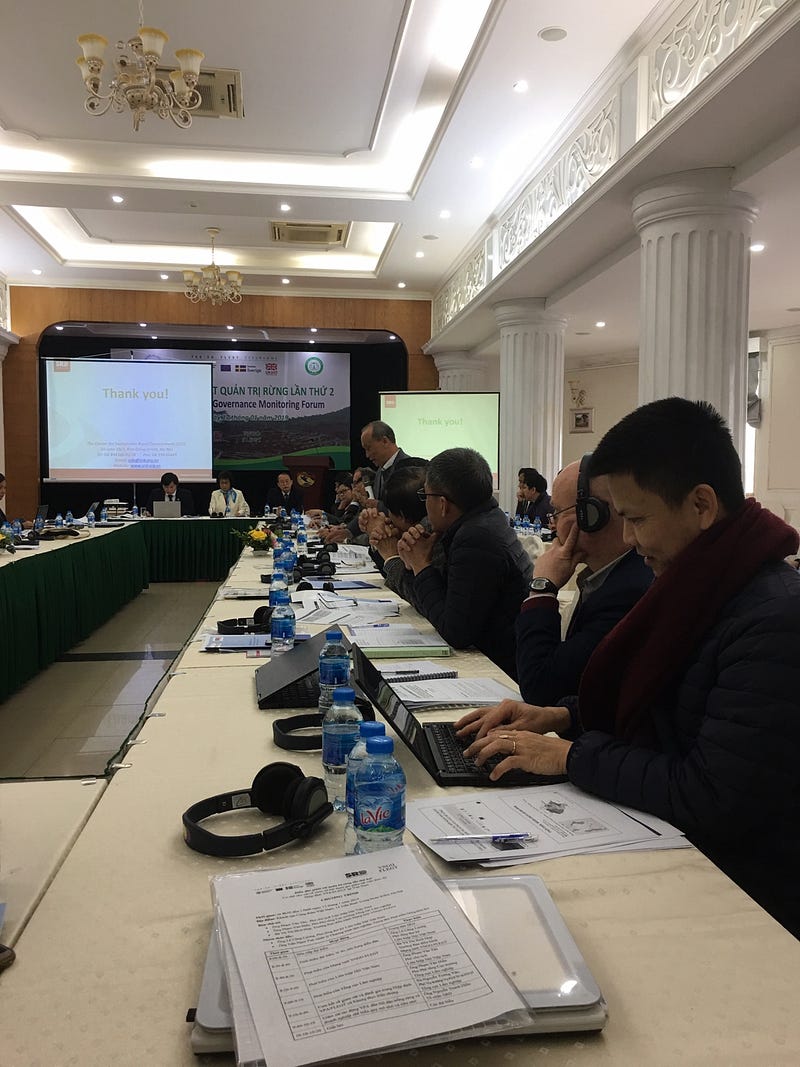
M. Truong Quang Hoang presented his research on timber businesses in the provinces of Dong Nai and Quang Tri. His team surveyed 90 enterprises from these two provinces with the goal to know whether timber enterprises will be able to comply with the VPA after its implementation.
66% of the surveyed enterprises were small and 28% were micro enterprises, the remaining 5% were medium size enterprises. Two third of the surveyed enterprises imported their timber from various countries like South Africa, Ghana, USA and New Zealand. The other third got its timber from domestic plantations.
The traceability requirement for the domestic plantation like inventory of forest products and asset sale contract had a very low level of compliance among surveyed enterprises. Concerning the transport and circulation of domestic wood, most enterprises met legal requirements. 67% of the surveyed enterprises maintained timber traceability records, however, only 12% kept track of timber circulation, sale and export. 26% of the enterprises kept a complete record of their business activities.
Concerning establishment and operation regulation, 78% complied with establishment regulations, 67% complied with environmental regulations, 38% complied with regulation on fire safety design and 99% maintained log books to document forest products flow. All enterprises complied with tax regulation, 61% complied with labor employment regulation, and 65% with insurance regulation.
Half of the enterprises had never participated in an event or activity related to forest regulation and timber legality, and only 29% had heard about the Vietnamese timber legality system.
As the implementation of the VPA goes on, businesses will have more regulations to comply with. The researcher concluded that training and outreach must be organize for households and small enterprises to update their paperwork and comply with the VPA. A special attention should be put on isolated households who might miss the information and have no idea how to comply with VPA regulations.
The last speaker was Ms Josil Murray, International Forestry Consultant for the Food and Agriculture Organization of the United Nations. During her speech, Ms. Murray reviewed the different timber legality system developed in the countries which already have signed a VPA. She stressed that every country have different governance level and capacity and therefore each country must design its own legality system.
In Indonesia, for example, the timber legality system called SVLK (Sistem Verificasi Legalitas Kayu) includes clear standard for forest management and timber processing. Independent auditors visit timber producing or processing companies, write an audit report, and reward a certificate to companies complying with regulations. The certificate allows timber companies to export timber products labelled with a FLEGT license and thereby access the high value European market.
In Indonesia, civil society can report any regulation transgression to licensing bodies which will sanction the company. Today, Indonesia has 5 regional monitor networks and 150 independent monitors evaluating the timber legality of various enterprises.
The Indonesian government acknowledged this independent monitoring system as a key part of the Indonesian timber legality system. Independent monitors have access to relevant information and location to investigate, moreover they are guaranteed protection and funding.
Indonesia was the first country to deliver FLEGT license in 2016. Today, it is still the only country able to export timber with a FLEGT license. For this reason, it is a model for many tropical countries wishing to export to Europe.
The Indonesian SVLK appears to be efficient, still Ms Murray pointed at the last position paper released by the Indonesian forest independent monitoring network. This paper recommended the Indonesian government to increase its transparency and disclose more information which is too often bound to ministries and agencies. In addition, information on non-compliance report should be made publicly available and widely accessible. The network also called for a stronger law enforcement, implementation of sanctions and revision of the current licensing regulations.
In African countries, independent monitoring system is either explicitly written in the legality timber system or recognized as playing a role but not included in the VPA text. For example, civil society organizations in Ghana decided to stay outside the VPA and not work under a formal agreement with the government to have more independence in creating their own monitoring framework.
In Cameroon, the VPA states that civil society is a potential source of observation for independent monitors, but it is not compulsory in the timber legality system. Cameroon has developed detailed methods about information gathering, training, information verification, communication, lobbying, coordinating etc. Each method is certified by the International Standardization Organization (ISO) which increases the reliability of the system to the international community.
There are many lessons to be learnt from the implementation of VPA abroad. First, it is key to have a common sound methodology instead of having different NGOs developing their own method. Second, engaging with local communities can facilitate the work of independent monitors as communities can anonymously report infraction on social media or text messages for monitors to validate it and report it to decision-makers. Third, independent monitors must find a sustainable source of funding to reduce their reliance on international donors.
The conclusion of these talks is the diversity of objectives and methods to monitor VPA implementation in Vietnam. On the one hand, monitoring can be focused on impacts, and on the other, it can focus on compliance. In the next years, Vietnam will have to organize its resources and define the goals of their monitoring system.
The open discussion following the talks stressed the importance to standardize the monitoring methods for assessment otherwise future evaluation of the VPA will fail. SRD has recently developed a VPA monitoring guidebook to standardize future evaluation in Vietnam. During the discussion, various actors proposed some improvement like creating a set of indicators to evaluate efficiency and clarifying the guidelines for each monitoring tool and indicator.
Ms Nguyen Tuong Van shared her worry about the cost of certifying timber enterprises. Since the government promised to make the certificate free of charge, it will have to sponsor timber enterprises itself.
A representative of a timber association from Dong Nai province warned the panel that some timber enterprises in his province chose to downsize and become household businesses to avoid VPA regulation and administrative burden.
In the afternoon, other speakers presented past projects related with forest governance and timber legality.
First, M. Tran Ngoc Tue reminded the assembly about the leading role of SRD as the coordinator of the network of Vietnamese organization working on the timber legality system (VNGO-FLEGT). He also emphasized on the partnership between SRD and VUSTA to improve the forestry sector and reduce carbon emission to mitigate climate change. The Forest Governance Market and Climate project funded by international donors like DFID and Fern can improve the benefit we get from the forest and reduce illegal deforestation. It aims at promoting regulation and increasing the participation of civil society especially for monitoring the VPA.
M. Lan from PanNature spoke about the success and challenges of a past project: Voices for Mekong Forest (V4MF) which goal was to empower non-state actors and improve forest governance in the Mekong region. More precisely, the objectives of the project were to develop a participatory monitoring system of forest governance outside the state, promote sharing of information and experience among Mekong countries, and build capacity for non-state actors to participate and improve the quality of forest governance. The project has been successful so far, and PanNature will continue to improve the skills of non-state partners to improve forest governance monitoring. Nonetheless, work still must be done in creating and selecting relevant indicators to evaluate forest governance.
For example, rangers monitoring forest cover on the field got training to work with a smartphone application and use forest data in their report, however this application is still unable to connect to the large national forestry database (FORMIS).
There is still room for improvement especially in detecting deforestation and tracing timber from the forest to the furniture store. Spotting deforestation event is not easy and people in Vietnam are trying to do it using satellite imagery in a project called Terra-I. M. Tran Ngoc Tue is still looking for funding to implement this remote sensing project in central-north Vietnamese provinces. Tim Dawson from the European Forest Institute commented on the difficulty to trace a log of timber. Even though barcode or QR code can be printed on the log, they are often degraded during transportation.
M. Truong Quang Hoang from the centre for rural development in central Vietnam (CRD) shortly presented CRD’s plan. On the one hand CRD will continue to build technical skills of small enterprises and civil society. On the other, CRD will create event to engage civil society in monitoring the timber legality system. As stated by M. Truong Quang Hoang, there are many challenges ahead and still a lot to be achieved.
Take Home Message
The Forest Governance Monitoring Forum is a good initiative, creating opportunities for stakeholders to exchange, discuss, share experiences and seek cooperation opportunities.
The implementation of an independent monitoring system including all forest sector stakeholders is necessary to respect the agreement; however, to avoid wasteful duplication and repetition, a comprehensive VPA monitoring and evaluation framework should be developed.
The VPA monitoring and evaluation framework will be developed in 2019 with the participation and consultation of various stakeholders, especially the VNGO-FLEGT network. The framework will include monitoring indicators and measurement methods and procedures. Monitoring and evaluation process will be conducted both before and during the VPA implementation with a focus on timber legality system. The evaluation will ensure that the VPA does not have negative effects on the vulnerable section of the population such as poor forest-dependent communities, ethnic communities and women.
Stakeholders will be encouraged to participate in monitoring and evaluating of specific contents in various geographical areas depending on their interests and capabilities. Monitoring reports will be used in the independent assessment. Stakeholders will also be involved in the timber legality system decree’s development process. Vietnam administration of forestry will organize training for Customs and Forest Protection Department staff as well as for social and environmental organizations.