
Nothing Invented by Anybody Ever
Nobody invented anything
Words shape our thoughts and expectations — priming. Can we be primed to think an act is out of our reach simply because the definition of the label for that achievement is misleading in a discouraging way? I think invention is such a word.

First, let’s talk about the 20th Century
The 20th century was possibly the most impacting century in all of human history for the sheer quantity and quality of life-changing commercialized innovation.
That century technically began on the first day of 1901 and ended on the last day of the year 2000.
Those hundred years, now a memory for some and a story for others, smacked more people with a super dose of innovation than any prior century ever.
Some smart people may ask how anyone can make that claim. To those people I rudely say, “maybe you are a child or very uninformed.”
The industrialized world witnessed the following, and more, go from fiction, rare, or unimagined to reasonably available and in many cases commonplace:
- Electricity and electric lighting everywhere
- Reliable automobiles, trucks, buses, and heavy machinery
- Large and small scale air travel
- Skyscrapers
- Safe air conditioning and refrigeration
- Sound and later video recording
- Antibiotics, Immunizations, and body imaging technologies
- Broadcast sound and video
- Harnessing the atom for good and bad
- Deep sea travel
- Space travel
- Satellite communications and earth imaging from space
- Computers here, there, computers everywhere
- The internet
- Mobile phones everywhere
All centuries before the 20th had, at best, a few sometimes very significant innovations.
However, no other century put something like all the knowledge of humanity into your pocket and connected you with every other person on the planet by bouncing messages off gadgets orbiting the planet. No other century before created anything like that and gave it to everyone. This was the first.
Some of us will be around to compare the 20th century’s standing against the freshly finished 21st. On that first day of the year 2101, about 80 years from now, the 20th century might still be king in many or most measures.
There was just so much innovation in that century. So many new things were created and made available to almost everyone on this little blue marble.
Now the shocking thing to many reasonable people reading this is that nobody invented anything in the 20th century.
Nobody invented anything.
Impossible right? Perhaps you can even think of a name associated with a few of the now-commonplace technologies and innovations that exploded into reality in the 20th century. Perhaps you think you know the inventor of one or more?
Take a moment and see if you can name an inventor or two.
If you named anyone, you are wrong.
The answer to who invented the innovations of the 20th century is nobody. Nobody invented any of them. None. And nobody is inventing anything now. And nobody invented anything ever.
How can nobody invent an invention?
Let’s consider some highlights in the creation of the commercial incandescent light bulb. This is the device which lit up the 20th century and still lights up significant corners of the 21st so far.
Note: Feel free to skip these chronologies, you will not be tested!
1802 — Humphry Davy shared his discovery that running a sizable electric current through a wire created light through “incandescence.” 1840 — Warren de la Rue demonstrated his discovery of long-lived incandescence using expensive platinum wire in a vacuum tube. 1880 — Thomas Edison’s company, Edison Electric Light Company, began marketing long-lived carbonized bamboo filament light bulbs which they had discovered how to mass-produce. 1906 — The General Electric Company patents the discovery of a way to commercially produce tungsten light bulb filament. This makes light bulbs relatively sturdier and much longer lived at a reasonable price.
We left many relevant discoveries and people out of the above list. Let’s move on anyways.
How about the mobile phone? Let’s consider some highlights of how that innovation came to be.
1667 — Robert Hooke credited with demonstrating his discovery that voice can be transmitted through a taut wire. (No electricity involved.) 1804 — Francisco Salva Campillo demonstrated his discovery of a way to electrically communicate through a wire. (Electrical click signals.) 1822 — Charles Babbage discovers a process by which computing could be mechanically automated. (All modern phone networks rely on computerized call management. This is a notable milestone in the dawn that automated computation was even possible.) 1861 — Johann Philipp Reis demonstrated his discovery of a way to transmit voice and music electro-mechanically. (Not wireless.) 1876 — Tivadar Puskás discovers a practical precursor to the telephone switchboard. (An operator could connect you to any other phone on a network by plugging in wires when requested.) 1886 — Heinrich Hertz discovered the radio wave phenomenon. 1895 — Guglielmo Marconi manufacturers devices applying his discovery of practical radio transmission 1946 — The AT&T company introduced a mobile phone service in St. Louis Missouri. (Crafty engineers had discovered a way to connect radio transmitted communications to land-line networks via dedicated operators. The phones weighed 80lbs.) 1947 — John Bardeen, Walter Brattain and William Shockley discover method of creating a working transistor. (Significant milestone in the development of miniaturized electronics to come.) 1958 — Jack Kilby discovered a method of producing entire electrical circuits on a chip. (Dawn of microchips and all the discoveries into miniaturization that followed.) 1973 — Motorola demonstrated that its engineers had discovered a way to package a mobile phone into a hand-held battery powered package. Besides leaving out many significant discoveries and the names of people that made them, notice a pattern? Is there something in common between the rise of the light bulb and the mobile phone?
How about finding a similarity that the development of the mobile phone and light bulb share with the development of space travel?
1044 — Chinese military compendium with earliest known formula for the discovery of what would later be known as gunpowder and descriptions of rocket weapons. (Some unknown tinkerers discovered you could shoot things through the sky by packing this explosive powder into a tube with one open end.) 1687 — Newton published his discovery of three fundamental laws of motion and the mathematics that model them. (These formulas are good enough to get into space.) 1926 — Robert Goddard proved by demonstration that he had discovered a way to power a rocket with liquid fuel. 1944 — Wernher von Braun and team prove they discovered ways of rocketing heavy explosive payloads long distances by delivering them to London. 1945 — Americans and Soviets discover caches of rockets and rocket scientists. (They take them home to accelerate more discoveries in rocket science.) 1957 — Soviets demonstrated their discovery of a successful way to deliver a satellite into orbit. 1961 — Yuri Gagarin proves Soviets discovered a way to deliver a person into orbit too. 1969 — Neil Armstrong proves to the world that the USA discovered a way to satisfy President John F. Kennedy’s goal that the United States send a man to the moon and bring him back safely.
What all these highlights share in common is discovery. Anything someone can claim was invented, we can also accurately describe as a discovery or sequence of discoveries. Everything invented has been an adventure of discovery. Everything that will ever be invented will actually be discovered.
Every innovation listed in the chronologies above has the word discovery. Go back and double-check if you don’t believe it.
Dictionary please.
Let’s do a quick review of a few words using the Merriam-Webster dictionary.
Discover
- to make known or visible
- to obtain sight or knowledge of for the first time
Discovery
- the act or process of discovering
Invent
- to produce (something, such as a useful device or process) for the first time through the use of the imagination or of ingenious thinking and experiment
- to devise by thinking
Invention
- something invented
- a product of the imagination
Look around for other generally acknowledged definitions of invention and discovery.
You’ll notice that none of the reasonable definitions for invention break out of the discovery space.
Just consider the definition of discover shown above, “making something known or visible” tramples over anything the word invention would claim as different. How can something be invented and not also have been made known or visible?
Invention is nothing new. It’s less than discovery.
Yawn. So what? Why point this out?
Because I’ve heard people say they lack the talent to invent anything. I know the ability to innovate is within them but for some reason they do not.
Mythos of the Inventor
If invention were to be something materially different than discovery, then this would suggest “to invent” has a special ingredient that “to discover” does not. Perhaps the act of inventing has an element of magic that the act of discovery lacks?
Edison had over 1001 US patents in his name at the time of his death. He was a prolific inventor by most accounts of the 20th century and he did discover many practical technical solutions. His nickname in the media at the time of his life, and for some time after, was “the Wizard of Menlo Park”. He did not invent all the things patented in his name. He was not a wizard. No one outside of role-playing games and movies is one. He was possibly a driven brilliant imaginative solution finder and definitely a shrewd aggressive businessman.
Edison was very good at grabbing onto ideas and discovering or incubating environments for discovery of practical applications of those ideas into products that changed lives around the world. He was also very good at grabbing money and credit along the way. He grabbed so much credit that he became a wizard.
When people believe in wizards, and they know they themselves are not possessing this mysterious touch of magic, they stop trying just a little bit to dream that they could do what the wizard has done.
Reject the mythos and empower yourself to learn what very real human beings have successfully done that you yourself might want to do.
But some of these people are geniuses right?
Maybe not all.
Lots of sweat
The jury is out on innate talent vs developed talent in many practical ways. Don’t buy into the lie that there are dumb people, smart people, and super smart people. It’s much more complicated than that and much more inspirational than many people suspect. The potential in everyone is mostly untapped. And developing potential in anyone begins with understanding it is really there to begin with.
In 1903 Edison himself was quoted with the following memorable, and I’ll dare say revealingly humble and inspirational insight:
Genius is one percent inspiration, ninety-nine percent perspiration.
What is this perspiration about? That’s the work. There is work up-front that enables you to materially understand what you see around you. This can be formal or informal challenging study of things you didn’t already know.
And there is work on the back-end refining and experimenting and pushing through marathons of self doubt and failure. Just look at the history of the light bulb and you will find decades of experimentation and failure before anyone made a profit.
And inspiration?
Is anyone likely to imagine the previously unseen and create the previously unimagined without challenging themselves or exposing themselves to catalysts of new ideas? If magic is the source of inspiration, then perhaps pow — magical insight from nothing.
However, let’s entertain the possibility that there is something more rational than magic at work here. Perhaps environment matters.
Inspiration comes from many sources, most of them likely unacknowledged as some interesting research studies have revealed. We don’t always know how an idea came to us. Sometimes the environmental inspiration is lost to us consciously but it was there. And the inspiration would not have happened without it.
Discoveries hidden from us
In 1931 Norman Maier devised an experiment in solution finding where subjects needed to find as many ways to tie two hanging cords together as possible.
The cords were just short enough that you could not reach both at the same time. However, the room had various objects lying about, including a pole and an extension cord. Just about everyone quickly discovered they could hold both to tie them if they extended one and also discovered they could tie them by using the pole to pull one close enough to grab. These two solutions were obvious.
Very few discovered a third way unless they witnessed a subliminal hint. The third way was to hang a weight to one cord and swing it, like a pendulum, so you could then grab the swinging cord and tie it to the other.
In some versions of the experiment the researcher lightly brushed by one of the cords while moving across the room, and the subject witnessed the cord swing slightly. In some other versions, there is a window with a curtain cord and the researcher passed the time flicking it while waiting for the subject to finish the puzzle.
Everyone exposed to the subliminal hint that then solved the difficult puzzle made up an explanation when asked how they stumbled onto their creative idea. (Malcolm Gladwell explains this wonderfully at length in his book Blink.)
Maier wrote about the responses: They made such statements as: “it just dawned on me’; ‘It was the only thing left’; ‘I just realized the cord would swing if I fastened a weight to it’; ‘Perhaps a course in physics suggested it to me’; ‘I tried to think of a way to get the cord over here, and the only way was to make it swing over.’ A professor of Psychology reported as follows: ‘Having exhausted everything else, the next thing was to swing it. I thought of the situation of swinging across a river. I had imagery of monkeys swinging from trees. This imagery appeared simultaneously with the solution. The idea appeared complete.’”
These people were not consciously lying. They had no conscious recollection of the hint so their minds filled the gap creating memories that were not real.
Don’t readily believe idea origin stories. People lie to themselves and then convincingly to everyone else. It happens.
Seek more hints.
Increase your opportunities for innovation by increasing your immersion in diversity. Look for people and places that offer the unfamiliar. Understand that people and places will lean your vision one way or another; it is inevitable. And you will be blind to many of these influences.
Recognize that when you are comfortable it is probably time to grow into new unfamiliar directions.
Look for and seek to challenge your existing ideas until you understand the flaws in what you previously thought was flawless.
There are always gaps and cracks in our mental models. We see them by stepping away. Celebrate the moments that your perspective changes. People with different life experiences and biases help us arrive at these celebrations of new insight.
Seek what you do not know even in what you think you knew.
You will find inspiration as you change the rooms you puzzle-solve in. And you might make up reasonable stories explaining how you arrived at your impressive ideas.
Maybe there is a formula for innovating new things?
Yes. And it’s all about connections.
To understand the formula for innovating new things you have to understand that all new things come from recognizing a connection between old insights and new discoveries.
By recognizing that discovery is what moves all innovation forward we can then constructively shift the conversation into how we can feed the discoveries we seek.
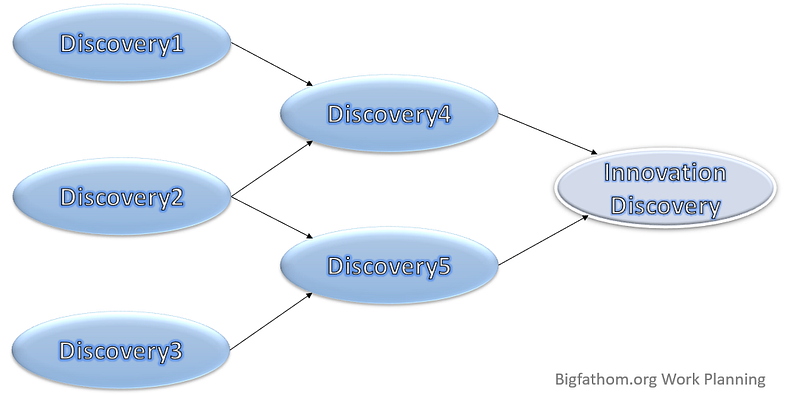
Let the vision of a specific new innovation pull you forward
To plan your efforts, work your way back from the imagined but not yet materialized idea; identify each discovery that must be made as a stepping stone to your final goal of creating what has not yet been created. The simple diagram above illustrates how conceptually each discovery leads to the next critical discovery and so forth. This process never really ends until you want it to.
Nothing new is completely new. This is a good fact. This is foundational to an empowering mindset.
You can do it
Create new things! No one needs to be a wizard to create what has not yet been created because innovation is the art of connecting discoveries.
We can all equip ourselves to discover.
Some people in history have honed their discovery skills to grab ideas that were invisible or just fleeting insights and dreams to those that were less prepared.
Innovators have created the novel and new by seeing a potential in themselves and in the world around them to bring into existence what had not existed before. And by preparing themselves through focused work to understand things that mattered, they saw a possibility that others did not. This potential is in all of us.
We will see what we are prepared to see, sometimes before anyone else.
Prepare yourself to discover and you will.
And remember, nobody invented anything. Everything is discovered.


