
Medium Writing Tips
Not All “Successful” Medium Articles Go Viral
Leveraging Medium’s high domain authority to promote your content in Google’s search engine
Many writers on Medium tend to aim for viral success within Medium’s platform. They focus on how to get curators to select their articles, how to get published in major publications, and how to optimize their article key words. There is nothing wrong with this strategy, and I have even written about my experience with articles gaining massive Medium views.
But for many writers, it can be discouraging to see your Medium article An Intro to Stochastic Calculus receive just 25 views while the article featured on the Medium’s home page, Five Unexpected Truths I Discovered From Bedazzling My Vajayjay with Swarovski Crystals, received 25,000 views.

However, many of these attention grabbing/click-bait articles only thrive for a relatively short time, and most of the traffic is generated through the Medium platform itself.
Even if the Medium curators/internal search algorithm “fails” your article, it is still possible to obtain large amount of views and have your content shared with a large audience.
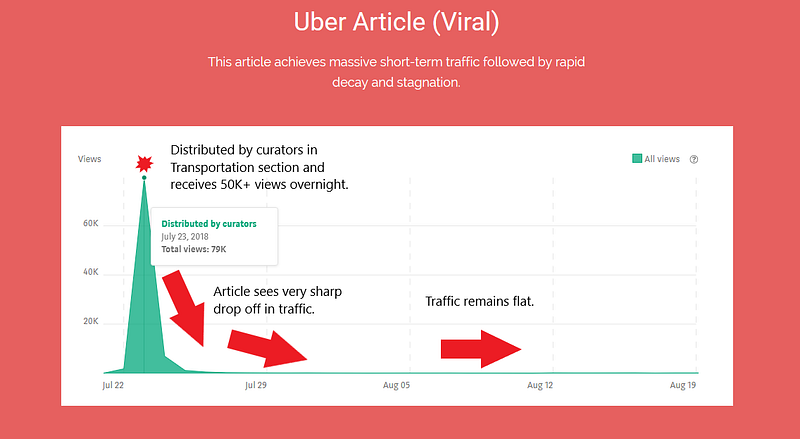
To illustrate this point, I’m going to show you the analytics behind two Medium articles I published. An article that essentially went viral and had a very brief, but massive surge in views, Uber’s Latest Scandal: Vomit Fraud and an article that grew in momentum months after being published, How to Bypass Virtually Every News Paywall:
The viral article achieved massive traffic over a few days, and I imagine this is the trajectory of many articles that are selected by curators on Medium. And this makes sense because Medium’s algorithm places an extremely high emphasis on the recency of articles. The Medium analytics for this article underscore this trajectory:
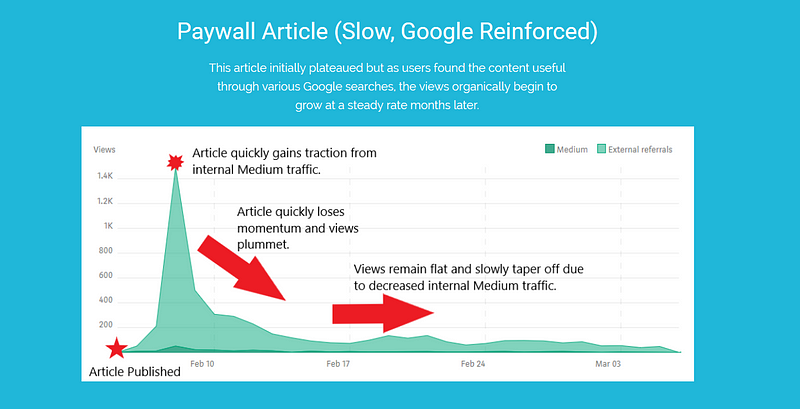
The Paywall article was published on February 6th and follows a much different trajectory. As you can see from the screenshots of my Medium article analytics, below, the article initially saw a surge of traffic a few days in.
Traffic then remained flat for over a month before it jumped from being completely overlooked (Google Search Results Page 10+) to being somewhat accessible (Google Search Results Page 3–5). Also worth noting, the article was almost immediately indexed in Google after publication due to: (1) Medium being a publishing platform with high domain authority; (2) The initial surge of traffic ensured it would be indexed quickly.
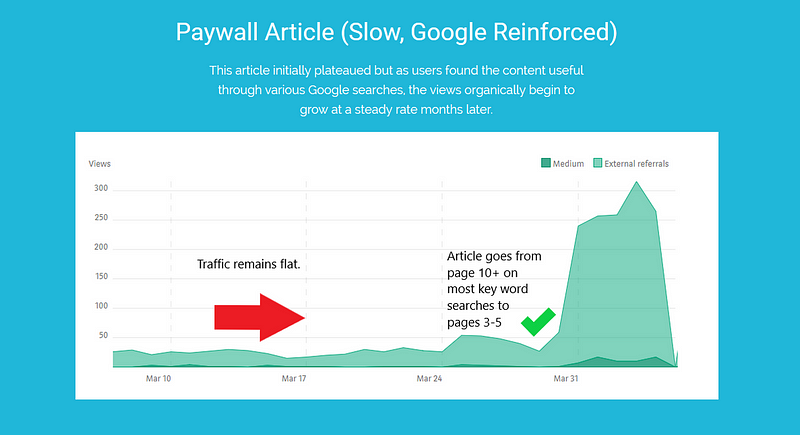
As the article oscillates in page rank in Google’s search algorithm, daily traffic continues to grow at a steady rate:
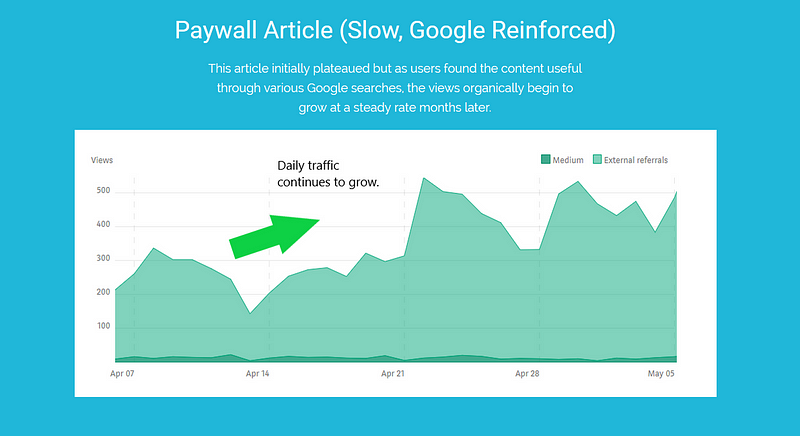
Now, in May and June, several months after the initial article was published, traffic is still consistently growing. In fact, it is approaching the single day high for total views (~1400) that it initially achieved only once after publication, on a consistent daily basis!
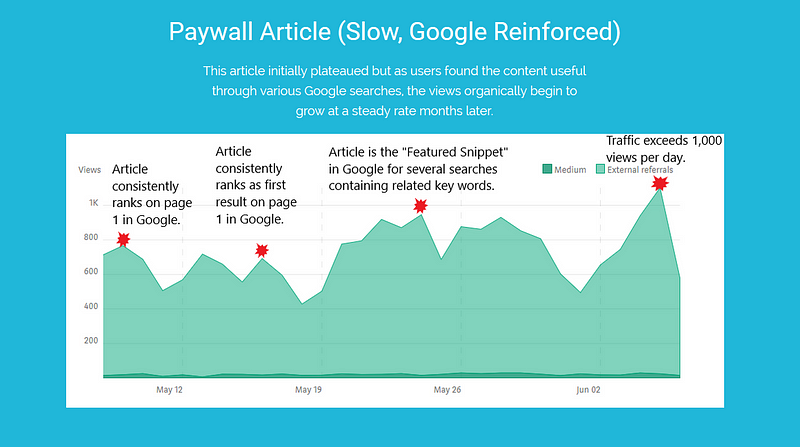
What caused this? First, views continued to grow at a fairly steady pace as the article climbed page rank in Google’s search engine. It gradually reached the bottom of the first page, then the number one spot on page 1, and finally it started becoming the featured snippet (position 0) in Google’s Search results.
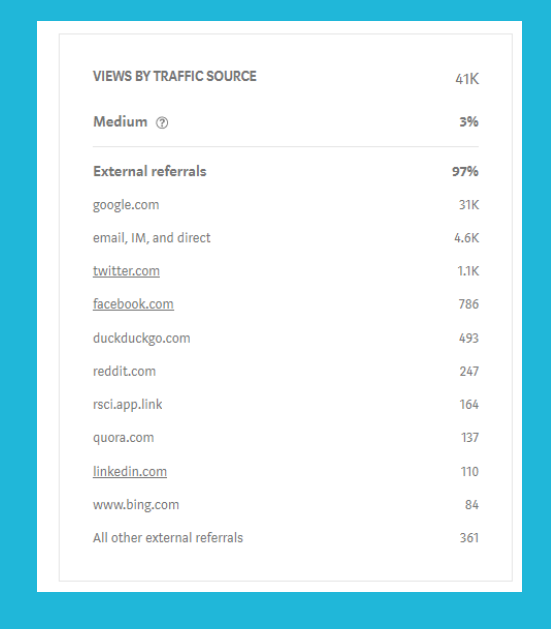
Second, while a majority of the article’s traffic comes from Google, there are a number of other sources indicating it is being shared on social media (likely from the Google post as I did not share this content on any platform but LinkedIn, where it received surprisingly few views).
Conclusion
So what are some of the takeaways from this?
- Your Medium article does not need to “go viral” for it to be successful — you can still achieve massive exposure by creating useful content that is boosted through Google’s search engine organically.
- Content is still king. The Uber article took me a fraction of the time to write, and I was shocked when it went viral, as I thought it was virtually useless. The Paywall article provided tremendous value to users, and even if Medium’s curators didn’t deem it noteworthy, tens of thousands of people who found an answer to their question through Google, would probably beg to differ.
- Original content wins out in either growth scenario. Regardless of whether an article achieves growth through viral momentum or slow algorithmic reinforcement, it must have unique and original content. Readers expect Medium curators to select original content and Google’s algorithm heavily favors unique content and can penalize websites for posting duplicate content.
Thanks for reading this article! Leave a comment below if you have any questions, and if you want to learn more about blogging, content marketing, or subscription newsletter strategy, be sure to sign up for the Blogging Guide Newsletter!
If you liked this article, here are some other articles you may enjoy:

Casey Botticello is an internet entrepreneur and the founder of Blogging Guide, an online community of writers with an award-winning newsletter. He is also the creator of the popular Medium Writing Course and the Substack Newsletter Course.
Casey previously worked at several tech startups, a lobbying & strategic communications firm, and has created several businesses of his own. He is a graduate of The University of Pennsylvania, where he received his B.A. in Urban Studies.
You can connect with him on LinkedIn, Twitter, Facebook, follow his Medium publications, Digital Marketing Lab and Medium Blogging Guide, or reach out to him directly on his personal website.


