
Non-Violent or Revolutionary: A False Choice for Social Activists
An Analysis of Civil Rights Contributors: Martin Luther King Jr., John Lewis, Malcolm X, and Huey P Newton
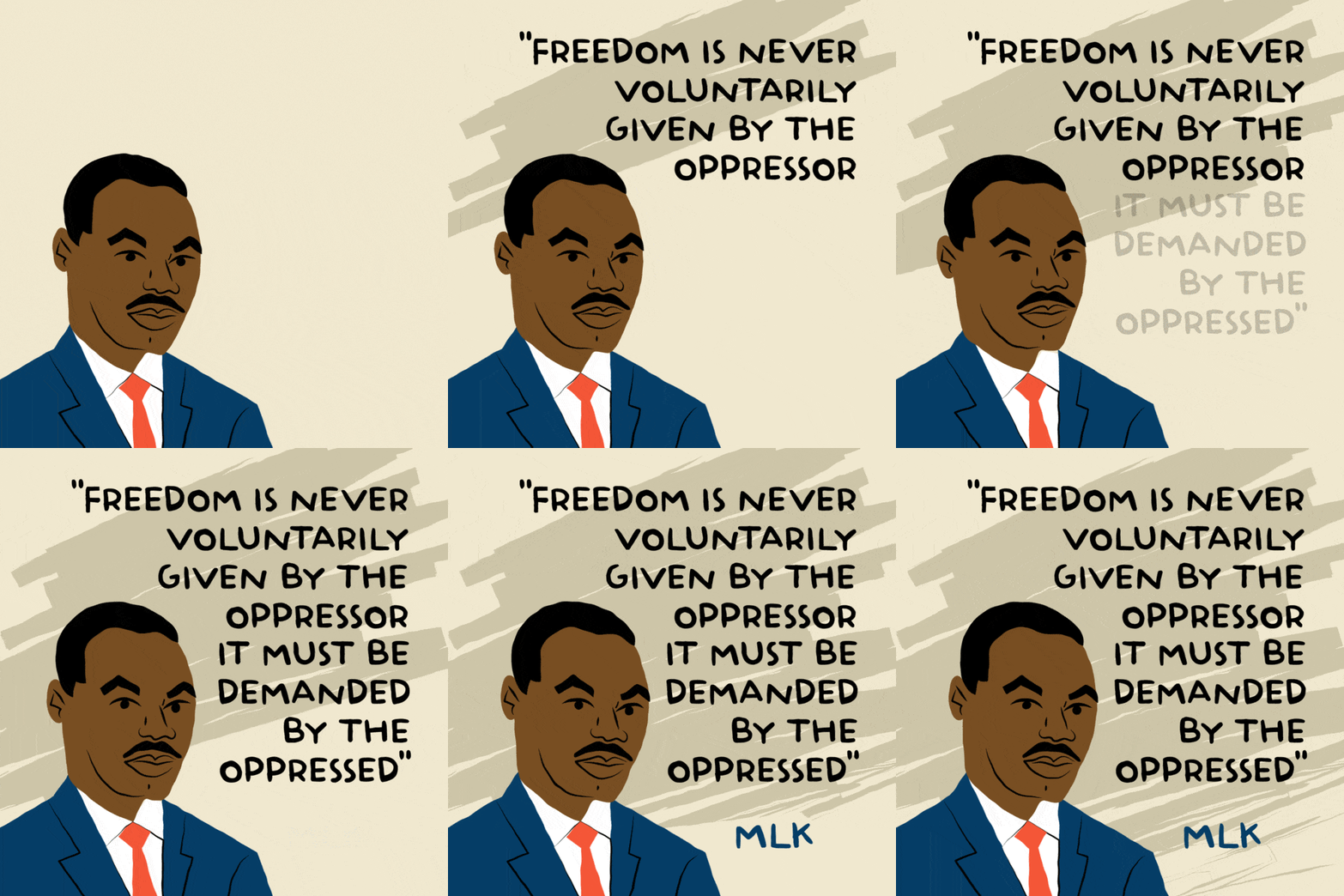
Let’s take stock of the role that Civil Rights leaders have played in developing the New Civil Rights Movement occurring today. Leaders like Martin Luther King Jr, Malcolm X, Huey P. Newton, and John Lewis fought for black liberation uniquely. The differences amongst these leaders whipped up disruption amongst black social activists from different generations.
Historians divided the Civil Rights Activists of yesteryear into two categories: non-violent and revolutionary. These categories became problematic amongst young and older generations of black people. They diverged in their approach to uplifting black people, families, and communities. Non-violent social activists made white people feel more comfortable because they know that these black people will take “no” for an answer. Revolutionary black activists frighten white people because they demand accountability and structural change as opposed to asking for it. While some professed a non-violent message, others applied revolutionary tactics. Non-violent activists and revolutionary activists were two sides of the same coin. Despite the different methods of resistance, they fought for black liberation.
Martin Luther King Jr.
Renowned for his “I Have a Dream speech” at the Lincoln Memorial in Washington DC, Martin Luther King Jr influenced American culture as a prolific speaker, social activist, and organizer. Using his platform, he ushered in an international conversation about race relations in America. Awarded the Nobel Peace Prize in 1964, Martin Luther King Jr. was praised for his non-violent opposition to racial inequality. His calm in the face of the storm was admirable.
“Influenced by Mohandas Gandhi, he advocated nonviolent civil disobedience to racial segregation. The peaceful protests he led throughout the American South were often met with violence, but King and his followers persisted, and their nonviolent movement gained momentum” (History.com Editors, 2010).
These flash-points don’t tell the whole story about Martin Luther King Jr., and his fight for black liberation. However, this is the narrative that moderates and white Americans have peddled to the American public. While MLK Jr. did not advocate the use of violence, he understood the importance of civil disobedience. He broke social norms in his time, disrupting racist systems. He encouraged students to participate in sit-ins in whites-only establishments and organized the infamous bus boycott, challenging the concept of segregation. In 1965, Martin Luther King Jr., broke an ordinance when he led protesters across the Edmund Pettus Bridge in Montgomery, Alabama. This day, called “Bloody Sunday,” characterized the threat of violence at every turn. Protesters were beaten that day. While he did not encourage violence, he acknowledged that violence was a possibility when challenging the oppressor. Moreover, Martin Luther King Jr. made, some interesting comments about rioting.
Martin Luther King Jr. spoke at length about riots:
“I think America must see that riots do not develop out of thin air. Certain conditions continue to exist in our society which must be condemned as vigorously as we condemn riots. But in the final analysis, a riot is the language of the unheard. And what is it that America has failed to hear? It has failed to hear that the plight of the Negro poor has worsened over the last few years. It has failed to hear that the promises of freedom and justice have not been met. And it has failed to hear that large segments of white society are more concerned about tranquility and the status quo than about justice, equality, and humanity. And so in a real sense our nation’s summers of riots are caused by our nation’s winters of delay. And as long as America postpones justice, we stand in the position of having these recurrences of violence and riots over and over again. Social justice and progress are the absolute guarantors of riot prevention” (Rothman, 2015).
Yes, MLK Jr preferred nonviolent tactics but he wasn’t against those who expressed raw anger and dismay at the injustices against black people. He wasn’t tone-deaf. Yet, the assertion that he was only an advocate for non-violence muddies the waters and his words have been used to condemn and scold young activists. Furthermore, it has watered down his message about racial inequality in America. He wasn’t saying that no one should lift a finger in disdain. Instead, he insisted that cooler heads prevail. Martin Luther King Jr. blamed white silence on matters of race for civil disruptions and riots, not rambunctious activists.
John Lewis
John Lewis, a non-violent Civil Rights advocate got in “good trouble” throughout his life. Arrested, chastised, and beaten, he persisted in his fight. At the ripe age of 23, Lewis was the youngest speaker at the infamous March on Washington. Before he entered Congress, his youth was full of turbulence. He was beaten on “Bloody Sunday” by law enforcement as they fought for voting rights for black people. This altercation influenced the public and lawmakers, leading to the creation of the 1965 Voting Rights Act.
“Lewis came to believe getting into trouble wasn’t necessarily a bad thing — messing with ‘the law’ was a powerful means of effecting change.
He delivered a fiery address, telling the nation, “We shall splinter the segregated South into a thousand pieces and put them together in the image of God and democracy. We must say: ‘Wake up, America. Wake up!’ For we cannot stop, and we will not and cannot be patient” (Collins, 2020)
These were not the words of a complacent man who valued peace over justice. John Lewis understood the necessity for systematic change. Patience was not his battle cry. He embraced urgency in his fights for Civil Rights. So, why do some want to portray John Lewis as a non-violent activist? Complacency fits the narrative. Many white people did not want to see a black uprising, even if it leads to the improvement of black lives. They would prefer if Black people asked nicely, sit quietly, and remained patient. However, Martin Luther King Jr. and John Lewis advocated for non-violence, not passivity.
Malcolm X
On the opposite side of the ideological spectrum, Malcolm X advocated for complete black liberation. His insistence that black people possessed the right to defend themselves was a revolutionary idea. As a member of the Nation of Islam, Malcolm X rejected white supremacy and never accepted the lie that black people were inferior.
“He predicted that the young blacks would no longer allow themselves to be exploited and brutalized without fighting back” (X & Karim, 2019).
Just because MLK Jr promoted non-violence doesn’t mean that Malcolm X advocated the use of violence. Instead, he insisted that black people had the right to defend themselves against violent attacks. In America, many black people silently endured physical abuse. In his pursuit of black liberation, Malcolm X denounced submissive behavior in the face of systematic racism and oppression. He understood that younger black people fought back differently than previous generations. Through the Nation of Islam, Malcolm X pulled some out of the darkness of complacency and encouraged black people to use discipline and persistence to achieve goals.
Martin Luther King Jr. and Malcolm X didn’t work together substantially. They only met once and disagreed about the methods for addressing overt and covert racism. Their ideological split represented the split within the black community. Black people applied various methods to address racial oppression. Marginalized communities often struggle to form a consensus.
“Despite their tremendous ideological differences,” Malcolm X wrote, “it is a disgrace for Negro leaders not to be able to submerge our ‘minor’ differences in order to seek a common solution to a common problem posed by a Common Enemy” (Brown, 2018)”.
Huey P. Newton
Unapologetically black, Huey P Newton fought white supremacy applying revolutionary intercommunualism. Unlike the other Civil Rights Activists, Huey’s movement didn’t have a religious litmus test. The Black Panther Party accepted all black people. Members of the movement recognized the impact of systematic racism on black communities. They created and implemented survival programs to address these issues head-on.
“The Panthers developed over 60 such community programs.”
The Free Breakfast for Children , Free Clothing, Free Dental, Free Commissary for Prisoners, Police Patrols, and Seniors Against a Fearful Environment (SAFE) enriched black communities (Huey P. Newton Story, 2020).
The Free Breakfast for Children Program provided breakfast for poor school children without exception. Huey P. Newton and the BPP recognized the importance to address poverty. Nutrition can play a major role in childhood development. By feeding the children, they aided impoverished parents. Everything they did was done to uplift black communities. Their tactics struck fear in the hearts of white men who saw BPP members holding guns. They legally registered and owned these guns. Yet, when black people exerted their rights to bear arms, they were seen as inherently criminal.
Their perception of criminality did not change even as they continued to implement survival programs. The FBI and local law enforcement recognized the Black Panther Party as a problematic organization. The American government, which denied the descendants of slaves reparations, wanted to destroy black heroes in the community. This was an attack on the fight for black socio-economic independence.
Huey P. Newton wanted black people to understand the history of racism and oppression in America.
“White America has seen to it that Black history has been suppressed in schools and in American history books. The bravery of hundreds of our ancestors who took part in slave rebellions has been lost in the mists of time, since plantation owners did their best to prevent any written accounts of uprisings.” — Dr. Huey P. Newton (Team & Powel, 2018)
Historians highlighted the differences amongst various Civil Rights Activists. This allowed liberal white people to support non-violent approaches while denying black people’s right to self-defense. Systematic racism plagued the black community. Police departments confront black communities differently. The same was true during the 1960s.
“The racist dog policemen must withdraw immediately from our communities, cease their wanton murder and brutality and torture of black people, or face the wrath of the armed people.” — Dr. Huey P. Newton (Team & Powel, 2018)
While his words may threaten white fragility, consider the relationship between the police and black communities. The hostility of this relationship has fostered feelings of contempt amongst black people. While some will soften their tone to appeal to white allies, others don’t pander. Both sides of this coin are necessary to achieve the goals of black people, fighting for liberation in Diaspora.
Read More about Justice, Equality, and Culture:
References:
A Huey P. Newton Story — Actions — Survival Programs. (2002). Retrieved July 20, 2020, from https://www.pbs.org/hueypnewton/actions/actions_survival.html
Brown, D. (2018, January 14). Martin Luther King Jr. met Malcolm X just once. The photo still haunts us with what was lost. Retrieved July 20, 2020, from https://www.washingtonpost.com/news/retropolis/wp/2018/01/14/martin-luther-king-jr-met-malcolm-x-just-once-the-photo-still-haunts-us-with-what-was-lost/
Collins, S. (2020, July 18). Rep. John Lewis, civil rights leader and moral center of Congress, has died at 80. Retrieved July 20, 2020, from https://www.vox.com/policy-and-politics/2020/7/18/21329404/rep-john-lewis-died-80-civil-rights-legend-moral-center-congress
History.com Editors. (2020.). (2010, February 09). Martin Luther KingJr., Nobel Peace Prize. Retrieved July 19, 2020, from https://www.history.com/this-day-in-history/king-wins-nobel-peace-prize
Rothman, L. (2015, April 28). Baltimore Protests: Behind “A Riot Is the Language of the Unheard”. Retrieved July 19, 2020, from https://time.com/3838515/baltimore-riots-language-unheard-quote/
Team, T., & Powel, A. (2018, August 22). 10 Dr. Huey P. Newton Quotes That Still Resonate Today . Retrieved July 20, 2020, from https://theblackdetour.com/10-dr-huey-p-newton-quotes-that-still-resonate-today/
X, M., & Karim, B. (2019). The end of white world supremacy: Four speeches. New York: Arcade Publishing.


