
New Study proves: Fish can calculate!
This is not a joke.
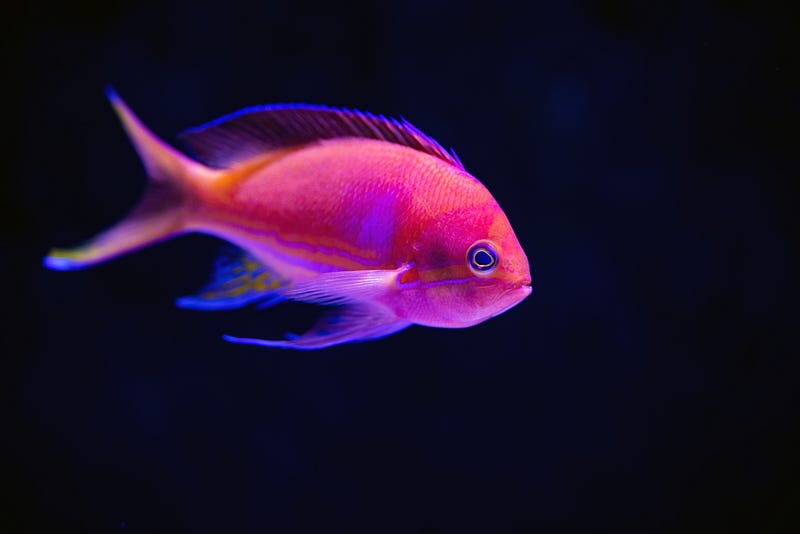
Fish are probably smarter than assumed so far. Mathematical abilities have already been demonstrated in primates, but also in bees and spiders.
Now, researchers led by Prof. Vera Schlüssel at the University of Bonn (Germany) have found that both stingrays and cichlids can learn to solve simple addition and subtraction problems in the number range up to 5.
How do you ask fish to solve a math problem?
The researchers found a very good answer to this question. They showed the fish a collection of geometric shapes (for example, 4squares). If they were colored blue, it meant “add one”. If they were yellow, the task was to subtract one. This method had previously been used to successfully test the calculating ability of bees.
Then the fish were shown two new images. In the example given, one with 3 squares and one with 5 squares.
Assuming the squares are blue, which shows the task of addition, the fish get food as a reward when they swam to the picture with 5 squares. This way, the fish learned to associate the blue color with the increase of the initially drawn amount and the yellow color with a decrease of it.
In order to check whether the fish had in fact learned to calculate, it was tested whether they could also correctly solve tasks that they had not yet seen. For this purpose, the exercise “3+1” or “3–” was skipped during the training. When the learning phase was completed, the fish were shown these tasks for the first time. Surprisingly, even in these cases they mostly swam to the correct results. This was true even when they had to choose between four and five objects after the “3+1” task — that is, two results that were both larger than the initial value.
Truly fascinating, isn’t it?
Another reason this is surprising is that fish do not have a neocortex. This part of the brain is also known as the “cerebral cortex” and is responsible for most of our complex cognitive tasks.

What is the purpose of the calculation ability?
What biological purpose this ability has is not yet known. Professor of zoology Vera Schlüssel states that so far no reason is known that would require the studied fish to have a particularly good understanding of numbers in their ecological niche.
Other species pay attention to the number of stripes of their sexual partners or the number of eggs in their clutch, which could explain their ability to calculate. However, this is not the case with stingrays and cichlids.
Here you can read about the study on the page of the University of Bonn.
Thanks for reading!
Wait a second. You should get my articles in your inbox. Subscribe here. Maybe you also want to start writing on Medium yourself and make money. I made $3400 in my second full month! You only need a membership for $5 a month. If you sign up with my link, you support me with a part of your fee without additional costs.
I think you will also like these stories: