
Nance
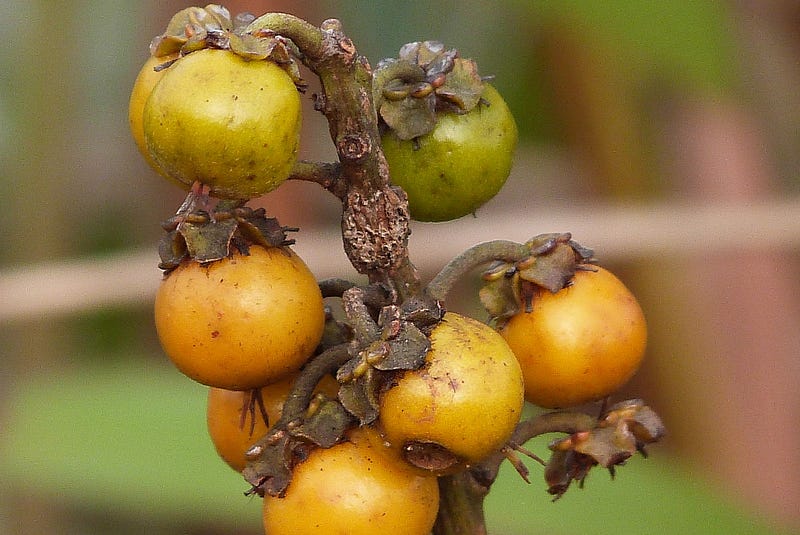
The fruit, not the slur
Today’s New York Times Spelling Bee letters:
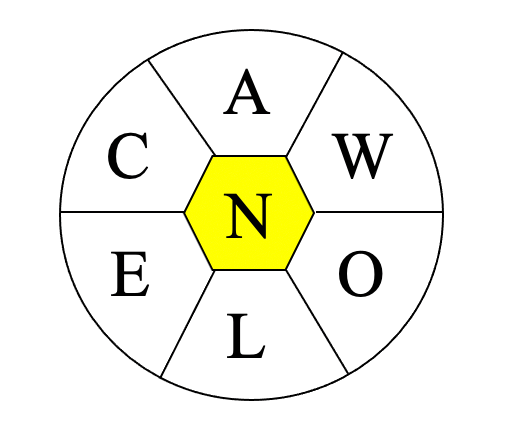
A, C, E, L, O, W, and center N (all words must include N)
Merriam-Webster says…
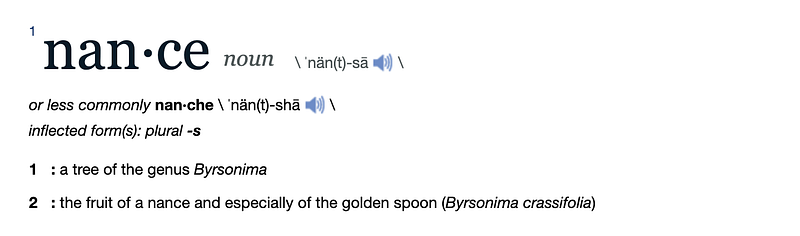
Silly little dictionary! Don’t you know nance can’t possibly be a word if the New York Times says it ain’t?
For further fascinating facts, check out the Spelling Bee Master.
What’s your favorite dord* from today’s puzzle?
My Two Cents
If you’re one of those readers who actually clicks on the links I provide, you may have noticed something in the Merriam Webster link. It gives only one definition of the word nance:
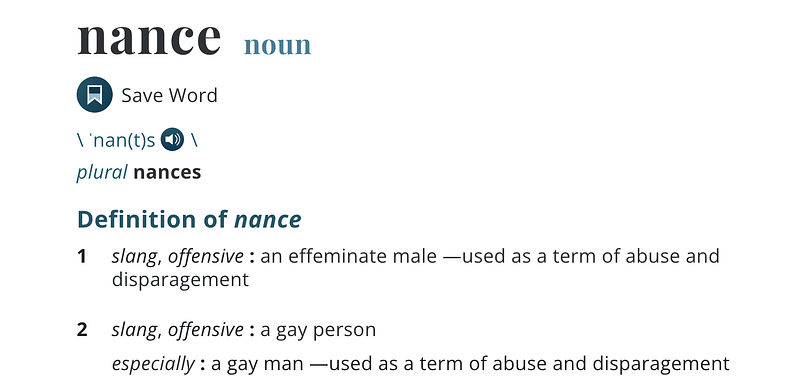
So why the discrepancy between the link and the screenshot I put further up, the one that references the fruit in its definitions? Well, because there are two online versions of the dictionary, and most readers probably have access to only one of them, the free one.
Merriam-Webster’s Collegiate Dictionary is the one anyone can use gratis. The unabridged version has a paywall, one that I’ve subscribed to because (1) I need it and (2) I don’t mind contributing to the dictionary since I’m using it on a daily basis to pen this column.
As you can conclude, the collegiate version of the Merriam Webster is, well, abridged. Although both dictionaries often match when it comes to words and their definitions, it’s not always the case; today’s daily dord* is a perfect example.
Tiny fruit
Nance refers to both the tree and the fruit it gives. The word comes from the comes from the Nahuatl nan-tzin, the name of the goddess Tonantzin (from to- “our” + nān “mother” + -tzin an honorific suffix). She was often referred to as nanchi, from which nanche and nance derived. And because Nahuatl was the original language, the tree and fruit have the same name in many Spanish-speaking countries.
In English, the nance is referred to by other names, including craboo, golden spoon, and, in Jamaica, hogberry.
Byrsonima crassifolia is a slow-growing large shrub or tree that can attain 33 ft (10 m) in height, even doubling that in exceptional cases. Its overall shape can vary from round-topped and spreading to more narrow and compact. Leaves have an elliptic or oblong-elliptic shape and are about the length of a small adult’s hand, and about half as wide. The flowers are reddish-orange or orangish-red (take your pick), and quite pretty. See for yourself.
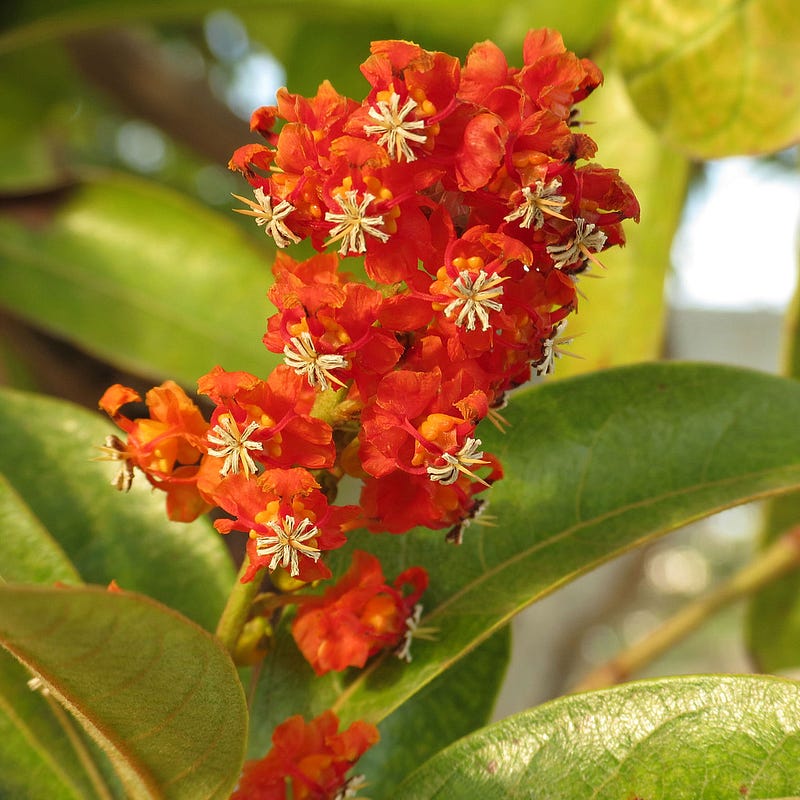
According to expert Julia F. Morton, who has become my go-to expert when it comes to many plants, the fruit of the nance tree is…
… peculiarly odorous, orange-yellow, round, 5/16 to 7/16 in (8–12 cm) wide, with thin skin and white, juicy, oily pulp varying in flavor from insipid to sweet, acid, or cheese-like. There is a single, fairly large, stone containing 1 to 3 white seeds.
But in this case I think she made a small error. Instead of centimeters (cm) the size of the fruit should be indicated in millimeters.
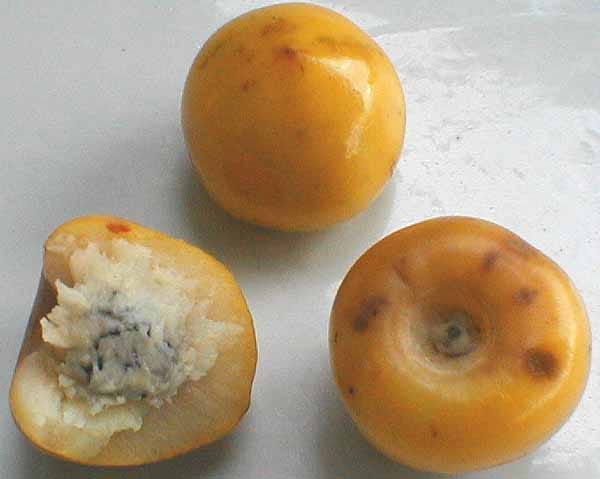
In the above photo the fruits look huge! Especially if you’re reading this on a computer or a tablet. Here they are on a plate, which may give you a better idea of their real size, which is closer to an olive than a peach.
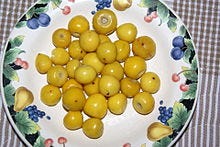
Yeah, that’s right. The fruits in the first picture were even bigger than the entire plate!
The skin of the fruit can impart a brownish tint to cotton cloth, so it has been used as a dye in some cultures. The bark of the tree has a strong fiber that can be used to tan leather. The branches of the nance can be cut into small pieces or crushed and thrown into rivers or ponds to stun fish and make them easier to catch. The wood itself can be used to smoke or grill meats.
Once ripe, the fruit has a sweet flavor with a slightly bitter aftertaste. In Costa Rica, the fruit is also made into a flavored liqueur known as vino de nance (nance wine). In Panama, the fruits are eaten raw or cooked as a dessert known as pesada de nance. This is made by cooking the fruit in water with sugar, and cornstarch, or with fresh corn milk and flour, and served with fresh white cheese. Nance is also used in juices, soft drinks, and even ice creams.
In Mexico, nance prepared and eaten in a variety of ways: raw, salty, in syrup, in ice cream, in frozen popsicles, and even as a liqueur known as Changunga Wine. In Nicaragua, nance candy is one of the country’s typical sweets.
Big slur
Aside from the fruit, there is another plant reference to nance that I found, but it’s a bit obscure. Albizia pistaciifolia is a species of plant in the bean family, and is found in Colombia, Ecuador, and Venezuela. In this last country, where I grew up, it’s called carabali, quiebrahacho or vera macho. But I don’t recall ever hearing of those names during the twenty-seven years I lived there. In Ecuador this plant is supposedly called nance, but I couldn’t verify that… so don’t go spreading this rumor around on your instas and tiktoks and tweeters.
Aside from the fruit and the dubious legume, nance is known as a variation of nancy, sometimes capitalized like the name. Merriam-Webster says that the first known use of the word was around 1910. And Urban Dictionary clarifies that “Nancy-boy” was a postwar term for a gay man, consider softer than other epithets. The men tagged with this slur were viewed as “harmless” or not “threatening or predatory”.
Almost exactly a year ago in this very column I wrote about the word nancy, and I encourage you to please read it and learn about its origins as an offensive term.
I remember it being used when I was growing up in the 70s and 80s, and not just by children who wanted to make fun of other kids who seemed effeminate or were not up to the manly standards of the bullies. I recall adults, including teachers and coaches, also using the term!
Now you know. Please don’t call anyone a nance. In fact, don’t use the word nance unless you’re referring to the tropical fruit. Oh, wait, you won’t even be able to do that… because the editors of the Spelling Bee decided that nance is a dord*.
You can check out my previous entry on another dord* here:
What the heck is a dord, you ask? Here’s the answer: