
Cooeed
The Australian cry that helped Sherlock Holmes solve a case

Today’s New York Times Spelling Bee letters:
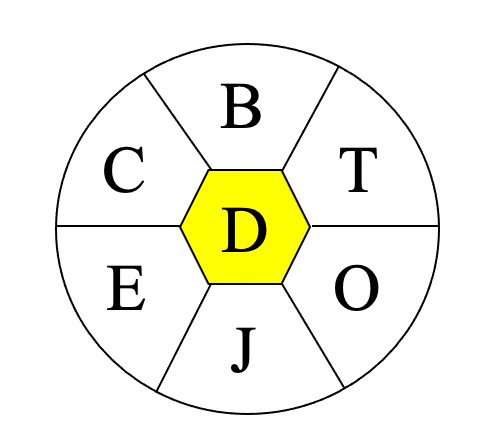
B, C, E, J, O, T, and center D (all words must include D)
Merriam-Webster says…

Silly little dictionary! Don’t you know cooeed can’t possibly be a word if the New York Times says it ain’t?
For further fascinating facts, check out the Spelling Bee Master.
What’s your favorite dord* from today’s puzzle?
My Two Cents
When I was a kid I had a thick tome with the collected stories of Sherlock Holmes. It included the four novels and fifty-six short stories penned by Sir Arthur Conan Doyle, the official count in the fictional detective’s canon. I think they were in set in the order in which they had been published, so A Study in Scarlet, the first novel, was the one I set to read first.
I was young, maybe ten or eleven years old, and although my reading level was high, I was not prepared to tackle the florid 19th-century English and what I considered to be a long and boring history of the Mormon Church as described by Conan Doyle. (There has been some controversy about the depiction of Mormonism in the novel. Levi Edgar Young ––a descendant of Brigham Young and a Mormon general authority–– claimed after Conan Doyle’s death that the author had apologized in private to Young, explaining that “He [Conan Doyle] said he had been misled by writings of the time about the Church”.)
After somehow finishing A Study in Scarlet and being duly impressed, I became a Sherlock fan and kept on reading. I didn’t finish the entire book, which I think I no longer have. I’ll need to get myself a fresh new copy and go back to reading Holmes as an adult.
Sherlock has been depicted by in movies and TV by many actors. The image of Holmes as played by Basil Rathbone was an iconic reference for decades:

More recently, Robert Downey, Jr. played the title character in a couple of films a decade or so ago. But one of my favorite portrayals has been that of Benedict Cumberbatch in the series Sherlock, which launched in 2010 and featured as its first case a modern adaptation of A Study in Scarlet. I remember feeling a bit dubious when I began watching the episode, but then this happened:
It wasn’t just the imaginative creativity, with the words on screen substituting for the detective’s thoughts, but also the wink at Sherlock Holmes fans. You see, in the novel, the interpretation of rache is reversed. A police inspector is the one who thinks it stands for the incomplete “Rachel”, while Holmes explains it’s German for “revenge”, but add that it’s a red herring.
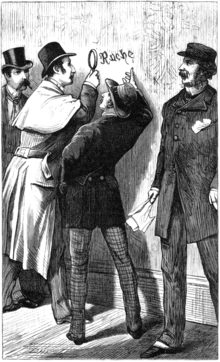
This flip of reasoning in the show caught my attention ––along with the style and the relationship between Watson and Holmes–– and I was hooked. I highly recommend the series.
Shout, shout, let it all out
The screenshot I provided of the dictionary’s definition of cooee is for the verb form. That’s because the daily dord* is cooeed, conjugated in past tense in order to include the center letter “d” that has to appear in every word as per the rules of the Spelling Bee game.
But the most commonly used form is the noun:
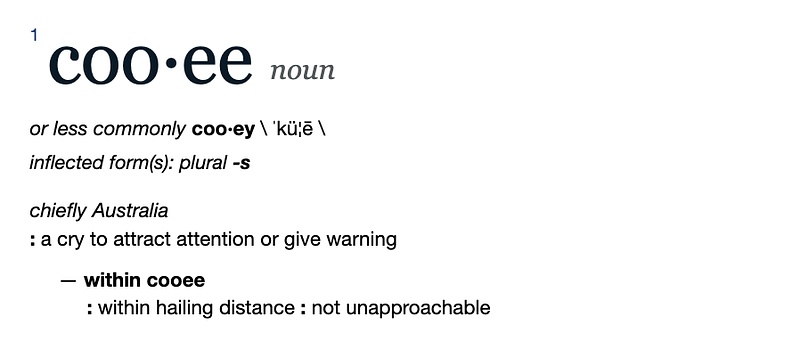
Our friends at Merriam-Webster aren’t particularly helpful today when it comes to the etymology of cooee, explaining that it is of “origin unknown”.
According to the Macquarie Concise Dictionary, however, the term comes from the Dharug language of Aborigines in Australia. Just last week I briefly mentioned the Dharug language, and telling you this gives me the perfect excuse to reference that article and earn an additional 13 cents. You’ll be happy to know it includes a photo of cute koalas (a redundant expression if there ever was one).
When one has cooeed shrilly and loudly, the call can travel quite a distance, which apparently is a point of pride amongst certain Australians. And because the sound is similar to some that animals make, a cooee can also be used as a camouflaged call for help. But make sure you’re in the Australian bush and not in a bustling urban center.
Nineteenth-century explorer Thomas Mitchell, in his book Three Expeditions into the Interior of Eastern Australia, mentions the Aborigine call by its alternate spelling of cooey. In one footnote he explains:
The natives’ mode of hailing each other when at a distance in the woods. It is so much more convenient than our own holla, or halloo, that it is universally adopted by the colonists of New South Wales.
During World War I the call was featured in recruitment posters.
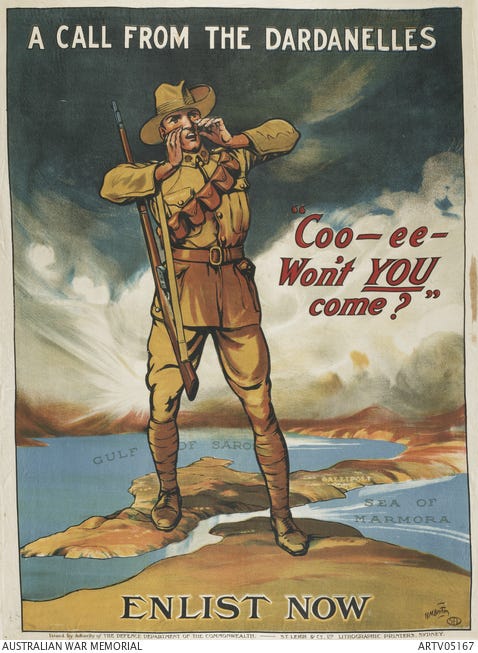
Today the expression “within cooee” has been adopted by Australian slang to indicate that something or someone is close by. The negative “not within cooee” is used as the equivalent to “not even close”, as in “I am not within cooee of making money by writing on a platform whose name comes between small and large.”
Elementary, my dear Watson
Did you you know that exact phrase never once appeared in any of the sixty Sherlock Holmes stories? Holmes called Watson “dear” more than once, and he sometimes used the expression “elementary”, but he never uttered the two together. It’s become one of those famous misquotes that still hang around the collective unconscious, like “Play it again, Sam” from the movie Casablanca.
Why are we talking about Sherlock Holmes anyway, you ask. Oh, you don’t ask? Well, I’m still gonna tell you.
In the short story “The Boscombe Valley Mystery”, one of the clues that helps Holmes solve the case is the fact that the victim cooeed someone while out in the woods. If you haven’t read the story, this explanation by Holmes to Watson might be a bit of a spoiler (although not terribly so).
The ‘Cooee!’ was meant to attract the attention of whoever it was that he had the appointment with. But ‘Cooee’ is a distinctly Australian cry, and one which is used between Australians. There is a strong presumption that the person whom Mc- Carthy expected to meet him at Boscombe Pool was someone who had been in Australia.
I hadn’t read a Conan Doyle mystery in many years. So it was interesting to get lost again in the world of Holmes as narrated by Watson, even for just a half hour or so. I did notice a few interesting things in this story. Some more spoilers, which you can skip for now and get back to later once you’ve read the story.
§ Moonshine appears in a sense that is not much used today. This is the sentence: “That McCarthy senior met his death from Mc-Carthy junior and that all theories to the contrary are the merest moonshine.” In this case, the word does not refer to “moonlight” or the illegally distilled whiskey made under said moonlight. It’s entry two as shown below.
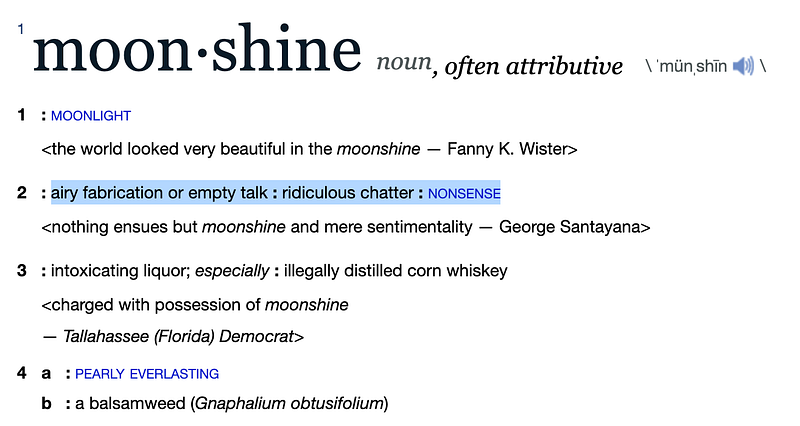
§ Slut I was not aware this word was used 150 years ago, but the dictionary says it’s been in use since the 15th century in the sense of “a lazy, careless, or slovenly woman”. In the story, however, the meaning is the one that developed later: “a lewd or dissolute woman especially a prostitute”. Here is the reference from the story: “He was urging his son to marry my daughter with as little regard for what she might think as if she were a slut from off the streets.”
§ Diabetes We take for granted many of the medicines we use today. But just over 100 years ago, in January of 1922, insulin was given to a diabetic patient for the first time ever. It had been extracted from an ox, after experiments with dogs had proved successful the year before.
But when Conan Doyle first published this Sherlock Holmes mystery in 1891, most people who got diabetes died rather quickly from it. This was especially true of what is commonly known as Type I diabetes, the one in which the pancreas stops producing insulin. It’s usually diagnosed in children or young adults, and back then it proved fatal within months, if not weeks.
In the story, one of the characters says the following: “I have had diabetes for years. My doctor says it is a question whether I shall live a month.” In this particular case, the character likely had Type II diabetes, which usually develops in late adulthood and sometimes in old age, and would not kill someone as quickly as Type I.
§ Religion One would not think someone as logical and rational as Sherlock Holmes would in any way acknowledge the existence of a supreme being, but the detective actually says this at one point: “You are yourself aware that you will soon have to answer for your deed at a higher court than the Assizes.” (An assize is a judicial inquest or trial.)
If you’re interested, you can check out “The Boscombe Valley Mystery” here. It’s a rather quick and entertaining read.
Now you know. Next time you’re doing a walkabout and need to call upon Sherlock Holmes, you can try cooee-ing him. Except you won’t be able to. And that’s because the editors of the Spelling Bee decided that cooeed is a dord*.
You can check out my previous entry on another dord* here:
What the heck is a dord, you ask? Here’s the answer: