
Myths and Ideas About the Two Halves of Our Brain – Part 4: The myth of left brain dominance
The logical vs creative myth is cactus, and a shiny new myth has swooped in to take its place. The new myth says that the left hemisphere is the dominant hemisphere, being our primary centre for language and action, whereas the right hemisphere is subordinate/minor and participates in non-language processes like identifying objects.
The myth of left brain dominance was based on two main lines of evidence, one related to language and the other related to handedness. In terms of language, damage to the left hemisphere is more likely to cause impairments than damage to the right hemisphere, and there’s evidence of a left hemisphere bias for vocalisations in some of our animal cousins as well.
As for handedness, most people have a bias for using the right side of their body. Because our brain’s hemispheres control opposite sides of the body, that means the left hemisphere is also in charge of most of our actions. The overlap between language and handedness was too much to resist, and many eagerly embraced the myth of left brain dominance.

The myth even passed an early test with flying colours. This occurred when researchers began to investigate the two hemispheres by studying so-called ‘split-brain’ patients. These were people with severe and intractable epilepsy who turned to a form of brain surgery as their last hope.
We briefly touched on epilepsy when we discussed the myth that we only use 10% of our brains. The key point for our purposes is that epileptic seizures are caused by runaway activity of our brain’s excitatory neurons. The area where a seizure originates is called an epileptic focus. From there, uncontrolled excitatory activity spreads throughout the brain, causing a seizure.
For people whose epilepsy hadn’t responded to other treatments, it was thought that seizures might not spread across the brain if the two hemispheres weren’t able to communicate. The surgery involved severing the main pathway of cells that connects the two hemispheres, known as the corpus callosum. Thankfully, this significantly reduced the frequency and severity of seizures in many people. For the Aussie readers: in a sure sign that fate has an Australian sense of humour, the neurosurgeon who proposed this idea was named Joe Bogen.
After the surgery, and to the surprise of many, the patients actually seemed to be exactly the same as before. After some time, brain researchers like Michael Gazzaniga realised that studying language processes in these people provided a chance to test the myth of left brain dominance. (Gazzaniga began his career in the early 1960s in the lab of Roger Sperry. As the head of the research program, Sperry later won a Nobel prize in 1981 for his lab’s work with split-brain patients, although further work has changed and refined our understanding since then.)
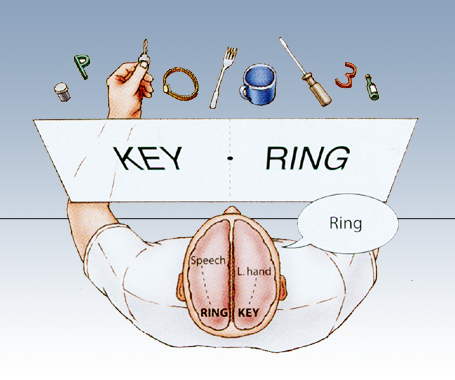
The rationale was this. If language is restricted to the left hemisphere and the lines of communication between the hemispheres have been cut, the correct information would only be useful for verbal responses when it’s in the left hemisphere. That’s because the right hemisphere wouldn’t be able to respond verbally or pass the information on to the left hemisphere.
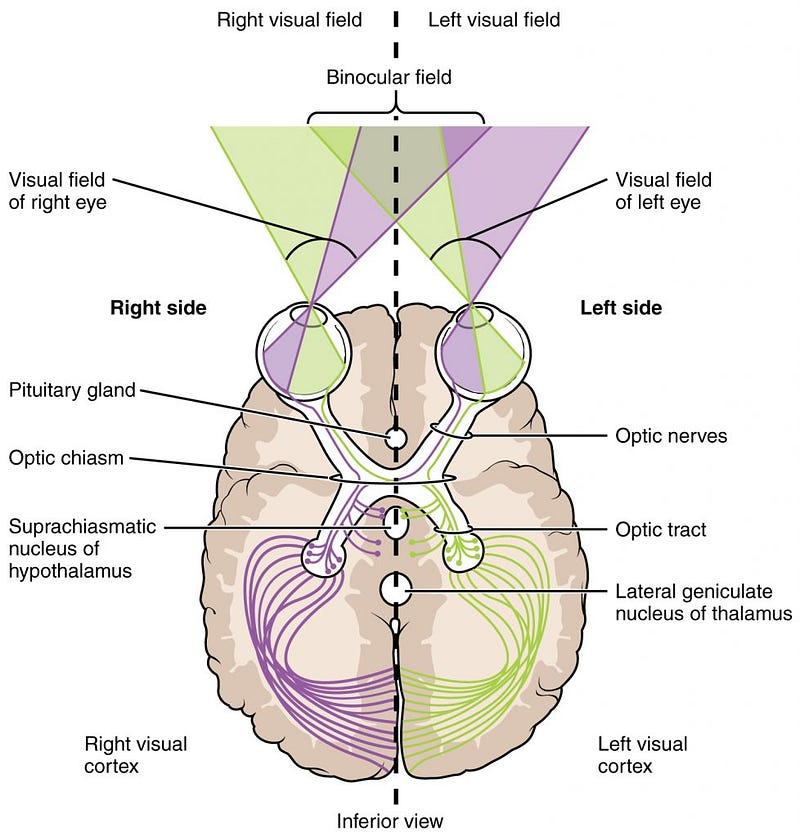
As luck would have it, this could easily be achieved thanks to a feature of our visual system. Although each of our eyes receives information and sends it to both hemispheres, information arriving at each eye is broken into left and right visual fields. Similar to how the hemispheres control opposite sides of the body, information from our left visual field is sent to the right hemisphere, while information from our right visual field is sent to the left hemisphere (see the diagram below for details).
If left brain dominance for language was correct, people with split brains should be able to provide correct verbal responses to questions when the necessary information is in the right visual field (left hemisphere), but not when it’s in the left visual field (right hemisphere). Amazingly, that’s exactly what the researchers found.
However, as Michael Gazzaniga outlines in his book Tales From Both Sides of the Brain, this is specific to the visual system, where information can be easily restricted to one hemisphere or the other. In contrast, other senses, such as touch, send some information from each side of the body to both hemispheres. As a result, even when the left hemisphere doesn’t know what the right hemisphere saw, both hemispheres will have at least a vague idea of what the other felt. (Read the bonus section at the end to find out what kind of responses the left hemisphere gave when it didn’t know the answer, and what this tells us.)
Combined with other evidence mentioned already, this seemed to provide a firm foundation for the idea of a dominant left hemisphere in charge of language and action. But as we alluded to last week, it’s not as simple as all that. Although there’s certainly truth to the idea of a dominant left hemisphere that supports language and action in many people, there are so many exceptions and qualifications that it’s closer to a myth than a hypothesis. So, let’s complicate things a bit.
Perhaps the most obvious objection to the myth of left brain dominance is the fact that a minority of people are left handers. Around 90% of people are right handed, and the remaining 10% are mostly left handed, with a very small fraction of people being ambidextrous.
The existence of lefties creates a problem for the myth of left brain dominance, as a person being left handed means that they have a bias for performing actions using their right hemisphere. Even worse, some lefties show a bias for using their right hemisphere for language, the exact opposite of the myth!
Right hemisphere dominance of language occurs in right handers as well, but is more common in lefties. The myth implies that the left and right hemispheres have innate roles, a line of thinking that leads fairly directly to genetics. However, variation is also found among identical twins who have exactly the same DNA, some of whom will differ in handedness and left/right hemispheric biases for processing language.
On that point, shout out to the twins who gave their handedness info so we could run an informal survey of our own. As you’d expect, those no good lefties are at it again, and some twins are indeed differently handed: right/left handedness was 75/25, and same/different handedness was ~83/17. A striking example of this variability is ‘mirror image’ twins, who split from each other relatively late in the womb and are each other’s opposite in certain respects, including handedness and, in extreme cases, even their internal organs!
The reality clearly isn’t as simple as the myth of left brain dominance would have us believe, and its credibility takes another hit when we look more closely at our animal cousins.
Some animals do rely more on their left hemisphere for vocalisations and prefer to use the right side of their body during action. However, these findings are nowhere near as universal as the myth of left brain dominance suggests. About two thirds of studied vertebrates show a bias for using one side of the body, with roughly one third showing no bias.
In general, a bias for acting with one side of the body is much more common in animals that walk on two legs, such as ourselves. When other animals do show a bias for using one side of their body, the specific side also varies considerably, even randomly. For example, mice, rats and monkeys show a roughly 50/50 split (i.e., random) for left/right body dominance, adorably referred to as ‘pawedness’. The pattern in birds is mixed, with some evidence of left footedness in different species.
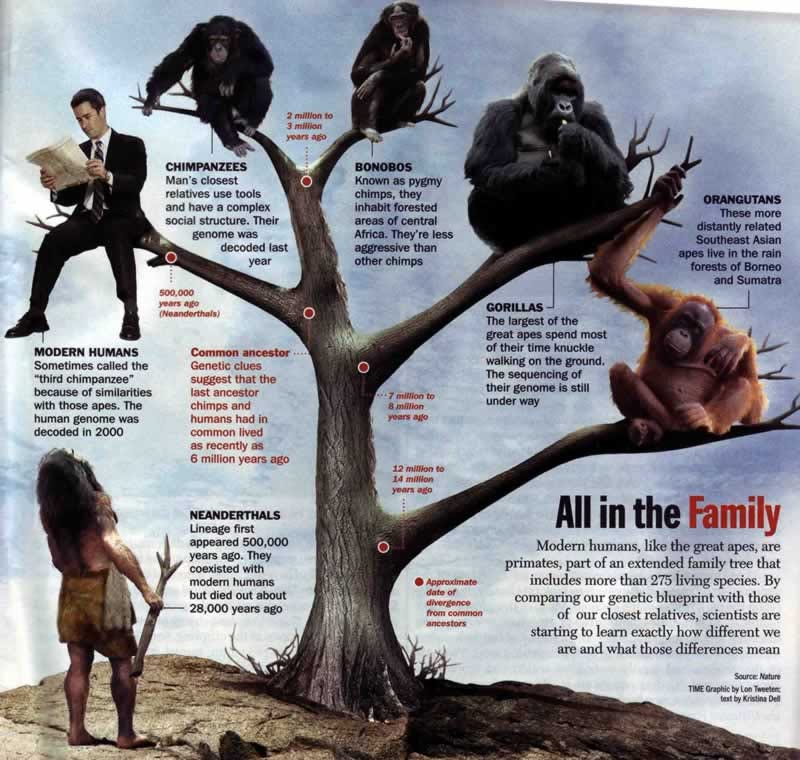
A preference for processing vocalisations in the left hemisphere is fairly common in primates — especially among the great apes, which includes ourselves and our closest living cousins. (There were other species of human, like the Neanderthals and Denisovans, who would be our closest living relatives. But we’re now the only species of human left, although they partly live on through us, as many people have small amounts of Neanderthal and/or Denisovan DNA in their genomes.)
But if you look more broadly across the Tree of Life, you find significant variation in left/right dominance for vocalisations. In a recent example, researchers reported that dogs show a bias for processing the meaning of human vocalisations in the left hemisphere, consistent with the myth of left brain dominance. However, in a slightly embarrassing but very human incident, it turned out that the dogs had actually shown a bias in the right hemisphere and the researchers had been reading the data backwards!
Finally, organisms that don’t have language or even vocalisations still have asymmetrical nervous systems (like the worm C. elegans). Contrary to the myth, this questions communication as a defining feature of nervous system asymmetry.
Taken together, a fuller picture of the evidence casts doubt on the myth of left brain dominance. And as we’ll see next time, there’s more bad news in store for our second myth. For instance, recent evidence contradicts the idea that language is exclusive to the left hemisphere. Returning to a familiar theme, it turns out that the right hemisphere also participates in language in a way that’s different but complementary to the language-related functions of the left hemisphere. Until then!
Bonus: Split-brain patients and the relentless overconfidence of the left hemisphere
Researchers found that severing the primary connection between the left and right hemispheres, the corpus callosum, prevented the hemispheres from communicating with each other. As a result, when an image was shown to the left visual field and sent to the right hemisphere, the person’s left hemisphere couldn’t answer when asked what the person had just been shown. Okay, so far so good.
Similarly, when an instruction was given to a person’s right hemisphere to perform an action with the left side of their body, the person’s left hemisphere was out of the loop and couldn’t explain what the person had just done, but this time gave a very different kind of answer. This is where it gets interesting. The left hemisphere didn’t just say I don’t know and ask the researcher to explain the situation. Instead, it made something up, spinning a story that it thought seemed plausible based on whatever cues were available to it at the time.
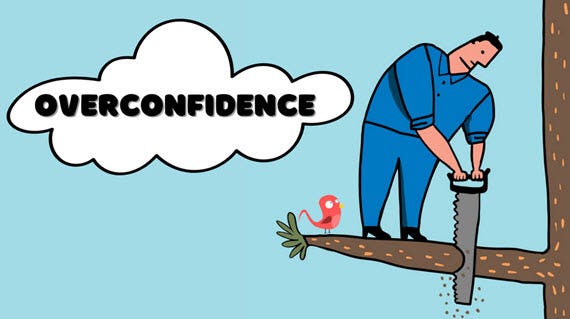
It turns out that the left hemisphere has an obsessive need to create a narrative that makes sense of our own actions, so much so that it would rather make something up than admit it doesn’t know. It lives by the saying, “Never let the truth get in the way of a good story!”, and has maximum confidence in its own deductive reasoning skills at all times. It’ll happily cook something up at the drop of a hat and then passionately believe its own invention.
At least in some ways, this relentless overconfidence in its own fabricated stories, and disregard for conflicting information, resembles the effects of right hemisphere strokes that we spoke about in a previous article. Think of former US President Woodrow Wilson, who denied his paralysis while sitting in a wheelchair, and never gave up his plans to win back the White House. Or US Supreme Court member William Douglas, who boasted to reporters about punting at an NFL level with his paralysed leg.
The similarity makes sense, as damage to the right hemisphere forces us to rely on the left hemisphere, warts and all. As we’ll see in an upcoming article, findings like this are important for the way Iain McGilchrist views the two hemispheres. Thanks for reading!