
Myths and Ideas About the Two Halves of Our Brain – Part 2: The logical vs creative myth
The most common myth about the two halves of the brain is probably that one is logical and mathematical like an accountant, and the other has the creativity and emotional expressiveness of an artist. We’re also told that having two hemispheres with different but complementary functions is computationally efficient, which translates to energetic/metabolic efficiency as well.
It’s not too hard to imagine how these ideas could be fused together: maybe the right hemisphere is a flaky visionary, whereas the left hemisphere is dull but also logical and reliable, perfect for handling the nuts and bolts. What can you say? Opposites attract and you can’t argue with results. At first blush, the neuromyth actually doesn’t look so shabby, but things quickly go sideways for the old myth once we start asking some more questions.
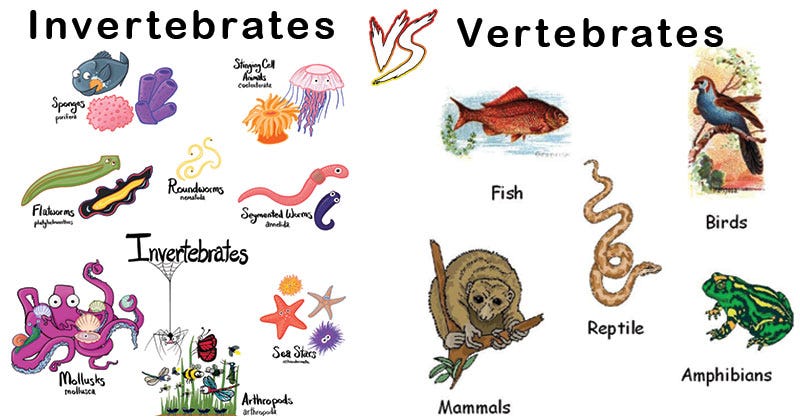
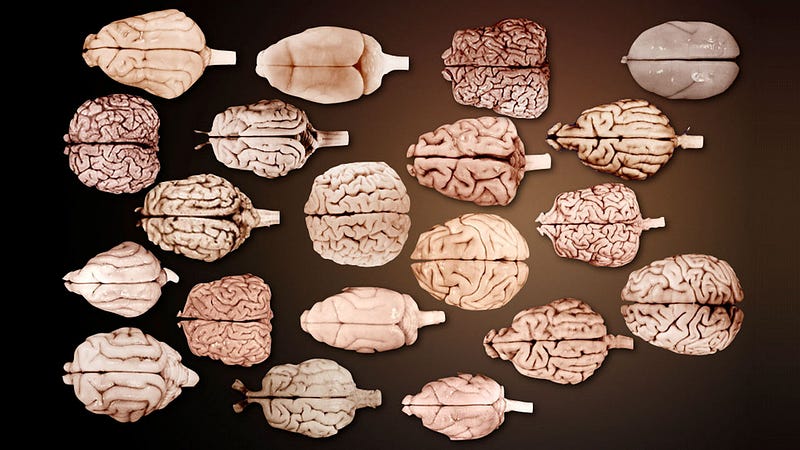
For starters, do other organisms also have brains with two asymmetrical halves? Brains made of two halves with different but complementary functions are biologically efficient. For this reason, you’d expect asymmetrical brains to be fairly widespread in the living world due to filtering by natural selection, as more efficient organisms outcompete less efficient organisms. Indeed, that’s exactly what you find.
To discuss this, we need to make a distinction between organisms with a spine, known as vertebrates, and those without a spine, known as invertebrates. As you can see in the figure above, mammals like us are joined in the vertebrate class by fish, reptiles, birds and amphibious animals such as frogs. Vertebrates have brains with nerve fibers that connect to the rest of their body via the spine.
Although the details are different from species to species, it’s very common to find asymmetrical hemispheres in the brains of our fellow vertebrates. The idea of hemispheric asymmetries doesn’t easily apply to all of our invertebrate cousins, like an octopus whose brain is also located in its tentacles, but still applies to others, at least in a more limited sense.
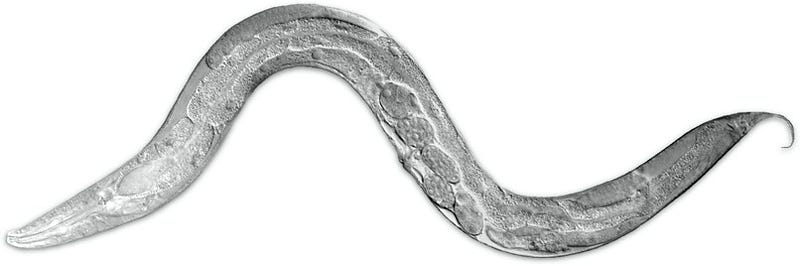
Brains are a specific type of nervous system, but not the only type. Many invertebrates don’t have a brain, but still have cells that function as a nervous system in a way that’s brain-like. One such invertebrate that’s studied a lot is a type of worm, the famous C. elegans.
This little roundworm is popular for research because its nervous system is so simple that its total number of ‘brain’ cells is exactly known: 302. (I’m not a worm researcher, but claims this precise always make you wonder — is it ever 301 or 303?) The important thing for us is that even this extremely simple nervous system shows evidence of having two halves with asymmetrical functions.
Similar evidence has also been found in other invertebrate animals, like slugs and various species of insect. Organisms such as worms, slugs, insects and fish aren’t exactly known for their artistic flair or emotional depth (we’ll exclude A Bug’s Life and Finding Nemo for the sake of everyone’s childhood), and yet many have asymmetrical nervous systems. This casts doubt on the logical vs creative myth as an answer for why our own nervous system comes in two hemispheres.
Even more difficult for the logical vs creative myth, the effects of brain damage in people tell a very different story. In one really bizarre and interesting example described by neuroscientist Onur Güntürkün, people who experience a stroke in their right hemisphere can lose the ability to recognise themselves in the mirror (he first speaks about self-recognition in other animals, and finishes with the example of right hemisphere damage in people).
They can see perfectly well, it’s not an issue with their vision. They also recognise that there’s something strange about this person in their mirror who always copies their style. However, they seem to have lost the ability to conclude that this strange person who wears their clothes and mirrors their behaviours is in fact their own reflection. And this isn’t even the strangest effect of right hemisphere damage.
The way the brain controls the body is quite interesting, as each hemisphere controls the opposite side of the body. When people experience a stroke, at least some paralysis is very common, so right hemisphere strokes often cause at least some paralysis in the left side of the body, and vice versa.
However, some people with right hemisphere damage refuse to acknowledge that they have any physical or mental symptoms of any kind. This curious phenomenon is known as anosognosia. Lack of insight into your own condition is its defining feature, and it’s most commonly associated with damage to the right hemisphere.
Suppose you ask a person with anosognosia to move a paralysed limb. They might insist that it moved when it actually remained completely still. They might say they don’t feel like moving it right now because it’s tired from all the moving it did before. They might deny that the limb belongs to them at all, and argue confidently that it clearly belongs to someone else. Or they might completely deny the existence of the paralysed side of their body, even when shown undeniable proof that it exists and belongs to them.
When people deny that a paralysed body part belongs to them, or that it exists at all, it’s known as asomatognosia. When the person argues that the limb actually belongs to someone else, that’s known as somatoparaphrenia. Although details and distinctions can be important, for the sake of simplicity, you can think of these as extensions of the lack of insight seen in anosognosia.
Iain McGilchrist is a psychiatrist, neuroscientist, philosopher and literary critic (yowza!), and describes examples of this in his book, The Master and His Emissary. In one case, a man initially seemed to have lost all awareness of the left side of his body. Several days later, he began to regain some awareness of his left hand, but no longer considered it part of his own body:
“this patient reports that from time to time an alien hand, which disturbs and annoys him, comes and places itself on his chest: he says ‘this hand presses on my tummy and chokes me.’ ‘This hand bothers me’, he says again, ‘it doesn’t belong to me, and I’m afraid it might thump me.’”
In another case, a hospital patient insisted that her paralysed arm actually belonged to her mum. When asked why her mum’s arm was in her room, she answered that her mum must’ve left it there. McGilchrist even cites a study in which the same symptoms could be artificially induced by selectively anaesthetising the right hemisphere. This is possible because the two hemispheres receive blood from different arteries.
Two historical examples of anosognosia are also quite well known: US President Woodrow Wilson, and a member of the US Supreme Court named William Douglas. Both suffered right hemisphere strokes, experienced significant paralysis and other symptoms, denied that anything was wrong, and tried to forge on despite the haters. Wilson, sitting in his wheelchair while denying his paralysis, was apparently planning to win back the presidency right up to the end of his life, and William Douglas told reporters that he was kicking footballs so well with his paralysed leg that he could play for the NFL.
If the logical vs creative myth was right, damage to the right hemisphere should blunt people emotionally and creatively, but have no effect on their logic and reasoning because their left hemisphere is intact. Instead, damage to the right hemisphere can prevent us from understanding that the person in the mirror is our own reflection, and that our body might be paralysed because of that stroke we had. This sounds a lot like a breakdown in logic and reasoning, which is supposedly the left hemisphere’s turf.
It’s not looking good for the logical vs creative myth, and it’ll only get worse next time when we talk about the effects of left hemisphere damage. Funnily enough, we’ll also see how the effects of left hemisphere damage paved the way for another myth: the left hemisphere is for language and the right hemisphere is for nonverbal functions. See you then!