
Travel
My Solo Voyage Across The Tasman Sea
Quieter than expected, with just one big leak…
People wonder what it’s like living aboard a boat long term and sailing long distances. This story may illustrate some aspects of that life. Many sailors will already know about some of the basic info I have included, but others may not. Either way, there’s always something to learn, not least for me reflecting on the voyage.
This long story is about my third crossing of the Tasman Sea. During the other two, which were very tough, I was accompanied by my First Mate (my better half) and we experienced in total 3 gales in twelve days (first voyage west to east from Eden, New South Wales to Nelson) and a tropical front which blew out two sails (east to west from Opua to Bundaberg, Queensland). For the third I was determined that my lady would fly across. She, I and my boat are of an age when things break more easily and I did not want her exposed to the risk. She was unhappy about it, but accepting.
Challenges and Planning
Generally, the weather patterns make a west to east crossing of the Tasman Sea more challenging than east-west. This is because on average the winds are easterly — i.e. ahead. My boat does not sail well to windward at all, so I expected to do a lot of motoring when the wind was unfavourable (and hopefully light).
Sail/Motor
I could not carry enough fuel to motor all the way across (nor would I want to). I was limited to 650 litres including a reserve of 130 litres. My boat will use 1 litre per mile at 6 knots in calm seas (no wind), and 0.7 litres per mile at 4 knots, motor sailing in moderate seas and close to the wind (30⁰-40⁰ angle). Any closer becomes too uncomfortable on a long voyage. Therefore I expected — nay hoped — to be able to sail for over half the distance.
I don’t like using the engine — too much to go wrong, but it has served me well for 25 years (it’s a Mercedes OM366 from a Unimog if you are interested). At sea I stop the engine every 24 hours and carry out the basic engine checks. I also change the fuel filters every 100 hours and before I go into harbour.
From Coffs Harbour, New South Wales, to Opua, New Zealand, is about 1140 nautical miles taking the most direct route (great circle). I expected to sail/motor 20% more than that distance.
I planned to average about 4 knots ~ 100 miles per day. That’s walking pace. Manageable for me, with stressing the rig or the engine too much. 100 miles a day was the average for sailing ships crossing the North Atlantic from Europe to North America.
Exit/Entry ports
When entering or departing a country there are a limited number of approved ports that can be used in order to satisfy the requirements of customs and immigration (and other organisations depending on country). Coffs Harbour in Australia and Opua, New Zealand, fitted those requirement. Advance notice has to be given (typically 48 hours).
Routing
I’ve sailed in many parts of the world, including many years in Brittany (France) where the tidal range can be up to 12 metres (40 feet) and which is wide open to the wide North Atlantic Ocean. Tidal currents amongst the Channel Islands can run as high as 10 knots and it’s not a place for the faint-hearted when conditions are bad. But generally, voyages there are short and manageable and shelter can usually be found within 12 hours.
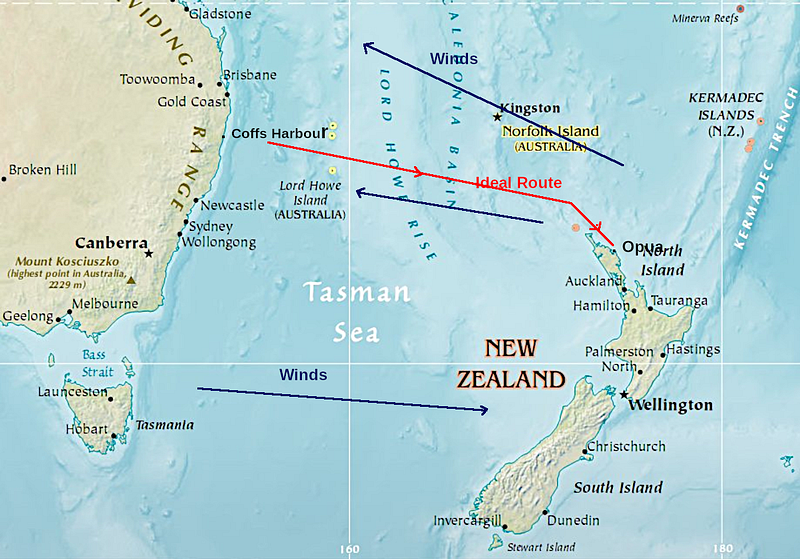
Not so the Tasman Sea. 1,000 miles across between Australia and New Zealand the tidal currents are non-existent away from land but any shelter can be as much as 5 or 6 days away. Most sea-going vessels can deal with a lot of wind if they have enough sea room, but the actual sea is something else. A small boat cannot compete with the weight of hundreds of tons of water in a big wave if it breaks over you.
The Tasman Sea usually has at least two swell systems apparent. One system comes up from the Southern Ocean, and one comes down from the Trade Wind belt. Add to those the locally generated wave systems and you have the potential for some vicious and irregular wave combinations. On my second trip a wave picked us up and lifted us bodily sideways and dumped us. There was no damage but the experience was unforgettable.
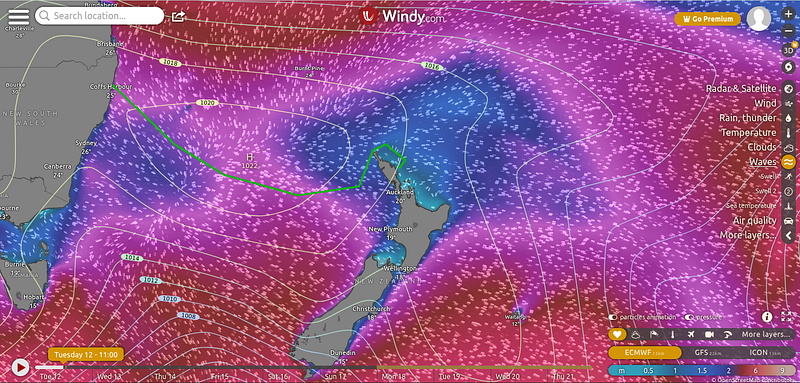
Today, as I write, the weather pattern over the Tasman Sea is very similar to that when I left Australia in mid-February. Here is an image of the wave patterns from windy.com. I’ve overlaid the route I planned, in green.
The Tasman can also experience sub-tropical cyclones the greatest risk of which is between November and April.
My ‘bible’ for routing is Jimmy Cornell’s ‘World Cruising Routes’. This covers weather and general navigational risks and suggests routes for most voyages a sailor would want to make. It distills several centuries of voyaging knowledge. Its recommended ‘best time’ for my planned trip is January/February. I planned to leave Australia before mid-February when my visa was due to expire. The boat too has a visa (1 year in Australia) and that was also due to expire, so it was time to move on.
You may have gathered that the planning has to be fairly long-range to meet the requirements of the authorities and the seasonal weather patterns. And the boat has to be ready. I was ready to leave by 1 February. The best weather window came about 10 days later.
Stores
The endurance of a sailing vessel is governed by her ability to carry/make fresh water. I had 700 litres of water which would last me a few months on my own, even including washing.
I provisioned for 20 days. I carried plenty of tinned and dried food, and my frozen meat and fresh vegetables lasted until I arrived (chicken thighs and fresh onions which I had to jettison more than 12 miles out due to New Zealand’s bio-security regulations). The bio security guy removed 2 tins of Spam during his visit! Australian corned beef was ok, but not tinned pork.
I also carried red wine. One glass only of Chateau Cardboard with my evening meal.
Loneliness
I’ve done a few long passages single-handed, the longest being 1,200 miles from the Canary Islands to Portugal, against the prevailing winds. That’s another story with a different set of challenges (except the wind direction always ahead), which I’ll save for another day. Therefore I was no stranger to the solitary experience and I’ve owned this current boat for 25 years so she we know each other well. She has looked after us well.
There is always something to fix, navigation to be done, weather forecasts to be downloaded (I use an old Iridium satphone to download weather gribs from saildocs.com). Spare moments are filled with a book of Times crosswords, solitaire, bird and sealife watching. I eat well and sleep when I can. So loneliness is not a major problem, and I kept in touch with the First Mate with a few satphone texts. She could follow my progress via AIS on marinetraffic.com.
Lookout
Almost all deep sea vessels have AIS these days and my radar has a guard ring setting. These will warn me audibly when a ship is in the vicinity. I stay away from the shipping routes and sleep when I need to. The risks of collision in the deep sea are then very small. Of course when approaching land or having to navigate within shipping routes then I have to keep a careful watch and cat-nap.
Sails
My boat is an old steel schooner, 15 m long. It was important to sail within my aging physical capabilities so I planned to sail with one reef in the mainsail, a yankee and a forestaysail. When conditions allowed I set a mainstaysail and let the reef out of the main. When motorsailing it was with forestaysail and reefed mainsail. The topsail (aka fisherman) stayed bagged on deck!
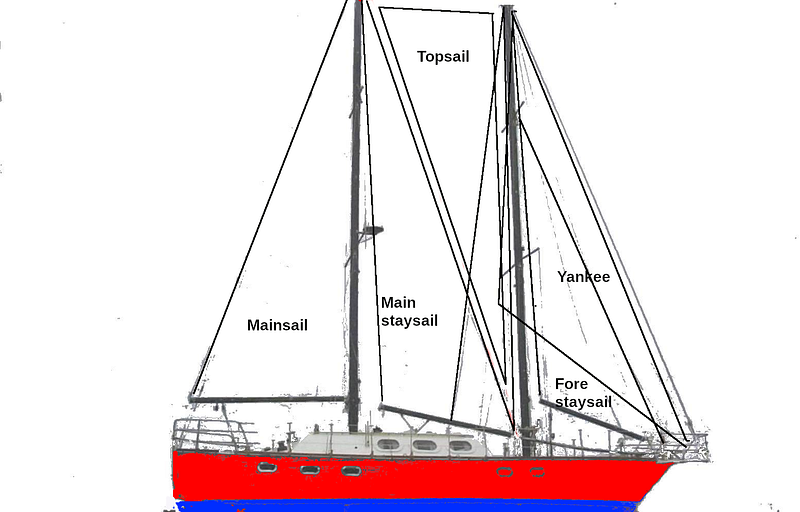
The yankee and mainstaysail are both on roller furlers, so can be set/furled from the cockpit. I rarely need to go forward on deck, except to do a daily rigging check. Although there are several sails they are of modest size to handle. She has a displacement of 27 tons and is comfortable at sea (usually). Smaller vessels are more lively and tiring to sail — and everything happens more quickly.
The voyage outcome
The weather
The 10 day weather forecast which I obtained before leaving turned out to be fairly reliable. That was a surprise, because anything past 3 days is usually dubious. But in this case I’d waited for what looked like a fairly stable pattern with a high pressure sitting over the Tasman Sea. Generally the winds were light, even non existent but I had a few good sailing days and rarely saw winds of over 20 knots.
I did have to deal with a couple of days of easterlies and had to bide my time until the direction shifted a little to allow me to make progress.
This is how the grib looked on the day I left Australia, my three Tasman crossing tracks in magenta — this latest is the middle track (technically, the second, northerly track was really a crossing of the Coral Sea):
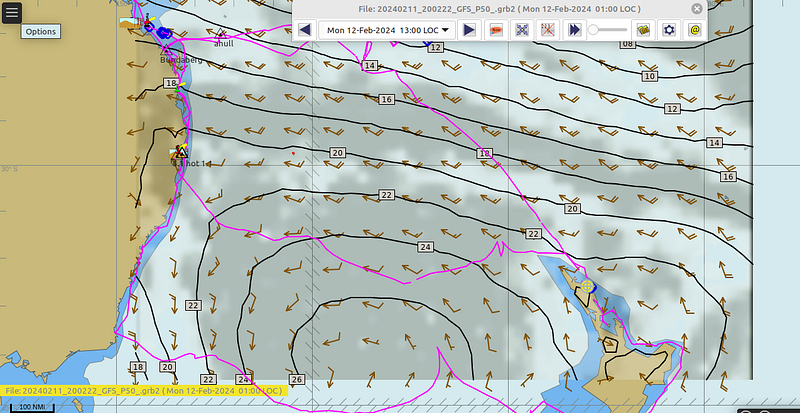
The sea conditions were generally good. The most uncomfortable were the first couple of days out from Coffs Harbour when the mixed swell directions unsettled my stomach (that’s rare for me) and the wind was from the north. This was compounded by the usual ‘first 3 days’ when the body is adjusting to the changed environment and sleep patterns. I took some Travacalm (ginger tablets).
The other uncomfortable time was rounding the Three Kings Islands at the top of New Zealand. Spring tides were running and there are overfalls aplenty so I kept well outside (away from the shipping, too). 10 miles east of King Bank the seas were very confused and uncomfortable for a few hours on the ebb but fortunately there was very little wind to really stir things up.
There were several days of blue skies and calm blue seas with just a little swell, but of course they were spoiled by the sound of the engine.
Was I sinking?
Three days out from Coffs Harbour during one of my checks of the bilges I discovered a few hundred litres of sea water. Then a pump failed and I rigged up another once I had traced the leak.
In the galley I have two sinks. In one, the drain fitting clamp screw had corroded and the fitting had separated slightly. Every time the boat rolled another 1/2 litre of seawater came in. I shut off the seacock. Then I fitted a replacement screw with fresh sealant.
Soon, all was dry. Panic over.
I have to remember to replace the other screw…
Wildlife
I group of shearwaters accompanied me for several days, then I started to see storm petrels. Then I saw a few Jesus birds (white faced storm petrels), so called because they appear to walk on water.
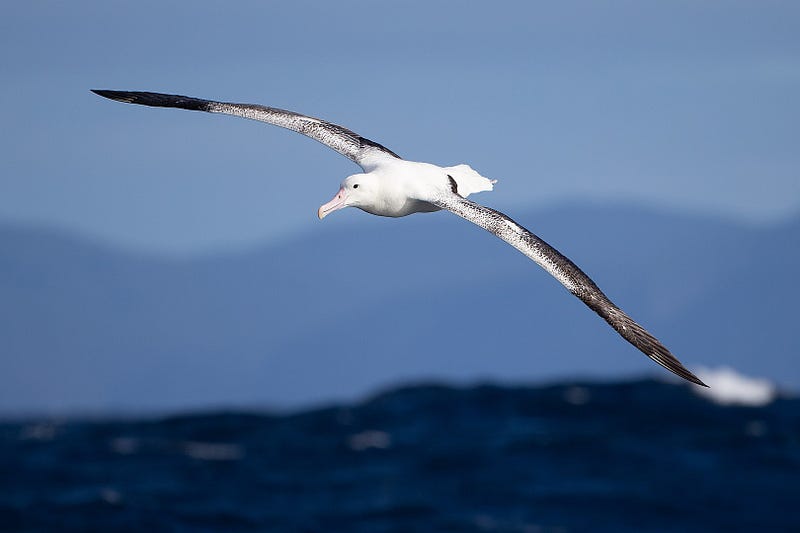
Undoubtedly, the highlight was seeing Royal albatrosses on 3 occasions as I approached New Zealand. They are amazingly graceful flyers.
There were also a few dolphins en route.
I don’t know if this qualifies as wildlife, but I did pass a few thousand people on a cruise ship…
The numbers
My log records 1,360 miles travelled ‘over the ground’ in 335 hrs ( 1 hour less than 2 weeks). That’s an average of 4.05 knots with 19% more distance than the direct route.
I had the engine running for 179 hours (52% of the time) and used 490 litres of fuel.
My expectations for the trip were minimum 12 days, maximum 20 days, so an outturn of 14 days and 19% extra distance was not too bad.
There were times when I was concerned about fuel consumption but all in all it worked out well.
I was lucky!
Why do it?
Sailing solo is not my preferred option, but sailing with crew presents a different set of challenges. I’ve done it many times, even trans-ocean from UK to Brazil and back in 2006.
Having my First Mate with me was not an option for this trip as I outlined earlier.
Also, the First Mate does not like curry. So I was able to indulge myself with curries every second day.
Of course I had to do it. I had to move the boat out of Australia or face paying many thousands of dollars import duty. That was not an option.
Also, I believe that it is important (for me at least) to get outside my comfort zone from time to time and I’ll not pretend that I didn’t face this trip with some trepidation.
What did I miss?
Apart from the First Mate that is?
I’m a current affairs junkie and the state of the world had been depressing me of late. Taking a couple of weeks away from it all was a bit of a retreat. I did download one BBC news bulletin en route. It’s slow on my satellite link at 4,800 bps, text only, but I was cheered to learn that Donald Trump had been fined $354 million for fraudulent business activities.
Where next?
I’ve barely arrived and yet I need to start thinking about where next? My New Zealand visa is good for six months and the boat has a Temporary Import Exemption (TIE) for two years. The TIE is great for saving sales tax on boat-related expenditure and is one reason why long distance Pacific sailors head to New Zealand for refits during the cyclone season.
But where next?
Fiji? We missed Fiji during our Pacific crossing so it’s unfinished business. A foreign boat can be based there for three years, but there is the cyclone risk to consider. Then, on to Vanuatu or New Caledonia?
New Caledonia? A taste of France with cyclone risk and yet another set of islands we missed in 2019. Then — Australia or Indonesia (Papua New Guinea is currently considered to be dangerous). Or on to Indonesia? Been there, done it. Last year. No desire to return.
Back to Australia? This is a possibility — we have family there but the one year visas require maximum stays of 3 months per visit for us. That involves return flights to another country.
But…
The options all involve voyages of about 1,000 miles. At least the wind direction would be more favourable.
We’ll see.
But for the moment the First Mate is enjoying her fishing (not my thing) and keeping us fed with snapper, kahawai and occasionally, gurnard.
If you’re interested in any of my/our other worldwide seagoing experiences, here’s a selection:
Full index here:
Follow me and I guarantee variety in your inbox with some unusual perspectives on sailing, tech, space, geopolitics and travel, together with daily news events and the minutiae of my daily life living on a boat. I also write techno-thrillers with maritime themes…

My novels are available at my Gumroad bookstore. Also at Amazon and Apple
Or maybe just buy me a coffee? and tell me what you liked reading (or not)…


