
Fresh Water
New Desalination Technology
Fresh water from salt, solar powered, with design input from machine learning. I can’t wait!
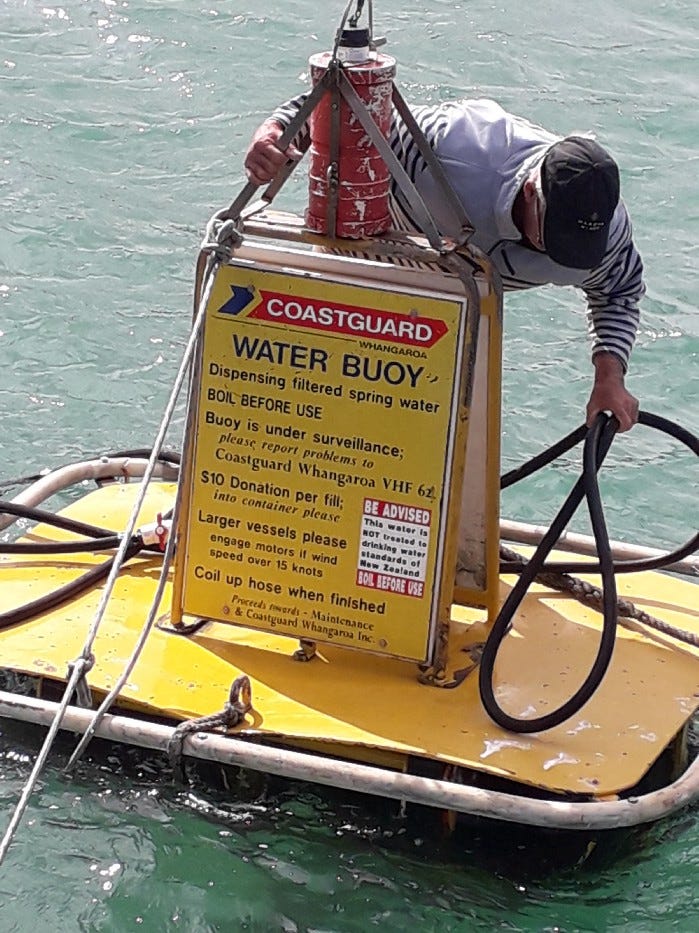
Water, water everywhere, nor any drop to drink!
KISS on a boat
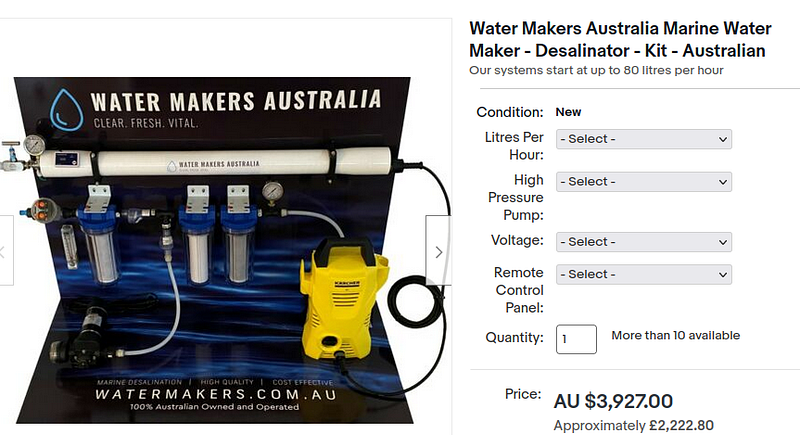
Living on a boat as I do, obtaining fresh water is a problem. I try to follow the KISS principle and so I’ve avoided the complexities associated with power-hungry marine desalination systems.
As an engineer once said to me:
Marine watermakers are an inefficient way of converting diesel fuel into water
Yes, they use a lot of power, which has to be generated. And you have to carry the fuel to run the generator.
I wrote about the challenges of obtaining water on a boat, here:
We get by, being careful with consumption and filling up when we can, catching rainwater to top up our tankage of about 110 gallons.
Safe, fresh water is a necessity of life.
I always said I’d wait for newer, simpler technology to come along.
And now it has.
New technology
MIT researchers have created a portable desalination unit that can automatically remove particles and salts simultaneously to generate drinking water. “This is really the culmination of a 10-year journey that I and my group have been on,” says senior author Jongyoon Han — MIT News
The basics
The team have developed a portable desalination unit, weighing less than 10 kilograms, that can remove particles and salts to generate drinking water from seawater.
A modest, portable solar panel can be utilized to power the device, which requires less energy to function than a cell phone charger. It automatically generates potable water that adheres to World Health Organization standards. The technology is incorporated into a user-friendly package that works with the press of one button.
This device, unlike other portable desalination units that require water to be pumped at high pressure through reveres-osmosis filters, removes particles from unclean water using electricity instead. The need for replacement filters is greatly reduced, resulting in decreased long-term maintenance needs.
Remote and resource-strapped locations, such as small islands or long-distance vessels (like mine), could utilise this device, as well as in disaster-relief situations. Or war zones.
The details
The design employs ion concentration polarization (ICP), which was first developed by Han’s group more than 10 years ago. ICP uses an electric field to charge membranes on both sides of a channel of water. As particles flow through the channel past the membranes, they are repelled or attracted depending on whether they have a positive or negative charge. The charged particles are siphoned into a second stream of water that is discharged at the end of the process.
The method was developed to remove both dissolved and suspended particles, allowing clean water to pass emerge from the channel. ICP consumes less energy than other processes because it only requires a low-pressure pump.
But ICP does not always remove all of the salts that float in the channel’s middle. As a result, the team added a second process known as electrodialysis to reduce any remaining salt ions.
Finding the right balance between the two parts of the process was challenging, but the problem was resolved using machine learning (ML).
The technology is conveniently packaged as you can see in the video below. A smartphone app controls the process.
A water-quality meter is included to confirm the potability of the output flow.
The team tested the package to the beach in Boston and it worked straight off.
On my boat?
Power consumption is 20 watts/litre — much less that for a reverse-osmosis marine system and it appears to be capable of running continuously.
Output is not voluminous at 300 cc per hour, but it would do me on my boat. We each (two of us) need about 4 litres a day when sailing in the tropics. And I’m sure it will be scaled up.
I can’t wait!
About me: If you follow me I guarantee variety in your inbox! I write on a wide range of topics including humor, tech and travel, together with daily news events and the minutiae of my daily life living on a boat. I also write techno-thrillers…and about…
…floating on water that I can’t drink
If you appreciate stories like these and want to support other writers and me, please consider signing up to become a Medium member. It’s only $5 a month, giving you unlimited access to incredible stories on Medium. If you sign up using my link below, I’ll earn a small commission at no extra cost to you.
Or just buy me a coffee?


