
My Husband’s Kidney Failure Journey, Continued
Bloodwork and PET scan results, PD update, and waiting for more tests
My husband was diagnosed with kidney failure in September of 2022. It took a visit to the Emergency Room, a stay in the ICU, and a total of eight days in the hospital to have him feeling better.
Dennett has been keeping us updated on her husband’s dialysis journey, so I thought it was time to finally sit and write an update of my own.
Since his initial hospital stay, my husband has had several surgeries, two kidney transplant consultations — one in Salt Lake City and one in Las Vegas — a visit to a hematologist, a PET scan, and an upcoming bone marrow biopsy and colonoscopy.
I’ll describe the consultations and the hematologist appointment in more detail in another post, but for now, here is an update on the peritoneal dialysis, bloodwork results, PET scan results, and the bone marrow biopsy miscommunication.
Peritoneal Dialysis
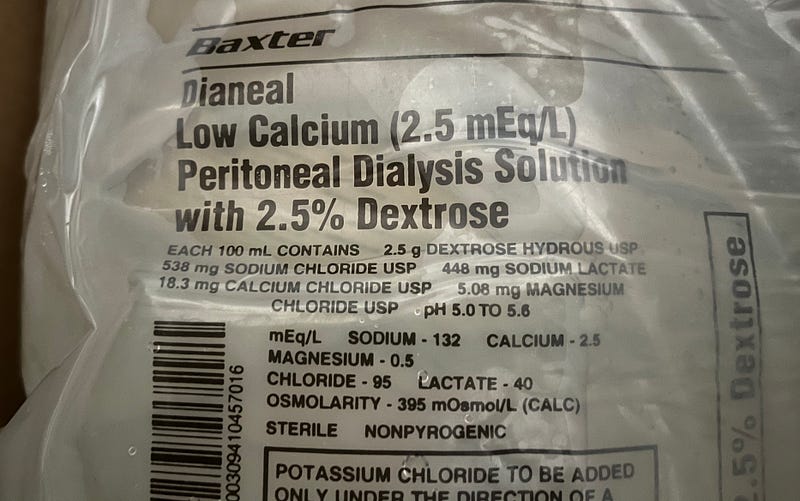
After several months of visiting the hemodialysis clinic, Dave was able to have a surgery that allows him to get peritoneal dialysis (PD) at home each night while he’s sleeping. PD makes it possible for him to travel for work without having to make an appointment at a dialysis clinic in another town. It’s not easy or convenient, but it is possible.
The PD process takes concentration because of the risk of infection (especially with two dogs in the house), and the boxes of solution take up a lot of space in the garage. The machine beeps and lights up during the night, so a night of uninterrupted sleep is rare these days. This journey has taken a lot of patience, and it’s definitely been a learning experience.
My husband is concerned about his weight gain with the PD solution, so he is working with the dialysis clinic and discussing the possibility of at-home hemodialysis. He would have to have another surgery to make a fistula for access to his veins, but he thinks it will be more convenient for life in general, especially traveling.
In order to be added to the kidney transplant list, Dave has to go through a series of tests. During his hematologist visit, they took 37 vials of blood to rule out autoimmune or genetic diseases that could disqualify him from a transplant.
They found high protein levels that could mean Multiple Myeloma, a type of blood cancer that affects plasma cells and bone marrow. The hematologist requested a PET scan and a bone marrow biopsy. Multiple Myeloma causes kidney failure, so that diagnosis would make a transplant unsuccessful.
PET Scan Results
Hypermetabolic right inguinal lymph nodes, which may be due to right inguinal nodal involvement…
Nonspecific focal hypermetabolism in the posterior distal descending colon. It may localize to intraluminal contents of a diverticulum or to a focal colonic lesion. Recommend colonoscopy.
Colonic diverticulosis. Dialysis catheter. Atherosclerosis. Small fat-containing umbilical hernia.
VISUALIZED MUSCULOSKELETAL SYSTEM: No hypermetabolic osseous lesions.
He has not gone over the results with a doctor yet, but of course, we went straight to Google. The test could be showing inflammation, not cancer, but he will have to have more tests to make sure.
Bone Marrow Biopsy: Postponed Due to Miscommunication
Dave’s bone marrow biopsy was scheduled for Friday, July 21. We drove the 30 minutes to the hospital in Reno and he checked in. They had him sit in a hospital bed, asked him all the questions about his health history, and got him hooked up to an IV.
The nurses took some blood samples, and we waited for the doctor to come in to explain the process and get his consent for the procedure. The doctor arrived and asked Dave when was the last time he’d eaten, which was breakfast that morning. The doctor stopped, saying he should have fasted so he could be sedated during the biopsy.
Dave’s doctor’s office had called the day before about the appointment and he’d asked them if he needed to fast. They said no, he would only have local anesthesia, so it wasn’t a problem if he ate that day.
We’re not sure how or why the miscommunication happened, especially with important information like that, but now we know.
Everyone, including Dave, decided it would be better to reschedule so he would at least have the option of being sedated. It sounds like the pain level for this particular biopsy depends on the person. The doctor said some people handle it well; he had performed a biopsy the previous day and the patient said it was only a 4/10 on the pain scale. Others do not handle it well at all and the pain is more like 8 or 9/10. I’d have rescheduled too!
The way the doctor was insisting on having it as an option gave me the impression that he’s probably been yelled at, screamed at, threatened, and called some nasty names by patients who were not sedated.
And Now We Wait
As frustrating as it is, we have to wait for the tests to be scheduled, then it’s more waiting for the doctor to go over the results. The bone marrow biopsy has not been rescheduled yet.
Because my husband isn’t 45 years old, he has to get pre-approval from his insurance for the colonoscopy before he can schedule the procedure. More waiting…


