
My First $1,000 Article Is About Baby Murder
5 lessons learned about writing and earning money online

As of March 17, 2021 (Happy St. Paddy’s Day), my first article to break $1k has made a total of $1,092.13
Surprisingly, this best-performing article is about baby murder. More accurately, it’s about unfortunate advice in a parenting book associated with a major spike in infant mortality in the 1940s and ’50s.
The article in question is “The Book That Killed 1,000 Babies”:
I thought it might make an interesting case study about writing for money online. So, in this story, I will share all the juicy data that I have about the article and the five surprising lessons I’ve learned.
“Our job is not to create content. Our job is to change the world of the people who consume it.“— Andrea Fryrear
Just the Stats
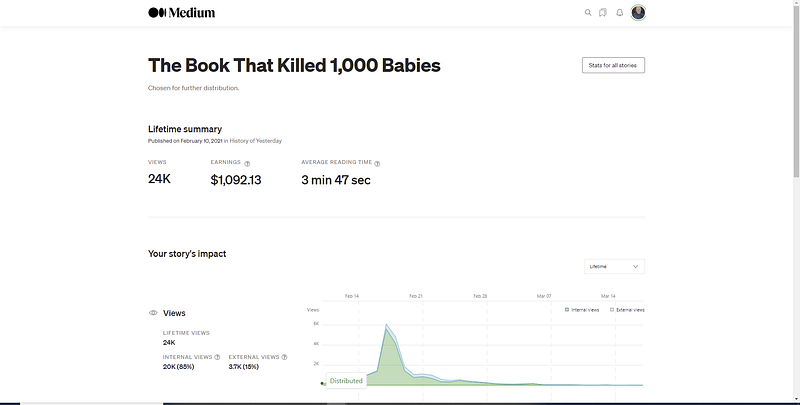
Whenever I study one of my high-performing articles, the first thing I do is dig into the analytics. I think good data proceeds good insights.
Therefore, here are the relevant statistics for my $1,000 article:
- Published on February 10, 2021
- Distributed on February 10, 2021
- 6 minute read time
- Published in History of Yesterday publication
- $1,092.13 earnings (so far)
- Title: 6 Words
- 24K lifetime views (so far)
- 20K internal views (85%)
- 3.7K external views (15%)
- 3.8K claps
- 54 comments (and boy were some of them doozies!)
- Average reading time: 3 minutes and 47 seconds
- Member reading time: 448 hours and 36 min
For me, the biggest takeaways from the data are the title, read time, and publication.
The short title includes a number and compelling words like baby and killed. This article is more proof that a 5–7 minute read time produces the best results.
Finally, I published the article in a smaller, niche publication.
Why I Wrote This Article
I wrote the baby article after researching online about books that caused the most destruction. I’m pretty sure the Bible gets that award, but that’s not my point here.
A parenting book popped up in my search.
That lead me down a line of exploration that resulted in the title, “The Book That Killed 1,000 Babies.” The title jumped out at me. Grabbed me by the throat. Tied me up and kept me in a basement dungeon-prison until I promised to write the article.
My muse is kind of an as*hole.
More like the archangel, Micheal, than Cupid — if you know what I’m saying.
Back to my story. The title came to me first, then I compiled the research into a coherent narrative that I thought accurately depicted the historical events. I put lots of research into it.
Unfortunately, much like the Doctor in my article, I had no idea what was coming.
The Unexpected but Expected Backlash
I expected some controversy. I’m no dummy; I knew the topic might strike a nerve.
I was writing about a doctor who had accomplished a lot of good for babies but had unwittingly added dangerous medical advice during, of all times, the baby boom. It was a catastrophic confluence of events.
Boy did I underestimate the response from readers.
Apparently, my article polarized many readers into two broad camps: generally supportive and vitriol-fueled murder-rabbits.
The following are just some of the comments. Since this isn’t meant to call out anyone, I’ll just use their first names.
Mark said:
A misleading and stupid article, a sensationalist title that puts blame on one person rather than literally the entire medical profession at the time. I will not waste another moment reading anything by such an irresponsible writer.
Ouch! This one hurt. Even though I relied on third-party credible sources to point out cause-and-effect, I do agree that the title is meant to grab attention. I wasn’t trying to place blame, but I did go back and revise a few phrases to try to make that clearer.
Tom was more subtle:
This guy must be thinking of Mr. Spock and the thousands of children whose hands he deformed by encouraging them to do the the Vulcan salute🖖. Seriously, this clickbait is bullshit. I wish I was following this hack so that I could unfollow him after this piece of crap.
Just kidding. He really laid into me. I’m not saying I don’t deserve it, but damn, I stopped reading my comments for a while after it started physically paining me.
To end on a lighter note, Ramona commented:
I have to be honest. I couldn’t finish the article. But the comments were awesome!
I actually laughed when I read this comment — it’s just so honest and so like something I might think and feel. The comments of almost anything online often are the best part of any post, article, or video.
In their defense, the commenters make some very good points. Mean maybe, but valid. Based on their feedback, I did add a disclaimer in the intro of the article.
After the disclaimer, I no longer received critical comments. It just goes to show that I still have lots to learn.
5 Lessons Learned About Writing Online
Speaking of learning, the experience with my article taught me five lessons about writing online.
1. Controversy works — but potentially at a cost
I believe the biggest reason for my article doing well is that the title is borderline clickbaity.
Also, it pissed people off — either against the tragedy of infant deaths and/or against me.
Controversy is a powerful marketing device.
It’s probably the reason the article took off with internal paid members on the platform. It’s probably why my “Science of Better Blowjobs" article is my second best performing article to date.
I think the edginess or taboo nature of some topics helps spread them to a bigger audience.
However, success can come at a cost. You might get hateful comments that degrade you and your writing. You might flinch with each criticism, endure painful introspection, even reply kindly but get a bitter backlash in return.
Then again, perhaps criticism is the currency of creation.
“Criticism is something we can avoid easily by saying nothing, doing nothing, and being nothing.”–Aristotle
2. Cross-topical articles can perform well
I really believe that one of the “secrets” to reaching a larger audience online is to write what I call “cross-topical” articles.
In other words, articles that include several different but related topics. For example, my “Book That Killed 1,000 Babies" article combines the topics of books, parenting, history, and true crime.
And, in fact, my five tags for that article are:
- History
- Books
- True Crime
- Life
- Parenting
3. Clickable titles get views and reads
If you’ve written online for any amount of time, you realize that titles can make or break your articles.
My understanding and skill at titles continue to evolve. I learn new tricks or templates almost weekly.
Some of my favorite recent insights about titles:
- Include “Me”, “I”, “You”, or “Your” in your title. Example: “The Most Important Skill Nobody Taught You”.
- Titles with the word “Damn” might do well, especially when “Damn” is placed near the end of the title. Example: “How I Write (and Publish) So Damn Much”.
- This formula tends to work: Number + Traits/Signs of + Unique Category. Example: “Five Signs of a Highly Intelligent Person”.
- Include a pop-culture reference. Example: “Can You Actually Make Money Selling Tweets? I DM’d a Crypto Trader to Find Out.”
- Take an interesting or unique perspective. Example: “Sex Robots Could Save Your Relationship”.
- Titles that start with “Yes” or “No”. For example: Yes, You Can Do That During the Work Day
- Short, simple, clear, and “boring” titles can sometimes work. I thought my “How to Sketch a Startup” title might not work, but it did and was even featured on the front page of The Start Up.
- Titles that ask an intriguing question. Example: Why Is The Age of Consent in Japan Only 13-Year-Old?
4. Articles can go “micro-viral” in niche publications
Both of my two best-performing articles were published in smaller, niche publications.
- “The Book That Killed 1,000 Babies” was published in History of Yesterday.
- “The Science of Better Blowjobs” was published in Heart Affairs.
I do also love publishing in bigger publications like The Writing Cooperative, Blank Page, P.S. I Love You, The Ascent, and Better Marketing. However, smaller publications that focus on a niche like true crime, history, or relationships can also earn you a good deal of money.
5. Your articles don’t need to be perfect
Thank God perfection isn’t a requirement for success with online writing. Although I rigorously edit my work, run my articles through Grammarly, and read my articles out loud, 100% of them contain mistakes.
I know this because I can spot them easily the moment I submit them or they get published.
Something about a published article spotlights my missed punctuation, misspellings, or misuse of words. There is always an error. Always.
But your articles don’t need to be perfect.
You can find success — small or large — with imperfect articles. Your title doesn’t have to wow the world for you to earn money. Your introduction doesn’t have to rival Shakespeare or Stephen King.
Your content doesn’t have to win any major awards (Leg lamps notwithstanding).
If you write authentic and original articles and edit them as best you can, then you can turn writing online into a robust income stream.
Miserable Failed Attempts At Replication
I tried to replicate the success of this article with two other articles in the same publication — both written out of a passion for the topics. But, of course, I also wanted them to do well.
After falling down a strange internet rabbit hole, I wrote the article, “The Crab That Saved 10 Million Lives”:
I really like this article, and it was well-received, but does not even come close to comparing with the reception of the baby murder story.
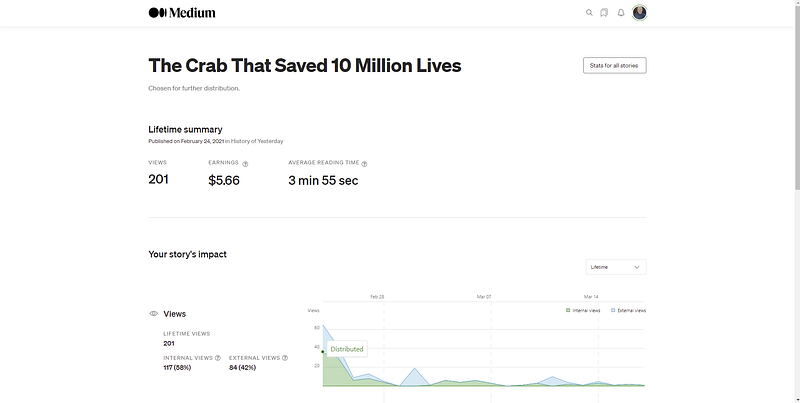
This story has 201 views and so far has earned $5.66. I think it might not have replicated my success because this one is slanted in a positive angle (saved versus killed). This article is also about crabs instead of babies.
Regardless, it’s a great article. You might like it.
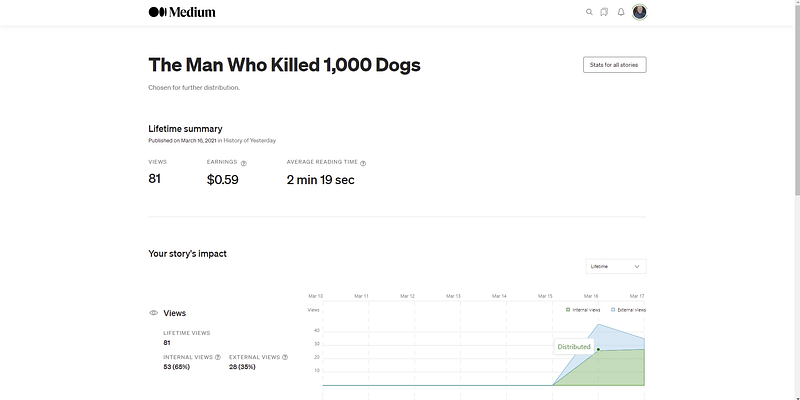
For my second attempt at replication, I switched back to a strategy of vulnerable victims + negative slant. I wrote “The Man Who Killed 1,000 Dogs”:
Like the baby book article, this one was difficult to research and write. It’s a horrendous true story that combines animals, true crime, and shocking cruelty.
Dogfighting is a topic that deserves attention.
I’m proud of the article, and I thought it might do well. However, it is both the most recent and (so far) worst performing of the three articles.
Final Thoughts
I’ve been wanting to write this article for a while. I hope that it sheds some light on my process.
I hope that it helps steer you towards your own viral or semi-viral success online. Writing can be hard. I hope that this information makes it just a little bit easier.
“We need to stop interrupting what people are interested in and be what people are interested in.” — Craig Davis


