
“My Best Friend’s Wedding”: A Subversive Romantic Comedy Classic Turns 25
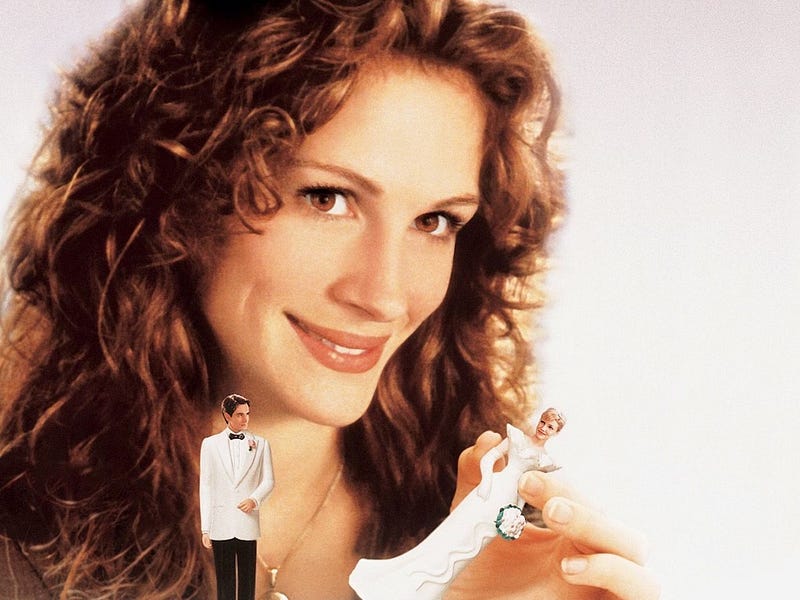
In 1997, Julia Roberts solidified her status as a box office powerhouse with this unconventional romantic comedy that defied expectations and featured three award-worthy performances.
It is hard to overstate how much My Best Friend’s Wedding defied expectations.
First, the film completely reversed Julia Roberts’ trajectory in Hollywood. The romantic comedy arrived at a critical juncture in her career when her star appeared to be fading. From 1989 to 1993, she scored two Oscar nominations (Best Supporting Actress for Steel Magnolias and Best Actress for Pretty Woman) and headlined four $100 million+ grossing blockbusters — Pretty Woman, Sleeping with the Enemy, Hook, and The Pelican Brief. But starting in 1994, she had a series of box office disappointments including I Love Trouble, Something to Talk About, Michael Collins, and Mary Reilly. The success of Wedding marked a major resurgence that led to a string of box office smashes like Stepmom, Notting Hill, Runaway Bride, Erin Brockovich (the film that won her the Best Actress Oscar), and Ocean’s Eleven.
The film was not just a box office hit, it was a bona fide smash. It grossed $127 million domestically and a further $172 million internationally for a total just shy of $300 million. That number may seem merely great by 2022 standards, but there are two important pieces of context. The first is that it was a very modestly budgeted film at $38 million, making the profit margin enormous. The second is that when adjusted for inflation that equates to a worldwide gross of $545 million, a sum virtually unheard of for a non-franchise comedy nowadays.
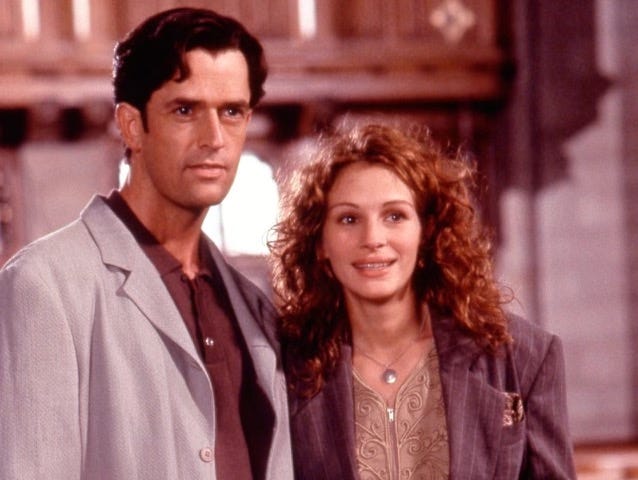
Additionally, the film garnered Roberts her best reviews in several years. The film was solidly well-liked by critics overall with a 73% critical approval rating on Metacritic and it also fared decently well with the industry, given its three Golden Globe nominations (Best Picture — Musical or Comedy and acting nods for Roberts and Everett), BAFTA nomination (for Everett), and Academy Award nomination (for its score). But even many of those who were not won over by the film as a whole voiced admiration for her against-type and nuanced performance.
The fact that the film’s lead role of Julianne “Jules” Potter was yet another way the film defied expectations. When audiences showed up to see “America’s Sweetheart” Julia Roberts headline a summer romantic comedy, virtually no one expected to see her playing a cold-hearted, self-centered, hard-drinking, chain-smoking, and foul-mouthed twenty-something determined to wreak utter havoc on the life of her beloved best friend. But that’s what they got. And that’s just the beginning of the expectation-defying elements that unfold on screen.
The film begins with Jules, a successful food critic, out to dinner with her editor and friend George (Rupert Everett). She calls to check her messages from her chunky cell phone and is surprised to find an urgent message from her best friend Michael (Dermot Mulroney), whom she has not talked to in several months. She suspects that he is calling to make good on their pact to marry each other if they are still single when they turn 28 (oh, how times have changed). When she returns his call, she is shocked to find out that he’s getting married to someone else…in a few days.
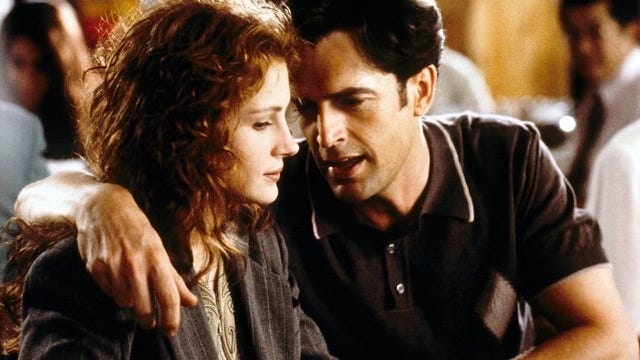
With her ego bruised and her backup plan derailed, she hops on a plane from New York to Chicago determined to do whatever it takes to break up his impending marriage and convince Michael to be with her instead. Jules expects to hate Michael’s fiancee Kimmy (Cameron Diaz), well, because she hates most people. It certainly doesn’t help that Kimmy is a stunningly beautiful, soft-spoken, seemingly naive, blonde-haired and blue-eyed college junior whose father is a billionaire multimedia mogul. But much to her surprise, Kimmy is irresistible. And when Kimmy asks her to fill in as her maid-of-honor, Jules is put in an exceedingly tricky position.
Jules engages in some truly evil schemes to drive Michael and Kimmy apart and each falls apart spectacularly, but not without chipping away at Michael and Kimmy’s trust in one another leaving Jules even more heartbroken. George swoops in to help her gain the courage to stop scheming and just tell Michael she loves him, but she chickens out and tries to pass off the gay, partnered George as her fiance. As George returns to New York, he tells Jules that it’s over and that she has to give up and let Michael and Kimmy be happy together. You can see in her eyes that she knows that he’s right, but her pride simply cannot allow her to give up the fight.
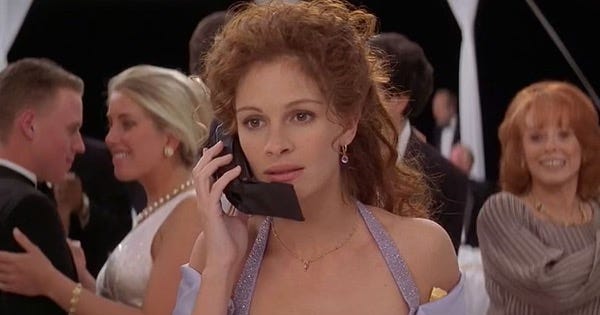
The film ends with Jules coming clean to Michael, who rejects her but forgives her. Jules begs for Kimmy’s forgiveness and gets it before finally doing what she should have done all along — put her own feelings aside and join them in celebrating their marriage. Clearly the filmmakers realized that however well-justified this ending was, it would be too bleak for many viewers. Michael and Kimmy may have inexplicably forgiven Jules, but would the audience?
To address this concern, they made a brilliant creative decision. After Michael and Jules go off to their honeymoon, a dejected Jules sits alone and despondent at the reception only to receive a call from George. It turns out he has flown there to be with her and help her mend her broken heart on the dance floor. It ends with Julia Roberts’ trademark toothy smile and infectious laugh. But the fact that the film ends with Roberts not in a romantic embrace with the man of her dreams but in the platonic embrace of her gay best friend is a genuine upending of everything everyone had come to suspect from mainstream romantic comedies.
Julia Roberts is utterly masterful as Jules. She delivers a tour-de-force performance that in some ways is similar to her career-best turn in Erin Brockovich a few years later. In both films, she expertly delivers vicious insults and tearful speeches with aplomb but truly excels in the quiet moments. Rewatching the film for the umpteenth time, I found myself transfixed with the subtleties of her performance, which is a treasure trove of nonverbal nuances. Even though some undoubtedly will argue that the casting of “America’s Sweetheart” as the villain who doesn’t get the guy to be a gimmick, I argue that it is actually the only way the film could work. Without someone as talented and universally beloved as Julia Roberts in the role, the character of Jules would likely have been flat-out rejected by audiences (undoubtedly spelling disaster for the film).
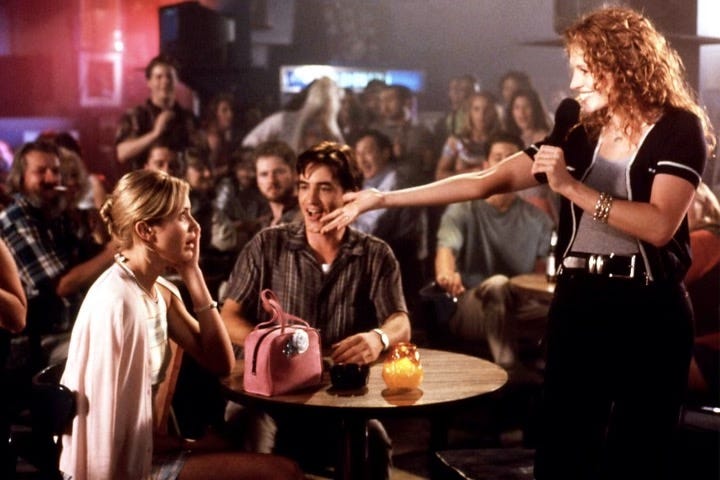
As much as the film benefits from casting Roberts as Jules, it benefits just as much from casting Cameron Diaz as Kimmy. After her auspicious film debut opposite Jim Carrey in 1994’s The Mask, Diaz became a hot commodity in Hollywood landing several high profile roles. Wedding was her best role to date and she knocked it out of the park. In lesser hands, the role could have been a grating, one-note plot device who the audience roots for the downfall of. In Diaz’s hands, however, she is a remarkably charming and sympathetic woman whose actions are believable, heartfelt, and endearing. Her karaoke scene when she goes from wide-eyed terror to humiliation to gleeful relief is simply brilliant acting and the character development she gets in the span of 100 minutes is ultimately the key to the whole plot working.
As George, Rupert Everett gives one of the best comic supporting performances of the decade. He is gorgeously handsome, spectacularly witty, and refined in his brief early scenes, only to transform into madcap comic genius during the scenes when he poses as Jules’s fiance. The luncheon scene where he tells a preposterous story about their first meeting at a mental institution and then leads the table in a singalong of “I Say a Little Prayer” briefly elevates the film from a top-notch romantic comedy to something truly transcendent. It is important to note what a breath of fresh air Everett’s performance as George was in 1997. The Birdcage had become a blockbuster the previous year and Ellen had just come out on her eponymous sitcom a few months earlier, but by and large depictions of gay people on the big and small screens alike were as villains, tragic figures, or punchlines. George was the picture of sophistication, fabulously successful, a deeply devoted friend, and the film’s moral center. George’s screen time may have been relatively brief, but he nevertheless became one of the most complex and affirming depictions of a gay character in a big screen comedy in the 1990s.
The weakest link of the ensemble is Dermot Mulroney. He is solid and holds his own in his dramatic scenes, but he never quite convinces you that two woman as gorgeous and complex as Jules and Kimmy would be sacrificing so much for him. But it is likely that his performance only feels lackluster in contrast to the truly extraordinary work of his costars. In my opinion, Roberts, Diaz, and Everett all should have been Oscar nominated. Unfortunately, it was not to be, due to a confluence of factors including the Academy’s bias against romantic comedies (and comedies in general), the film’s early summer release date, and the wild number of contenders that emerged at the end of the year (e.g., Titanic, LA Confidential, Good Will Hunting, As Good As It Gets, and Boogie Nights).
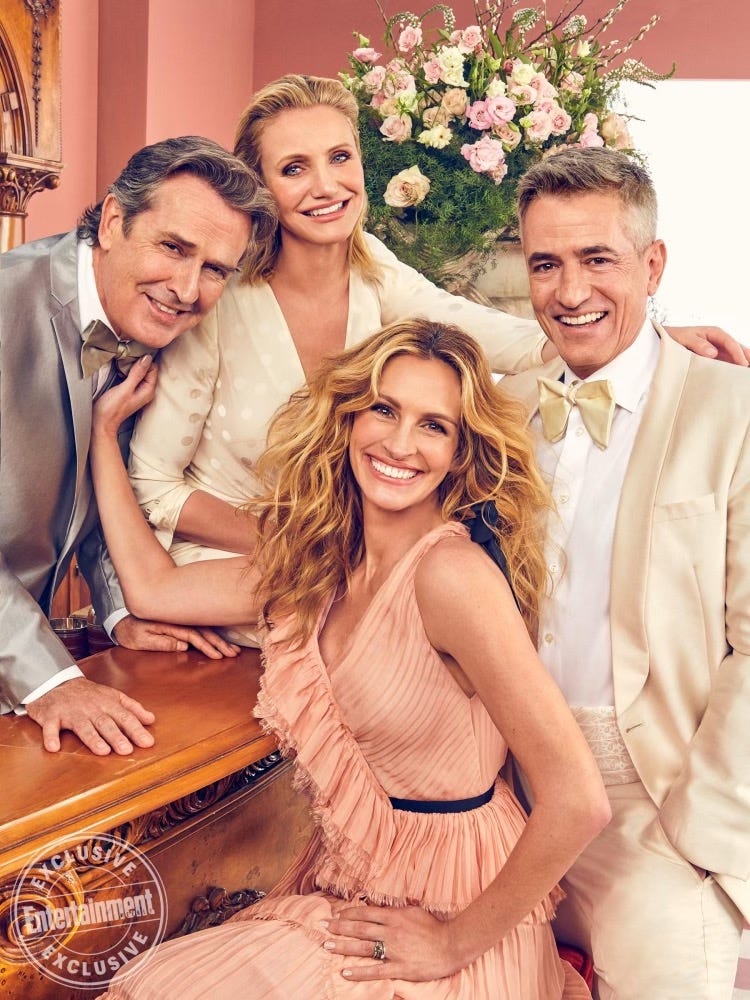
The film’s screenplay deserves almost as much credit for the film’s success as the inspired performances. The plot’s setup is admittedly full of classic romantic comedy contrivances. (You know, the kind that force characters to deal with wildly unrealistic circumstances in a remarkably condensed time frame only to have a convenient twist of fate miraculously intervene.) But screenwriter Ronald Bass, who had previously won an Oscar for writing 1988 Best Picture winner Rain Man, knows how to leverage the contrivances for great comic and dramatic effect. His screenplay manages to be a classic romantic comedy while simultaneously subverting nearly all of the traditional elements of the genre. In addition to the audacious twists and turns of the plot there are some eminently quotable lines, genuinely funny sequences, and notable psychological complexity.
Director P.J. Hogan was a natural fit to bring the screenplay to screen given his recent success with the beloved 1994 Australian comedy Muriel’s Wedding (which launched Toni Collette’s career). He makes a number of very wise choices throughout the film, including downplaying the elements of slapstick and broad company in order to emphasize the film’s more complex and original elements, superbly and seamlessly showcasing the film’s setting of Chicago, and using classic pop music to full effect. From the kitschy opening rendition of “Wishing and Hoping” by a bride and her bridesmaids (undoubtedly included to set up a stark contrast between traditional depictions of womanhood in big-screen romances with what is about to unfold) to the strains of “The Way You Look Tonight” at the film-capping wedding reception, the music in the film is exquisitely integrated.
The film is certainly not without its flaws, mostly due to some frustrating plot mechanics, one too many mean-spirited schemes, and a few times when the film strays a bit too far into conventional rom-com territory. Ultimately, though, My Best Friend’s Wedding took the all-too-familiar conventions of the romantic comedy genre and subverted them wildly. This is a wide-release summer comedy from a major studio released a quarter century ago where the plucky heroine is actually the villain, the protagonist ends up losing the man of her dreams and winds up alone, and the normally inconsequential and stereotypical sassy gay best friend is actually a fully rounded character who saves the day.
25 years after its release, My Best Friend’s Wedding remains a wildly entertaining and audacious film.
Follow the author of this article on Medium and Twitter.
Read other articles about films by this author.


