
“Bridget Jones’s Diary”: A Modern Romantic Comedy Classic Turns 20
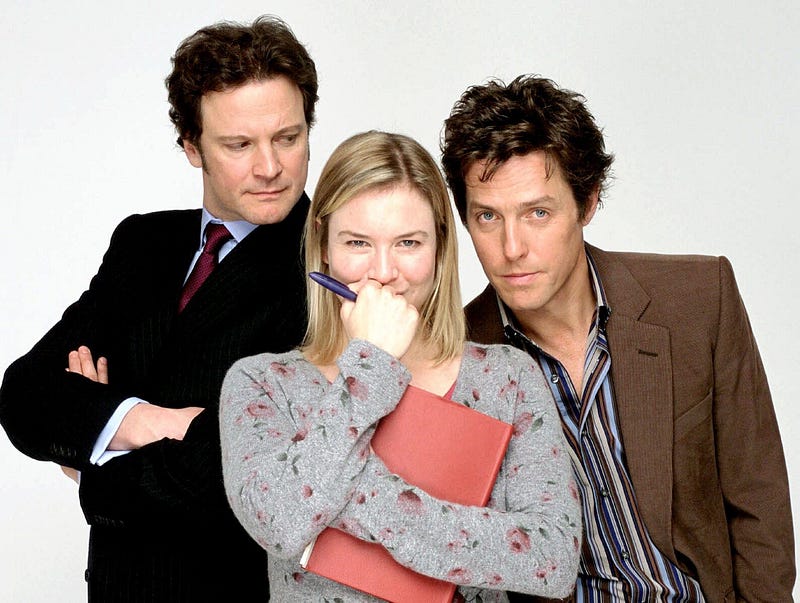
20 years ago today, a film adaptation of Helen Fielding’s best-selling novel about a thirtysomething British singleton was released in theaters. It was an enormous box office hit, propelled Renee Zellweger’s career into the stratosphere, and spawned two commercially successful sequels. On the anniversary of its release, I look back at what made it such a popular film and how it holds up two decades later.
The Origin and Initial Release of Bridget Jones’s Diary
The story of Bridget Jones’s Diary begins in the mid-1990s when The Independent, a London-based newspaper, approached author Helen Fielding about writing a series of columns about her travails as a thirtysomething singleton. She thought it would be too embarrassing to make it autobiographical so instead she created an exaggerated comic character named Bridget Jones, whose diary entries she would publish anonymously in the periodical.
Fielding’s anonymity didn’t last long, but the impact of the character she created certainly did. The publishing company she was writing a novel for asked her to scrap her plan and instead convert her Bridget Jones columns into a novel. She agreed and borrowed heavily from Jane Austen’s 1813 masterpiece Pride and Prejudice for themes and plot structure. The novel was published in 1996 to rave reviews and huge sales (it sold over 2 million copies in its first decade). The novel is considered by many to be the ur-text of the “chick-lit” phenomenon (or in other words, the original and standard bearer for the massive array of light literary romances with strong female protagonists that were released in subsequent years).
Working Title Films snatched up the film rights to the novel before it became a true cultural phenomenon and they quickly got to work on bringing it to screen. The search for who should play Bridget Jones was long and exhausting, reportedly taking over two years. Numerous A-list actresses were considered but ultimately not selected for reasons such as being deemed too beautiful (Rachel Weisz), deemed too young (Kate Winslet and Cameron Diaz), being unavailable due to schedule conflicts (Toni Collette), or for unknown reasons (Helena Bonham Carter, Cate Blanchett, and Emily Watson).
The eventual decision to cast Renee Zellweger, a native of Texas, in the role of the British icon was very controversial at the time. But the filmmakers were impressed by her remarkable dedication. She lobbied hard for the role and fully committed to it, taking a temporary job in a publicity department, gaining 20 pounds, and working with an esteemed acting coach who specializes in accents (the same one who worked with Gwyneth Paltrow for her Oscar-winning turn in Shakespeare in Love). When the film was finally released and people saw Zellweger’s stunning and authentic performance, complaints about her casting virtually disappeared.
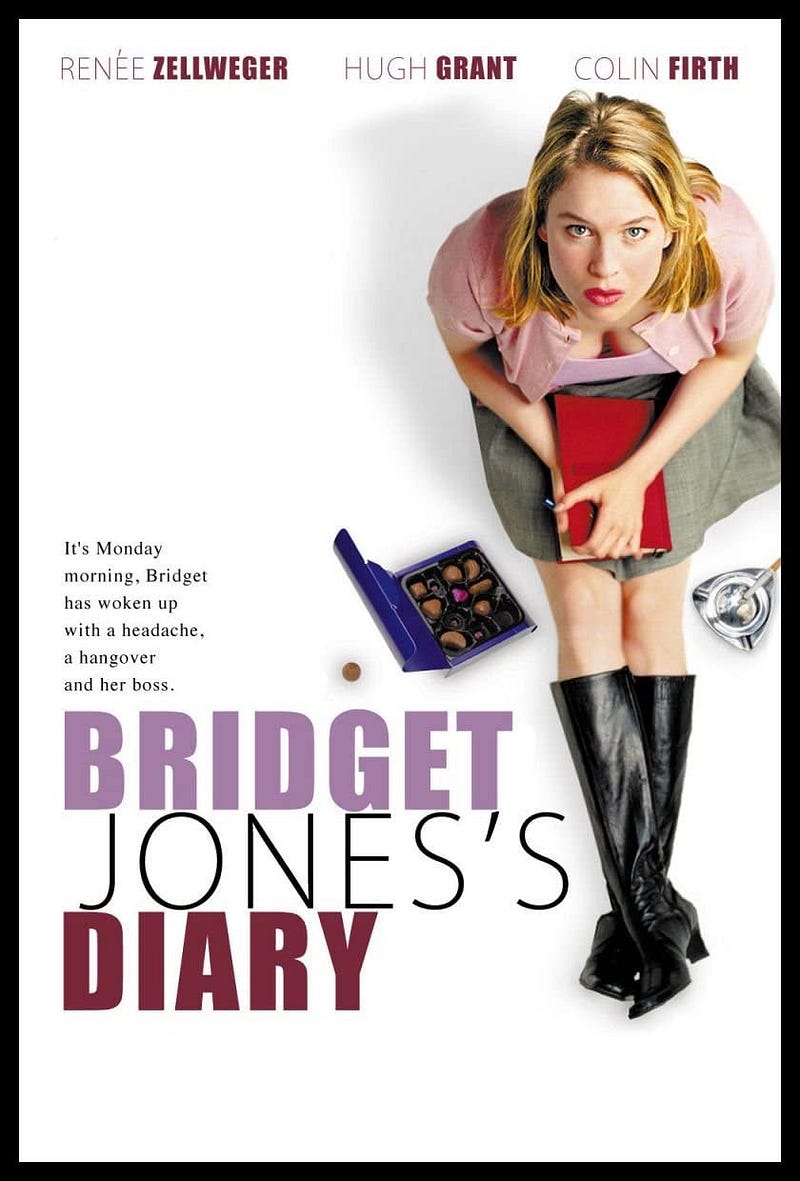
The film was released on April 13, 2001 in both the United States and the United Kingdom. It was enormously profitable during its theatrical run, grossing a total of $281.9 million globally on a modest $25 million budget. Critics were enthusiastic, resulting in an 80% approval rating on Rotten Tomatoes. The film also went on to have a long and profitable run both in the home video market and on cable television.
Perhaps the most impressive feat related to Bridget Jones’s Diary is what a consistent and formidable player Renee Zellweger was during awards season. Despite being universally praised by critics, the film had two major barriers to overcome. First, it was released less than three weeks after the 73rd Academy Awards. In order to be competitive for the 74th Academy Awards, her performance had to maintain buzz for a full year. Few performances have ever been able to do this. Second, it had to overcome the bias against contemporary romantic comedies. It is exceedingly rare for an entry in the genre to be cited by the Academy in an acting category, with Diane Keaton (Annie Hall and Something’s Gotta Give), Julia Roberts (Pretty Woman), Holly Hunter (Broadcast News), and Cher (Moonstruck) being among the few exceptions in the last half century.
But Renee Zellweger overcame both of those barriers. She was nominated for virtually every major award for her performance, including the Golden Globe Award, Screen Actors Guild Award, BAFTA Award, and the Academy Award. She would get nominated the following year for her turn as aspiring jazz singer and murderer Roxie Hart in Best Picture winner Chicago and again the year after that for her turn as a redneck in the Civil War epic Cold Mountain (for which she won Best Supporting Actress). Her star dimmed a bit after that and she ended up taking a long hiatus from starring in films. Last year, she came back in a big way when her performance as film legend Judy Garland in the aptly titled Judy swept the awards season and won her a second Academy Award.
To date, Bridget Jones’s Diary has spawned two sequels. The first, Bridget Jones: The Edge of Reason was released in 2004 and was based on the sequel of the same name by Fielding that was published in 1999. It received poor reviews from critics, who found that it was too predictable and silly. Nevertheless it scored Renee Zellweger another Golden Globe nomination for Best Actress in a Motion Picture — Musical or Comedy and was almost as profitable as its predecessor (it grossed $265.1 million on a $45 budget).
Twelve long years later, a third film entitled Bridget Jones’s Baby was released. The film marked the return of Sharon Maguire to the director’s chair (she was replaced by Beeban Kidron for the second film) and a return to acting after a six-year hiatus by Zellweger. As opposed to the first two films that were based on novels by Fielding, it was an original screenplay written by the trio of screenwriters who wrote the original. Despite majorly underperforming in the United States, it was a big hit globally, grossing $212.0 million on a $35 million budget. It also garnered much stronger reviews than the previous installment, with many critics seeing it as an impressive return to form. (It also features an absolutely hilarious supporting turn from Oscar-winning legend Emma Thompson that alone justifies its existence.)
Bridget Jones’s Baby was purportedly the last of the franchise, but I suspect that the combined power of the renewed buzz around Zellweger following her Oscar win and Hollywood’s relentless pursuit of reviving long-dormant franchises means that it is quite possible we will be blessed with more Bridget Jones in the near future.
A Contemporary Re-Evaluation of Bridget Jones’s Diary
I end up watching Bridget Jones’s Diary around once a year, often during the holidays due to the fact that the majority of the film takes place around Christmas on two consecutive years. (Like While You Were Sleeping, this film is undeservingly excluded from virtually all lists of modern Christmas classics!) Every single time I watch it, it engrosses me, moves me, and makes me howl with laughter.
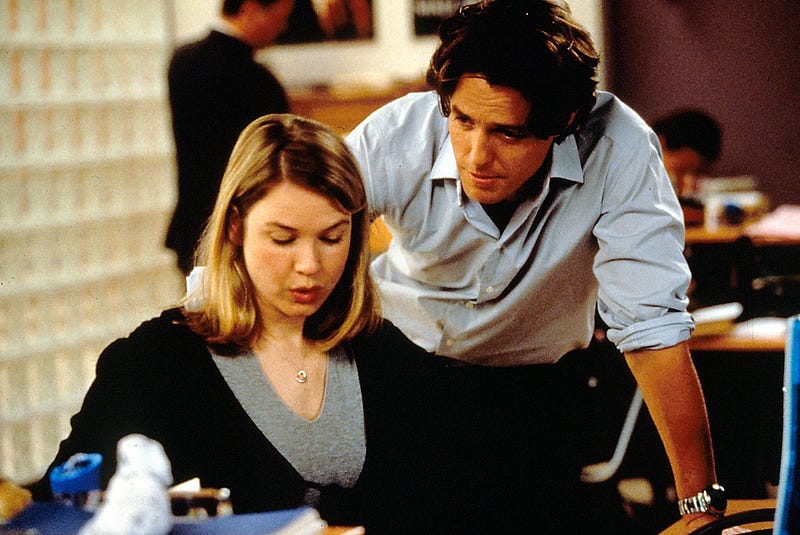
The MVP of the film is undoubtedly Renee Zellweger. She unquestionably earns her Academy Award nomination in the film’s opening seven minutes alone, when she goes from irritably hungover to stammeringly flirtatious to painfully rejected to forlornly lip syncing a schmaltzy power ballad. She nails every single thing the screenplay asks her to do, whether it’s humiliating physical comedy, razor-sharp and profane insults, or moments of profound and silent heartbreak. And the training with the accent coach were enormously successful — her British accent is superb and unwavering; it is hard to imagine that anyone watching the film not knowing who Zellweger is would even question whether she is British.
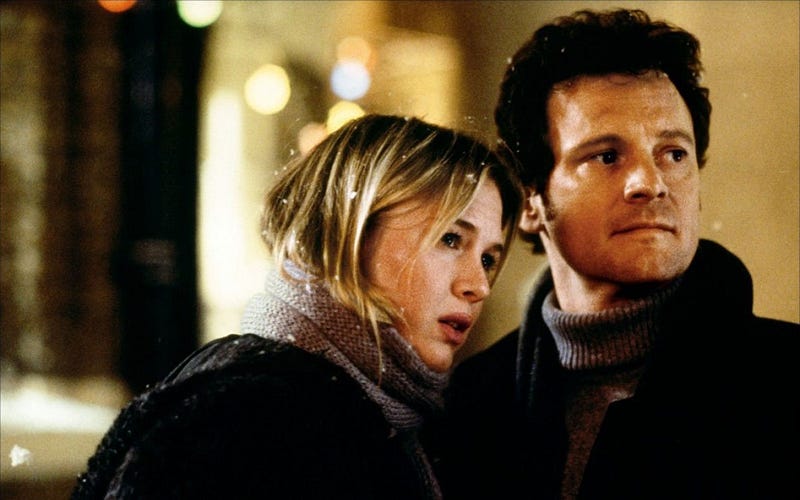
The rest of the cast is superb as well, particularly Hugh Grant and Colin Firth as the two men with whom Bridget becomes embroiled in a love triangle with. Grant, who rose to fame playing charming and affable romantic leads in comedies like Four Weddings and a Funeral and Notting Hill, plays gleefully against type as Bridget’s despicable and womanizing boss Daniel Cleaver. In stark contrast, Firth plays directly into his well-known persona that was established by his star-marking turn as Mr. Darcy in the BBC adaptation of Pride and Prejudice. He simultaneously satirizes and pays homage to that iconic performance in his role of Mark Darcy, the top barrister who is a mortal enemy of Daniel’s and finds himself dumbfounded by his attraction to Bridget.
Outside the main three characters, there are numerous memorable supporting performances. The most notable are undoubtedly veteran character actors Gemma Jones and Jim Broadbent as Bridget’s parents. They have their own heart-tugging subplot and both are sensational, with Jones having some of the film’s cruelest and funniest lines and Broadbent being genuinely heartbreaking. (Fun fact: Broadbent won the Academy Award for Best Supporting Actor that very year, albeit for a different film.) As Bridget’s trio of foul-mouthed but loyal friends, Sally Phillips, James Callis, and Shirley Henderson are an absolute hoot and deserve a spinoff of their own. (In an amusing twist, Henderson — who would go on to play bathroom-dwelling sad sack Moaning Myrtle in the Harry Potter films — has her first notable moment in the film sobbing uncontrollably in a restroom.)
The excellent screenplay was co-written by a powerhouse trio that could not have been better selected. First, there was Fielding herself ensuring that her literary vision got translated to the screen. Second, there was Richard Curtis, who had already proven himself the master of the British romantic comedy with Four Weddings and a Funeral and Notting Hill (he would also go on to write and direct Love Actually). Third, there was Andrew Davies, known for his masterful adaptations of literary classics for the BBC (including the 1995 version of Pride and Prejudice that launched Firth into superstardom). Their combined expertise results in a screenplay that contains fully drawn characters and a satisfying plot arc while being swooningly romantic and sharply witty.
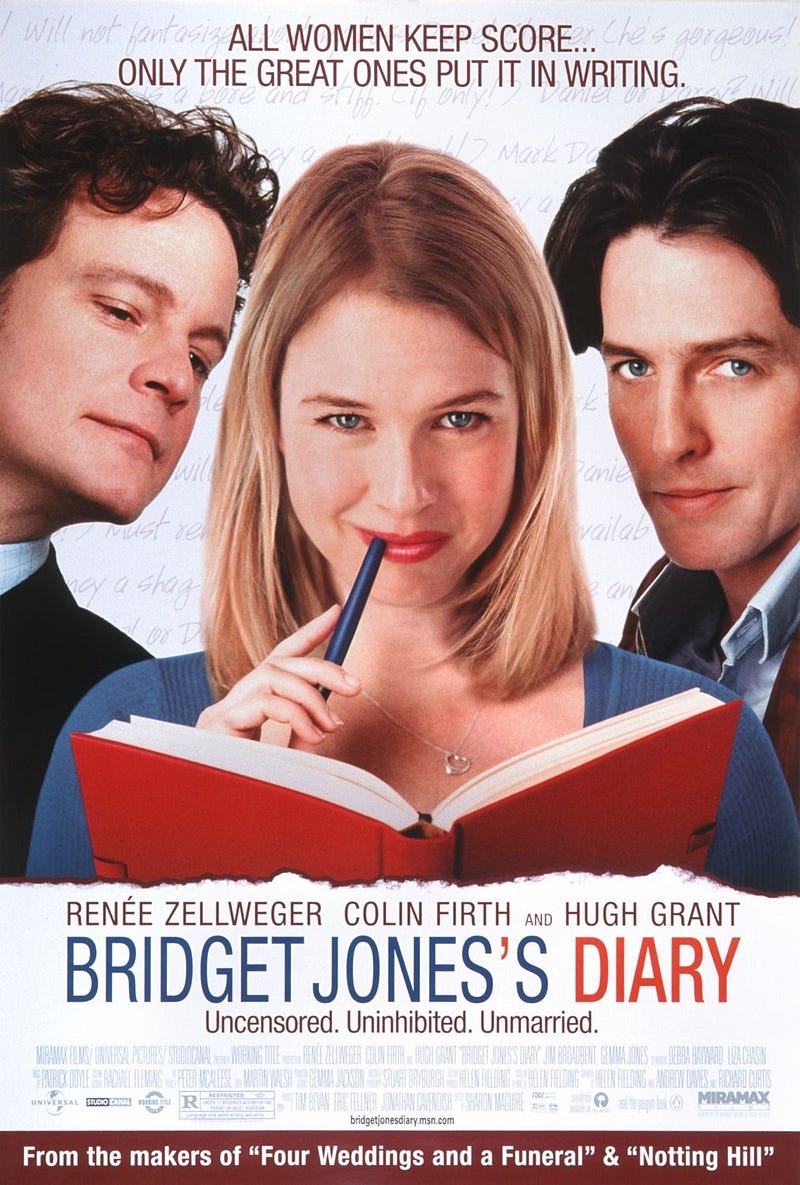
Director Sharon Maguire keeps things moving at a brisk pace and stages the key moments superbly. She proves equally adept at filming the dramatic reveals, broad slapstick, and lingering closeups of painful emotions. The film also makes an utterly superb use of music. Rather than going for contemporary pop tunes, which would have made it feel dated months after its release, the film opts for classic, recognizable, and emotionally evocative tunes like Aretha Franklin’s “Respect,” Nillson’s “Without You,” Diana Ross’s “Ain’t No Mountain High Enough,” Marvin Gaye’s “Let’s Get it On,” and Geri Halliwell’s cover of “It’s Raining Men.” They are all used exquisitely, enhancing the emotion of key moments without becoming distracting.
As a film, Bridget Jones’s Diary has some notable flaws that prevent it from reaching the lofty heights of my all-time favorite romantic comedies When Harry Met Sally and The American President. In particular, the big plot twists are fairly convoluted and the climax plays out a bit too predictably. And while I admire its brisk 97-minute running time, most of the film’s brilliant supporting cast is seriously underutilized. But these are minor quibbles.
First and foremost, Bridget Jones’s Diary endures because it is a rare romantic comedy that excels at being both genuinely hilarious and heartwarmingly romantic. There are countless one-liners that sear into your brain and moments of cringe-inducing awkwardness that The Office would have trouble matching. And this comedy exists alongside some truly powerful character dynamics and character development. Although it’s rarely cited when people chronicle the list of the most moving and effective moments from modern romantic comedies the “I like you, just as you are” speeches delivered by both Bridget and Mark at key moments in the film deeply move me immensely every single time.
But Bridget Jones’s Diary endures in popular culture for more than reasons than just being a great romantic comedy. The character of Bridget Jones is an utterly fascinating and singular one. She is average (or, rather, above average but not particularly exceptional) in appearance, intellect, wit, courage, warmth, confidence, or professional success. Yet she is also remarkably resilient, relentlessly pushes toward self-improvement, and maintains her humor and passion. We don’t often see movies about people like Bridget Jones and it is for precisely that reason that she resonated with international audiences.
Bridget Jones also symbolizes a new wave of feminism that was a precursor to shows like Ally McBeal and Sex and the City. This wave of feminism was not about women fighting for equal rights or proving their ability to maintain phenomenal professional success, but rather women fighting for their right to flout traditional gender roles by getting to be what society has always allowed men to be—well-liked and respected despite being complicated, selfish, perpetually single, promiscuous, hard-drinking, and under-achieving.
For these reasons and more, Bridget Jones is a modern cultural icon.
And the 2001 film that brought her to the screen is a modern comedy classic.
Follow the author of this article on Medium and Twitter.
Read recent articles about revisiting modern classics:


