avatarHenya Drescher

Free AI web copilot to create summaries, insights and extended knowledge, download it at here

2168

Abstract

sion of successful social and political transformation. It will not bring about systemic change, nor will it end notions of white supremacy or eradicate structural racism.</p><p id="93c4" type="7">But the fact that pro-Confederate sentiments have become unpopular is not a reason to resort to mob rule to get rid of them.</p><p id="5f1f">Revising history can untangle the string of miscommunication. Not by a call to extinguish monuments, but rather by unveiling the truth. Record history by addressing its victims as well as its victors. Social reconstruction, remolding, and development must be achieved through intelligent control for the interpretation of the entire world.</p><p id="a5f6">Of course, asking frustrated and angry people to be orderly in their response to oppression is unlikely to produce a positive response. That’s why it’s essential for civic authorities to take charge and address such questions, and to do so by taking action to control the situation rather than just responding to it after it has happened.</p><p id="a9f8">The trouble is that the popular response is often more visceral than considered — and this sparks deeper concerns amongst citizens who are ready to embrace change but only if it is principled and orderly. Removal of monuments by rioting and vandalism creates risks that removal through peaceful persuasion generally does not. Moreover, rioters and vandals are unlikely to limit their destructive activities to memorials, thus lessening the influence of removing the monuments at all. The fury of the counter-protests in Charlottesville and other cities show how high the stakes are, and how difficult removing the symbols of slavery and colonialism will be.</p><h1 id="fbda">There has to be a way…</h1><p id="e841">There has to be a way to engage people with the facts of historical injustice while also appealing to their sense of belonging. This means that minorities will be able to see themselves represented in ways that recognize their historical marginalization while also making their contemporary perspectives and experiences a central part of civic culture.</p><p id="5796">Thank you for reading. If you enjoy

Options

ed it, you might also like some of my other thoughts.</p><div id="0147" class="link-block"> <a href="https://readmedium.com/language-of-hate-and-intimidation-d795926b3688"> <div> <div> <h2>Language of Hate and Intimidation</h2> <div><h3>How do you make one group of people hate another group of people they have never met?</h3></div> <div><p>medium.com</p></div> </div> <div> <div style="background-image: url(https://miro.readmedium.com/v2/resize:fit:320/1*dqYcGbIQE2O5nF1UvoM8yQ.jpeg)"></div> </div> </div> </a> </div><div id="f407" class="link-block"> <a href="https://readmedium.com/freedom-of-speech-and-who-owns-it-9aa1aa739161"> <div> <div> <h2>Freedom of Speech and Who Owns it</h2> <div><h3>Freedom of speech is a principle that supports the freedom of an individual or a community to articulate their opinions…</h3></div> <div><p>medium.com</p></div> </div> <div> <div style="background-image: url(https://miro.readmedium.com/v2/resize:fit:320/1*hUL7MFYuahID1RRFct6NMA.jpeg)"></div> </div> </div> </a> </div><div id="699a" class="link-block"> <a href="https://readmedium.com/what-is-moral-injury-382861c49c58"> <div> <div> <h2>What is Moral Injury</h2> <div><h3>Moral injury is the damage done to one’s conscience or moral compass when that person perpetrates, witnesses, or fails…</h3></div> <div><p>medium.com</p></div> </div> <div> <div style="background-image: url(https://miro.readmedium.com/v2/resize:fit:320/1*ujyWWVWuBJ7PM498rAPlfg.png)"></div> </div> </div> </a> </div><figure id="ecf9"><img src="https://cdn-images-1.readmedium.com/v2/resize:fit:800/1*N6tjD7N0sSqRujsTVNs5dg.jpeg"><figcaption></figcaption></figure></article></body>

Monuments & Their Power

The memory of the American Civil War is frozen in marble, granite, and bronze.
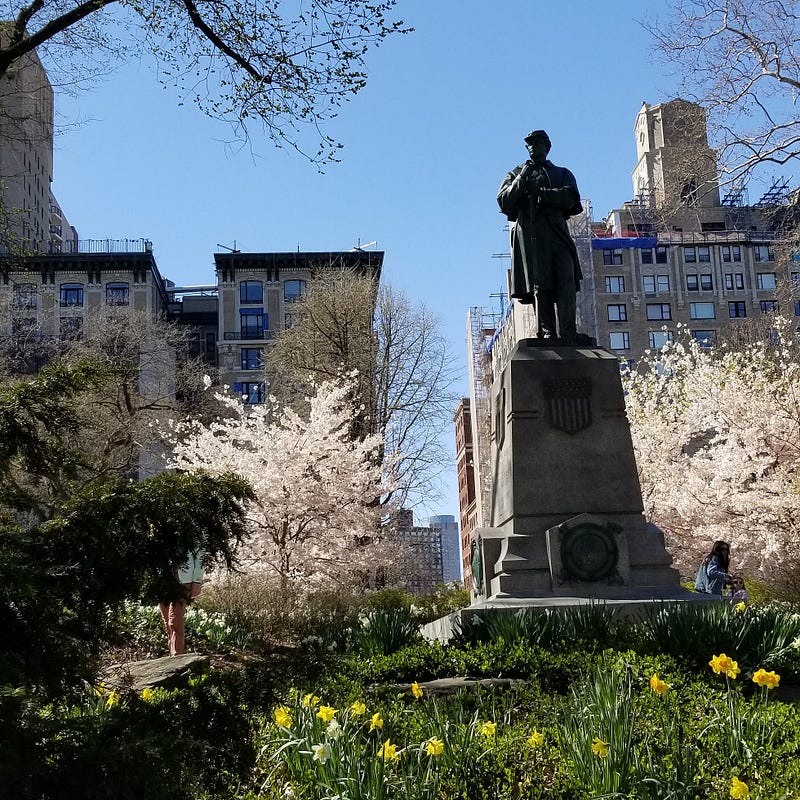
Statue in Central Park — New York, NY

As the lens people view the world through begins to feel insufficient, they search for more in-depth explanations and discover the buried continuities between the injustices of the past and the present. Some assume that the past is past, what’s done is done, that former ideas and values no longer have the power to threaten or harm, repudiate a forward-looking healing justice process.

Not long ago, it was possible to see the past as immaterial — that history had no grasp on the postcolonial, post-Cold War, post-everything present.

At some point, ideas we took for granted lost their clarifying power. We no longer accept life’s gift and wash away the past and all that remains is now. All around us, the historical forces that have shaped our lives have now become visible. The urban monuments we barely noticed are now in full view and at the center of protest movements around the world.

From New York to Bristol to Sydney to Bulawayo, no monument is safe. In that dreamy youth, we might believe that some men were evil and that only obliteration could usher us into paradise. But history has no place in elections and battles. We should begin reading the world from a gradually widening point of view and bring the past into perspective. After all, heritage is passed on for a reason. To help future generations understand ideas by starting with the roots from which they have grown, to examine it anew by resorting to language.

These monuments have kept their power to normalize the supremacy of one group over another. But tearing down Confederate statues may do little to further the goal of ending the legacy of slavery. The destruction of monuments offers a dangerous illusion of successful social and political transformation. It will not bring about systemic change, nor will it end notions of white supremacy or eradicate structural racism.

But the fact that pro-Confederate sentiments have become unpopular is not a reason to resort to mob rule to get rid of them.

Revising history can untangle the string of miscommunication. Not by a call to extinguish monuments, but rather by unveiling the truth. Record history by addressing its victims as well as its victors. Social reconstruction, remolding, and development must be achieved through intelligent control for the interpretation of the entire world.

Of course, asking frustrated and angry people to be orderly in their response to oppression is unlikely to produce a positive response. That’s why it’s essential for civic authorities to take charge and address such questions, and to do so by taking action to control the situation rather than just responding to it after it has happened.

The trouble is that the popular response is often more visceral than considered — and this sparks deeper concerns amongst citizens who are ready to embrace change but only if it is principled and orderly. Removal of monuments by rioting and vandalism creates risks that removal through peaceful persuasion generally does not. Moreover, rioters and vandals are unlikely to limit their destructive activities to memorials, thus lessening the influence of removing the monuments at all. The fury of the counter-protests in Charlottesville and other cities show how high the stakes are, and how difficult removing the symbols of slavery and colonialism will be.

There has to be a way…

There has to be a way to engage people with the facts of historical injustice while also appealing to their sense of belonging. This means that minorities will be able to see themselves represented in ways that recognize their historical marginalization while also making their contemporary perspectives and experiences a central part of civic culture.

Thank you for reading. If you enjoyed it, you might also like some of my other thoughts.

History
Heritage
Slavery
Social Change
Opinion
Recommended from ReadMedium