
Microsoft enforces it’s Self Service BI Strategy
How Power BI Data Marts should drive Data Driven Culture

With Power BI Data Mart, Microsoft wants to enable customers to gain insights from data faster and without IT.
Microsoft had already published some interesting updates around Power BI in the past weeks, some of which I was particularly happy about and wrote a small article about.
In addition to these smaller and sometimes larger updates, however, one notices that the topic of self-service BI with the Data Marts tool is also clearly focused on here. Microsoft Power BI Datamarts is a fully managed SQL database that allows users to easily perform relational database analytics using no-code or low-code [1].
Microsoft is now following up with some improvements. In addition to new regions, in this case South East Asia, new connectors are also available, for example for:
- Amazon Athena
- Asana
- Azure Databricks and Databricks
- Google Sheets
- MariaDB
- SurveyMonkey
In addition to these somewhat major technical improvements, some enhancements to the user experience and features that support the user in creating data marts have also become available — these can be found in the official statement from Microsoft [1].
Also likely to be a step forward for the whole Self Service BI theme is the also recently announced move to better integrate Power BI with the Mobile Teams app. This means that analyses from mobile devices will also be better supported.
However, as genious this step by Microsoft may be in the face of competition from Google, AWS, and others might be, it naturally also involves a risk. After all, modern data platforms such as Data Lakes and Data Lakehouses are supposed to limit data silos and shadow IT. This means that data is stored, monitored and shared centrally with the help of IT and data teams. Often, data marts are also created for individual areas, but with the involvement of specialized experts.
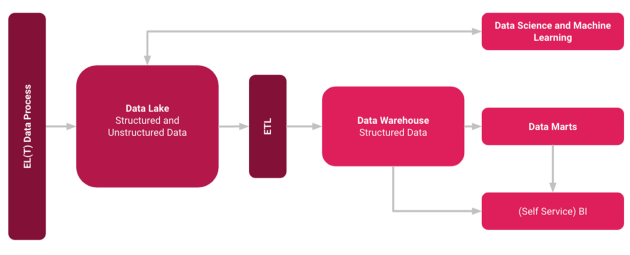
Now, however, departments can create their own data marts. The advantage of this is that goals are often achieved more quickly, but the disadvantage is that mistakes may be made or sources may be included that are then only known to the respective business. Of course, this could lead to problems if these sources no longer function as usual or other departments do not see this data because it is not shown in a data catalog.
To avoid this, it is advisable to work together with data and IT teams or to employ experts in the business departments to monitor these data processes. In this way, faster results can be produced, but these can also be monitored and, in a later step, perhaps also standardized and made more useful for the entire company.
Sources and Further Readings
[1] Microsoft Power BI Blog, Announcing improvements to Datamart Query editor (2022)
[2] Microsoft Power BI Blog, What’s New in Datamarts — August 2022 (2022)