
Metaverse Definition
Everyone’s talking about the metaverse. Why? And what the heck does “metaverse” mean, anyway?
The word doesn’t have a perfect definition at this point; but that’s OK: the metaverse is a process of becoming, not just being.
When I need to give a concise explanation, I say this:
The metaverse is the internet evolving into a creative space for anyone who wants to craft experiences.
The keywords are experiences, space and creative.

If I need to give a slightly expanded definition, I’ve written that the metaverse is defined by these attributes:
- An emphasis on activities
- …in increasingly immersive places in which the self is present
- …crafted by an exponential rise in creators
- …supported by the connective tissue to link and embed immersive, emergent content
Let’s peel back the onion and explore where the concept began, and why I think my definition makes sense.
Background: Snow Crash

Neal Stephenson coined the term metaverse in 1992 with the release of Snow Crash, which deals with the spread of malware that can cause brain damage to people in the real world. Stephenson saw the Metaverse (capitalized in the novel) as the successor to the internet (which itself was still quite nascent at the time he wrote the story). Here’s a brief excerpt describing how he envisioned it:
[Hiro Protagonist] is not seeing real people, of course. This is all a part of the moving illustration drawn by his computer according to specifications coming down the fiber-optic cable. The people are pieces of software called avatars. They are the audiovisual bodies that people use to communicate with each other in the Metaverse. Hiro’s avatar is now on the Street, too, and if the couples coming off the monorail look over in his direction, they can see him, just as he’s seeing them. They could strike up a conversation: Hiro in the U-Stor-It in L.A. and the four teenagers probably on a couch in a suburb of Chicago, each with their own laptop. But they probably won’t talk to each other, any more than they would in Reality.
Metaverse Etymology
Stephenson probably used “meta” because it had both an established meaning, as well as a newer meaning that had taken root in computer science culture.
In the original Greek, “meta,” means “after,” “beyond” or “between.” “Metaphysics” was written about by Aristotle — and dealt with the nature of reality that one might study after studying the physical world. The metatarsal bones in your foot are the bones between the toes (phalanges) and the tarsal bones that make up the upper part of your foot. In “metamorphosis” means changing form to a new one that is beyond the current form.

The field of metamathematics, advanced by David Hilbert starting from 1920, dealt with the study of mathematics using mathematical tools. This self-referential meaning became the core of most versions of meta-anything that came after.
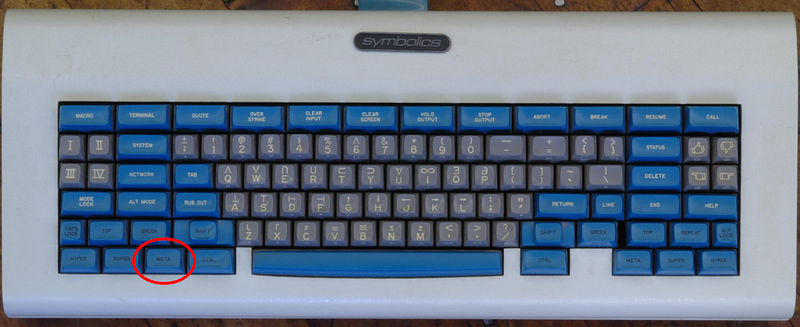
“Meta” started taking on a technological connotation with the advent of Lisp programming. Originally defined in 1958, Lisp is the second-oldest programming language (after Fortran). Lisp was considered a good language for artificial intelligence programming, partly due its capabilities for what was called metaprogramming: the ability for a program to modify itself during execution.
As Lisp became popular, quite a few keyboards designed for Lisp programmers even featured a Meta key:
Metaprogramming the Biocomputer

Ten years after the invention of Lisp, John Lilly applied the concept of metaprogramming to human beings in Programming and Metaprogramming in the Human Biocomputer, which 1960's psychadelics icon Timothy Leary once called “one of the three most important ideas of the 20th century.” This book’s central thesis is that our environment is constantly “programming” us — and deals with Lilly’s experiments in LSD which he believed could allow one to modify our own programs.
Strange Loops
In 1979, Douglas Hofstadter published Gödel, Escher, Bach: An Eternal Golden Braid, which is probably most responsible for perpetuating “meta” within geek culture. It’s a 777 page meditation on human consciousness, artificial intelligence, Gödel’s incompleteness theorem, and various self-referential art forms.
Drawing upon the earlier usages within metamathemtics and metaprogramming, the “meta” prefix is used in this book to mean being self-referential. For example, a meta-wish is a wish about wishes (e.g., when you you’re granted a wish and ask to have a hundred wishes).
This is the meaning that stuck within popular culture: when we talk about something being “meta,” it’s because we’re talking self-referentially about something:
- A metagame is the game about a game — and can include all of the emergent, social aspects that exist around the immediate experiences of gameplay — such as guild mechanics, livestreaming or trying to create a dominant strategy to counter currently-popular strategies.
- metalearning (learning about learning)
- metacognition (thinking about thinking)
- metadata (data about data)
- meta tags in the HTML code of webpages (information about the informational content of the webpage).
Meta Metaverse

So what’s all this mean for “metaverse?”
I suspect Stephenson was thinking about a combination of things: that the metaverse of Snow Crash was really about having a universe beyond our own… and either explicitly or not, he was just influenced by how “meta” had become embedded within geek culture (without building on the self-referential aspect of its meaning).
But I’m going to make the case that the meaning of the metaverse has evolved since Stephenson wrote about it in the early 90's — and that it now absorbs both aspects of meaning: the idea of having another plane of reality along with the idea of self-referentiality.
The Metaverse is for Metaprogramming
What we do with the metaverse is have experiences.
But experiences are what shape us. That’s the programming that Lilly was writing about back in the 60’s. We’re increasingly having more and more of our identities defined by what we do online — indeed, there are already plenty of people (gamers, livestreamers, etc.) who are far more known by their online identity than their physical one.
That’s where creativity fits in. The creativity of the metaverse is the metaprogramming… The experience of crafting new experiences for people.
Creativity and the Metaverse
That’s why I’m comfortable with my simple definition of the metaverse as the internet evolving into a creative space for anyone who wants to craft experiences.
And that’s also why the metaverse is not going to be one thing. The metaverse is about a multiverse of metaverses that will exist. It is Roblox and games built in Unity; Fortnite and Rec Room; Clubhouse and WebXR. It is about open ecosystems as well as the walled-gardens.
Most of all: it’s about an exponential rise in human expression.
The metaverse will be co-created by all of us.
Further Reading
- Market Map of the Metaverse describes the metaverse in terms of the companies and projects that are building it.
- 9 Megatrends Shaping the Metaverse discusses some of the big, global trends that are affecting the evolution of the metaverse.
- The Experiences of the Metaverse attempts to catalog the main types of experiences that people have within the metaverse.
- What We Talk About When We Talk About the Metaverse was the inaugural post in Building the Metaverse, and gives a bit of history around how the meaning of the metaverse has evolved beyond the centralized control of Snow Crash and Ready Player One.
If you enjoy those articles, I think you’ll also like flipping through a slide-deck I put together that brings together many of the concepts I write about in Building the Metaverse:


