
Market Map of the Metaverse
NOTE: this article is now on my Substack, where my blog continues; please read it there!
In my article on the value-chain of the metaverse, I described the seven layers of the ecosystem. In this article I’m going to focus-in on three of the most important metaverse companies — Unity, Epic Games and Roblox — and describe the commonalities and differences.
Let’s start with where companies (and some open source projects) sit within the market (version 7.0 — updated August 31, 2022):
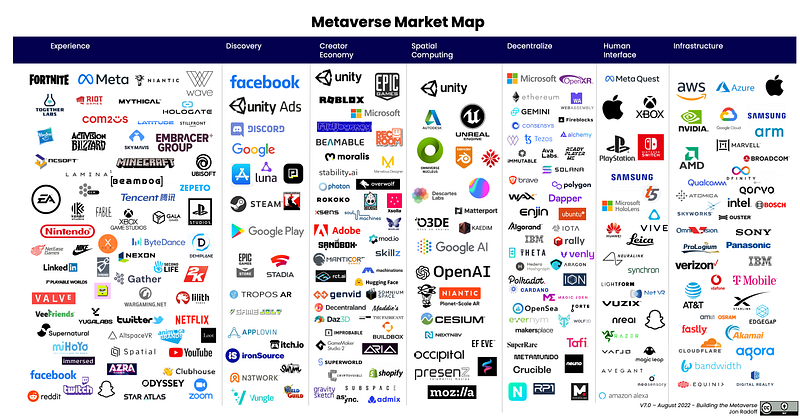
Brief recap of what each of these layers represent:
- Experience is what we actually engage with: games, social experiences, live music, etc.
- Discovery is how people learn that an experience exists.
- The Creator Economy is everything that helps creators make and monetize things for the metaverse: design tools, animation systems, graphics tools, monetization technologies, etc. Read The Evolution of the Creator Economy for more insights on how these markets evolve.
- Spatial Computing refers to the software that brings objects into 3D, computing into objects in the world, and allow us to interact with them. It includes 3D engines, gesture recognition, spatial mapping, and AI to support it.
- Decentralization is everything that is moving more of the ecosystem to a permissionless, distributed and more democratized structure.
- Human Interface refers to the hardware that helps us access the metaverse — everything from mobile devices to VR headsets to future technologies like advanced haptics and smartglasses.
- Infrastructure is the semiconductors, material science, cloud computing and telecommunications networks that make it possible to construct any of the higher layers.
For the purpose of clarity, I had to make some judgments about where to place certain companies and products: there are smaller or “hobby” scale projects across virtually all of the categories, and I didn’t attempt to recognize absolutely everything — but I think this is where most of the significant companies are located. For very large companies, I recognized that they have sub-brands that could be recognized in multiple categories. If you think I missed anything, I’d be happy to hear your input for a future update!
Now, back to the three large platforms that we’ll be differentiating: Unity, Epic Games and Roblox. It is important to realize that each of these companies has gotten so large that it has significant efforts across multiple layers of the metaverse onion.
Unity
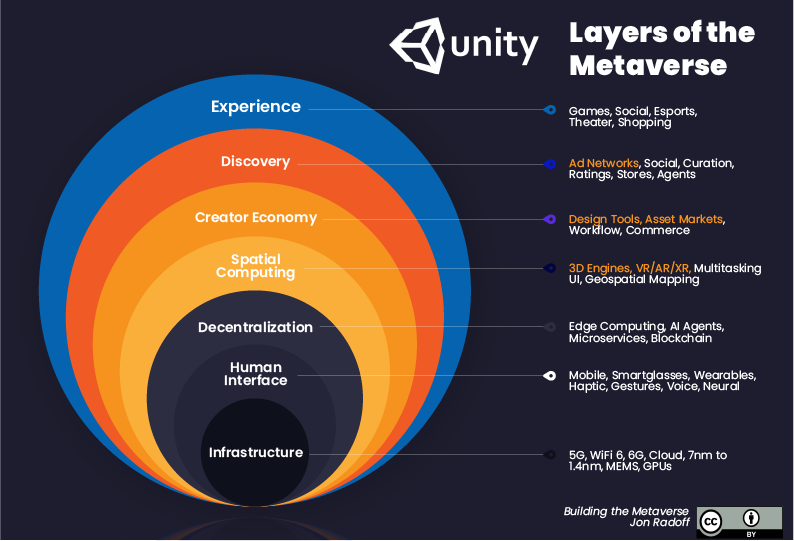
The core of Unity is their 3D development platform, a fully-integrated 3D engine and design studio for game developers, AR/VR/XR and metaverse experiences. It supports a large ecosystem of plug-ins and assets available through their Asset Store.
Unity generates a substantial portion of its revenue through the Unity Ads network — one of the big-three video ad networks along with Facebook and Google.
Epic Games
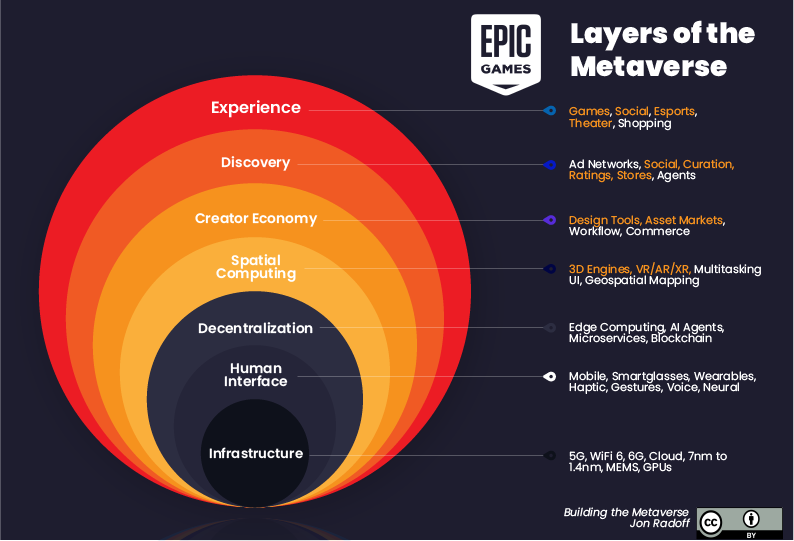
Epic just raised another $1B in private capital and the list of categories they exist in is impressive:
- Unique amongst the three leading metaverse platforms, they own game properties: Fortnite being the best-known. Using the huge audience of Fortnite, they’ve also used it as a platform for other metaverse experiences, such as the Travis Scott music concert that brought in an incredible 45 million viewers. Fortnite is monetized as a free-to-play game.
- Unreal Engine is Epic’s 3D engine environment, design studio and asset marketplace. The engine is being increasingly used in Hollywood film productions such as the Mandalorian, and they’re invested in technologies to help populate the metaverse with metahumans. Epic takes 5% of the revenue of any game built on the engine.
- The Epic Games launcher is a game store — and like Steam, which it competes with — is also a social ecosystem for players. Epic has invested over $300M in exclusive third-party games. Epic takes a revenue share on anything purchased through the launcher.
Roblox
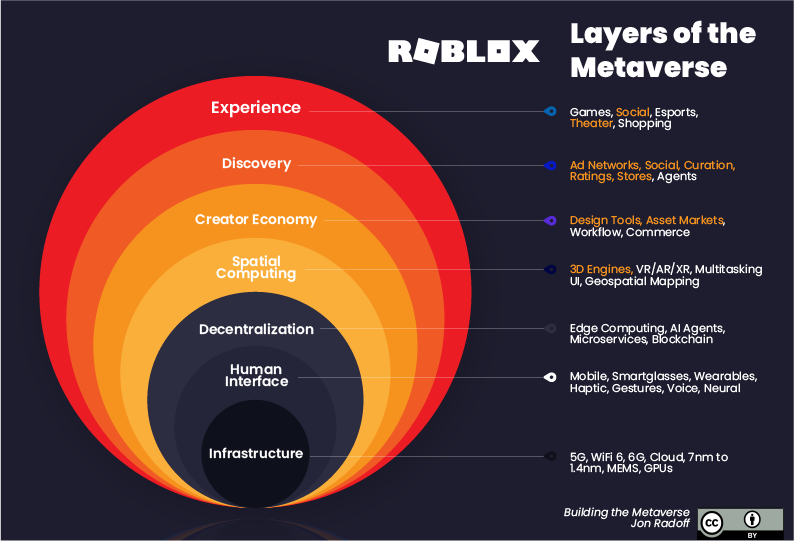
Roblox is often the most misunderstood of these three companies because they are sometimes called a “game.” But Roblox itself is not a game; it is a platform containing a multitude of games.
- Roblox does not make games of their own — like Unity, they’re leaving that entirely to their creators. But like Epic, they’ve used the platform as a place for online live concerts, such as Lil Nas X’s concert that reached an astounding 33 million people on Roblox. The Roblox business model is to split revenue between their creators and themselves.
- The discovery-layer of Roblox is essentially a “YouTube for Games” where you can discover what other creators have made. Imagine everything that YouTube does for videos — and then think of how the curation, discovery, social structure and ratings apply to a vast network of games. Roblox has an advertising platform that can be used to promote games in this ecosystem, although they receive a relatively small portion of their revenue from this compared to the concerted effort at Unity to create a competitive ad network.
- Roblox has their own proprietary 3D engine which is integrated with their design platform as well as a marketplace that creators use to share assets and code with each other.
Three Companies and Three Big Differences
The similarity between these companies is that each provides a way for creators to make experiences and games for the metaverse. How they monetize and enable creators varies substantially.
One of the big distinctions is sources of revenue: Unity gets an enormous amount of revenue from their ad network, which surpasses the license revenue they receive for their development platform. Epic gets massive revenue from their own games, such as Fortnite — and also collects a revenue share from other products that build on their engine; and Roblox gets most of their revenue from sales of Robux, which they split with their creators.
Both Epic and Roblox have a significant social ecosystem that wraps-around their stores and experiences. Unity has left the social and gameplay experiences to their own customers.
Each company has enormous value to mine from the metaverse over the next several years. How they build beyond that will depend on how they continue to build upon the successes of their products, expand into adjacent domains, and continue to support the creator economy.
Note: to see how Facebook/Meta fits into this same model, read Facebook as a Metaverse Company. And to see how Apple, Facebook/Meta and Microsoft compare to each other in, read Clash of the Metaverse Titans.
Are you a creator in any of these platforms? Why? What do you love, and what worries you? Let me know in the comments below!
Further Reading
If you enjoyed this coverage of the market structure of the metaverse, I think you’ll enjoy flipping through these slides:
After you’ve enjoyed that, please enjoy a couple other articles. Here are two favorites:
- The Metaverse Value-Chain. How value flows through the 7 industry layers.
- The Experiences of the Metaverse. I dive into some of the specific experiences that people will have — and are already having — in the metaverse.
- Facebook/Meta did a rebranding since this article was originally written; you can learn about their investments in the metaverse in Facebook as a Metaverse Company.
- Read Clash of the Metaverse Titans to see a similar comparison, but for Apple, Microsoft and Meta.
- Market Map of Generative AI for Virtual Worlds is a new slice based on the value-chain used for this map; it explains the technologies that are supporting the new field of generative AI and how it relates to metaverse and games.


