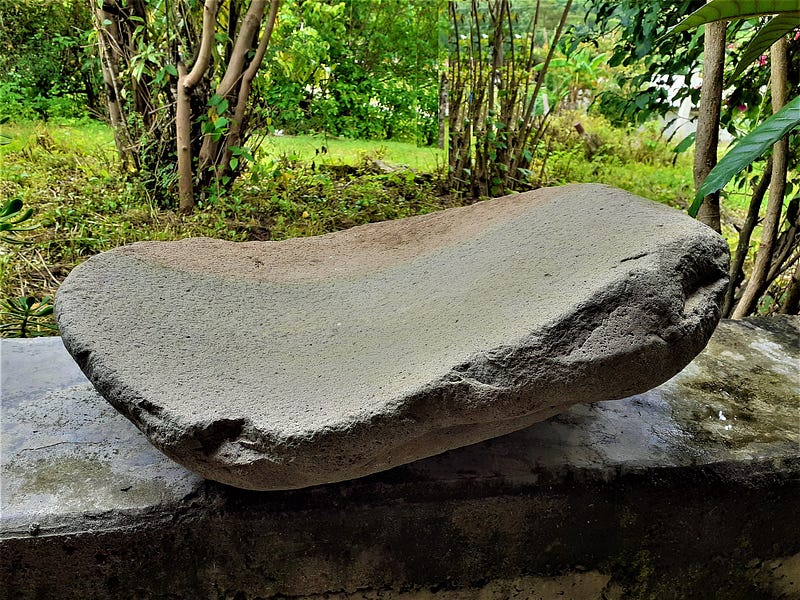
rain is ground, usually with the aid of a cylindrical piece (also made of stone) known as a <i>mano</i>. Both <i>metates</i> and <i>manos</i> are made of volcanic stone whose low porosity allows the ground meal to be easily removed. Large <i>metates</i> can be very heavy and were usually placed in fixed locations inside the home, most likely the cooking area.</p><p id="199a">This is a pre-Columbian <a href="https://en.wikipedia.org/wiki/Mixtec">Mixtec</a> metate. You can probably tell it’s not very portable.</p><figure id="9bec"><img src="https://cdn-images-1.readmedium.com/v2/resize:fit:800/0*1tC0OZaGT_bMepvW.jpg"><figcaption></figcaption></figure><p id="abee">And here is Isabel Nicolás, a Mixtec woman, grinding corn in a considerably smaller <i>metate</i>.</p><figure id="f885"><img src="https://cdn-images-1.readmedium.com/v2/resize:fit:800/1*xChBGyS66X-UscHeRrRbDA.png"><figcaption>Photo by Eduardo Ruiz Mondragón</figcaption></figure><p id="84f1">In an <a href="https://www.themijachronicles.com/2010/07/lessons-in-back-breaking-meso-american-cooking-how-to-season-a-metate/">article</a> on her website <i>The Mija Chronicle</i>s, Lesley Téllez describes the grinding process on a <i>metate</i> thusly:</p><blockquote id="60e3"><p>You kneel in front of it and grip the metlapil (the Nahuatl word for “mano,” or grinding stone) on either side. Then, you use your wrists to kind of rotate the metlapil forward, while at the same time pressing downward, hard, with the palms of your hands. The idea is to create contact between the metlapil, the bits you’re grinding, and the tablet; you don’t want to just scrape the metlapil back and forth, or else you’d never get anything done. You might get perhaps 10 good grinds in one go. Then you collect what’s on the metate, sweep it back toward the center and go again. It’s taxing on your wrists, fingers, knees, toes, shoulders and lower back. (One student said yesterday that it might be more comfortable if we all took off our shoes. Not something to try in cooking class, but maybe at home.)</p></blockquote><p id="6581">Metates can be used not only to grind grains into flour, but also to turn the flour into dough, as shown in this video made by Stephanie and her sister, Cloud. Their Youtube channel, <a href="https://www.youtube.com/c/Viewsontheroad/featured">Views on the Road</a>, is full of interesting videos about authentic Mexican food. In this one, Stephanie shows us how to prepare corn tortillas. She combines modern and traditional techniques by pre-grinding the corn in a blender, and then using the metate to finish the grind and make the <b>corn masa</b>.</p>
<figure id="bc93">
<div>
<div>
<img class="ratio" src="http://placehold.it/16x9">
<iframe class="" src="https://cdn.embedly.com/widgets/media.html?src=https%3A%2F%2Fwww.youtube.com%2Fembed%2FD_nAy8vphr4%3Ffeature%3Doembed&display_name=YouTube&url=https%3A%2F%2Fwww.youtube.com%2Fwatch%3Fv%3DD_nAy8vphr4&image=https%3A%2F%2Fi.ytimg.com%2Fvi%2FD_nAy8vphr4%2Fhqdefault.jpg&key=a19fcc184b9711e1b4764040d3dc5c07&type=text%2Fhtml&schema=youtube" allowfullscreen="" frameborder="0" height="480" width="854">
</div>
</div>
</figure></iframe></div></div></figure><p id="2efd">The process seems very labor intensive… but the end product looks delicious!</p><h2 id="2778">Uppercase M</h2><p id="7949">Interestingly, there are a few <i>Metates</i> that are spelled with a capital M. Even more interestingly… most may not exist.</p><p id="728e">Wikipedia lists three bodies of water named <i>Metate</i> in its disambiguation page. Two are tributaries of Mexican rivers and one is a stream in the province of Zambezia, Mozambique. No to be confused with Zamunda, the fictional country in <a href="https://www.youtube.com/watch?v=KFroCRDXw5E"><i>Coming to America</i></a>.</p><p id="fc3f">But I couldn’t find references to these <i>Metates</i> anywhere else. I did find a <b>Río Metates</b> in Oaxaca, México. Despite the name, it’s not a river, but a small town with under 1,000 residents. However, one would think the name of the town may have come from a nearby river.</p><figure id="c4fe"><img src="https://cdn-images-1.readmedium.com/v2/resize:fit:800/1*ATjaK7mUkvBcgWdbNiyXkA.png"><figcaption>Credit: accuweather.com; fair use</figcaption></figure><p id="9caf">The Mexican postal code web site classifies it as a “settlement” (<i>asentamiento</i>) and says its postal code is 69718. In case you need
Options
to mail someone there a letter, well, you’re welcome.</p><p id="3038">I did find a capitalized <i>Metate</i> whose existence I could verify. Unfortunately, its existence ended a decade ago. I’m talking, of course, of the Pomona College yearbook that was issued for more than 110 years starting in 1894. Yes, 1894!</p><p id="f252"><b>Pomona College</b> is a private liberal arts college established in 1887 in Claremont, California by Congregationalists (Protestant churches in the Reformed tradition that have a congregational form of church government and trace their origins to the Puritan settlers) who wished to recreate a “college of the New England type” on the West Coast. It offers 48 majors in liberal arts disciplines on it 140-acre campus located 35 miles (56 km) east of downtown Los Angeles, near the foothills of the San Gabriel Mountains.</p><p id="fceb">Among its noted alumni are Westerns actor Joel McCrea, singer and songwriter Kris Kristofferson, 2020 Nobel Prize in Chemistry co-winner Jennifer Doudna, basketball coach Gregg Popovich, and writers David Foster Wallace and Jonathan Lethem.</p><p id="faac">According to an article in <i>The Student Life</i>, the yearbook was discontinued in 2012 due to “a decline in student interest” that “prompted the Associated Students of Pomona College (ASPC) to cut funding” for it. The yearbook was originally called Speculum, but a year after it was first published the name was changed to <i>Metate</i>, after the grinding stone. According to the Online Archive of California, this name was picked “to reflect the group’s efforts “to grind up and get into mentally digestible condition the year’s doings” as they put the yearbook together.”</p><p id="ad5d">That online archive has all 118 bound volumes in PDF format, apparently. Just in case you’re interested in perusing them, here is the link:</p><div id="cea6" class="link-block">
<a href="https://oac.cdlib.org/findaid/ark:/13030/c8d223cv/">
<div>
<div>
<h2>Finding Aid for the Metate (Yearbook) Collection, 1895-2012</h2>
<div><h3>Published annually, in print, by Pomona College from 1895 through 2012, Metate is the yearbook for the college. The…</h3></div>
<div><p>oac.cdlib.org</p></div>
</div>
<div>
<div style="background-image: url(https://miro.readmedium.com/v2/resize:fit:320/0*NFdDAvx4NQ64HgZo)"></div>
</div>
</div>
</a>
</div><p id="9fd9">If a digital copy is not enough, you can always search for specific years on Amazon, where some of the really old ones go for hundreds of dollars.</p><figure id="daa8"><img src="https://cdn-images-1.readmedium.com/v2/resize:fit:800/1*ElKmV4k4Vt0q1rTL1c-u3w.png"><figcaption></figcaption></figure><p id="6d34">Yeah, better stick to the PDFs.</p><p id="be17">Now you know. Next time you’re in a Mexican restaurant, ask them if they’re authentically grinding their corn on <i>metates</i>. Don’t be surprised if you’re kicked out, though. Not because that’s a rude remark… but because the editors of the Spelling Bee decided that <i>metate </i>is a dord*.</p><p id="6eef">You can check out my previous entry on another <b>dord* </b>here:</p><div id="9096" class="link-block">
<a href="https://readmedium.com/vanda-b58016a8b159">
<div>
<div>
<h2>Vanda</h2>
<div><h3>An orchid and a princess… and an opera, to boot</h3></div>
<div><p>medium.com</p></div>
</div>
<div>
<div style="background-image: url(https://miro.readmedium.com/v2/resize:fit:320/0*bynMaYPsmk8mR-l3)"></div>
</div>
</div>
</a>
</div><p id="10a0">*What the heck is a <b>dord, </b>you ask? Here’s the answer:</p><div id="7cad" class="link-block">
<a href="https://www.merriam-webster.com/words-at-play/dord-a-ghost-word">
<div>
<div>
<h2>'Dord': A Ghost Word</h2>
<div><h3>One of the questions people like to ask lexicographers is this: Can you sneak something into the dictionary? Can you…</h3></div>
<div><p>www.merriam-webster.com</p></div>
</div>
<div>
<div style="background-image: url(https://miro.readmedium.com/v2/resize:fit:320/0*vHzKjoiD9vnh6Ka1)"></div>
</div>
</div>
</a>
</div></article></body>
Metate
Connecting with a dord* from last year
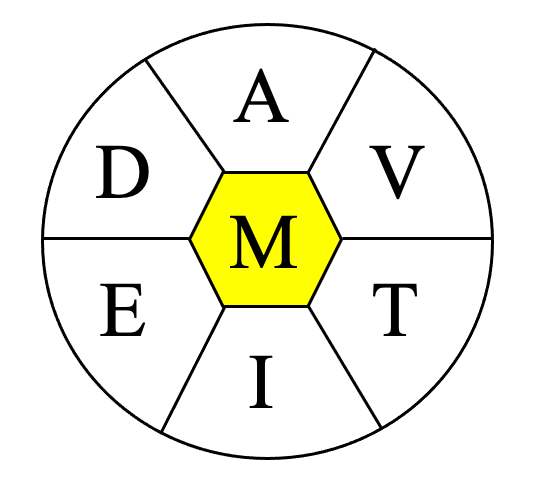
Today’s New York Times Spelling Bee letters:
Art: Iva Reztok
A, D, E, I, T, V, and center M (all words must include M)
To paraphrase the late, great 20th-century philosopher Yogi Berra: “When I saw that word, I thought it was deja vu all over again”. Or maybe I’m paraphrasing someone else. After all, as Yogi himself claimed: “I really didn’t say everything I said”. And that quote has been verified.
By the way, if you’re a fan of Berra and/or his sayings, I highly recommend the book he authored with Dave Kaplan, When You Come to a Fork in the Road, Take It!: Inspiration and Wisdom from One of Baseball’s Greatest Heroes. Among other things, you’ll find out why that famous titular aphorism does, in fact, make sense.
When I saw metate among the list of today’s rejected words, or dords*, I was sure I had already written an article about it. The word sounded familiar, and when I looked into it I found images I was sure I had used. But the primitive search function Medium has to look up ones own articles showed zero results when I typed in “metate”. After reading some more about the word, something clicked in my mind and I remembered that last year I had written an article about a different word that was very much connected to metate. You’re welcome to read it and help me earn an extra 13 cents today. But please come back to today’s column and scroll all the way to the end.
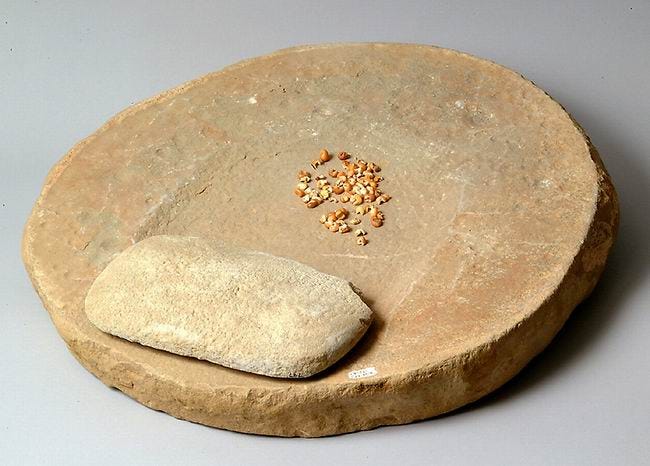
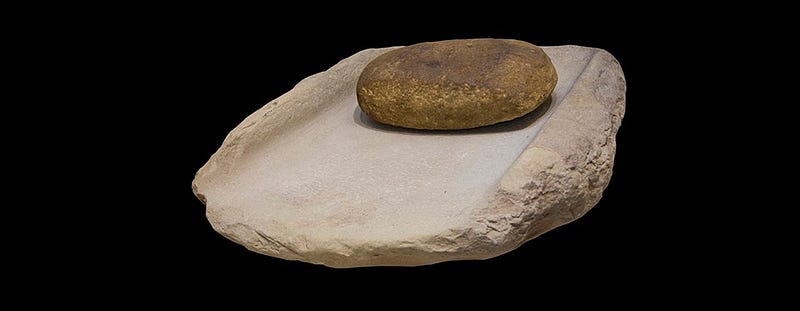
There is, indeed, more to the word mano than that expression. Turns out mano is the handstone used for grinding maize and other grains on the metate. In the photo at the top of this article, the big round stone is the metate, while the smaller stone that looks like a loaf of bread is the mano. Don’t you dare scroll up! Here is a different picture with both elements, in case you decided to skip the link to the article about mano:
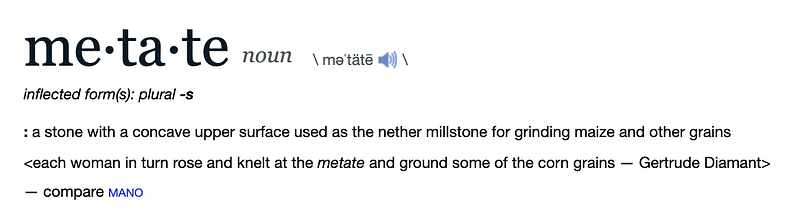
The term metate comes to English from the Nahuatl word metatl, Nahuatl being part of the Aztec family of languages. This basic yet key tool originated in Mesoamerican cuisine as a stone mortar with a rectangular shape and a slightly concave upper surface. Metates may come with supports or tapered legs of different heights that tilt the surface on which the grain is ground, usually with the aid of a cylindrical piece (also made of stone) known as a mano. Both metates and manos are made of volcanic stone whose low porosity allows the ground meal to be easily removed. Large metates can be very heavy and were usually placed in fixed locations inside the home, most likely the cooking area.
This is a pre-Columbian Mixtec metate. You can probably tell it’s not very portable.
And here is Isabel Nicolás, a Mixtec woman, grinding corn in a considerably smaller metate.
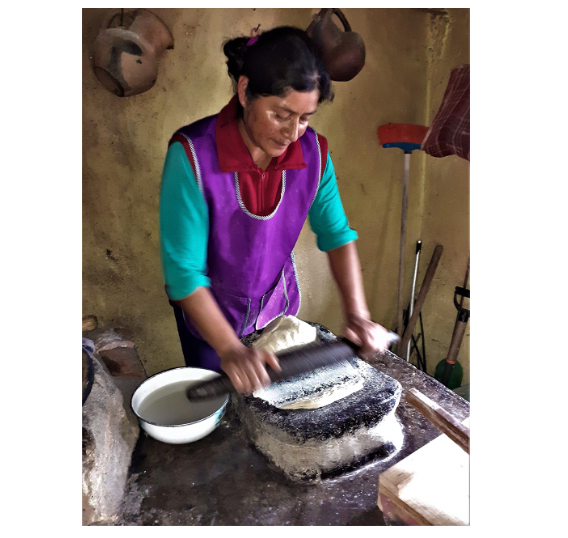
Photo by Eduardo Ruiz Mondragón
In an article on her website The Mija Chronicles, Lesley Téllez describes the grinding process on a metate thusly:
You kneel in front of it and grip the metlapil (the Nahuatl word for “mano,” or grinding stone) on either side. Then, you use your wrists to kind of rotate the metlapil forward, while at the same time pressing downward, hard, with the palms of your hands. The idea is to create contact between the metlapil, the bits you’re grinding, and the tablet; you don’t want to just scrape the metlapil back and forth, or else you’d never get anything done. You might get perhaps 10 good grinds in one go. Then you collect what’s on the metate, sweep it back toward the center and go again. It’s taxing on your wrists, fingers, knees, toes, shoulders and lower back. (One student said yesterday that it might be more comfortable if we all took off our shoes. Not something to try in cooking class, but maybe at home.)
Metates can be used not only to grind grains into flour, but also to turn the flour into dough, as shown in this video made by Stephanie and her sister, Cloud. Their Youtube channel, Views on the Road, is full of interesting videos about authentic Mexican food. In this one, Stephanie shows us how to prepare corn tortillas. She combines modern and traditional techniques by pre-grinding the corn in a blender, and then using the metate to finish the grind and make the corn masa.
The process seems very labor intensive… but the end product looks delicious!
Uppercase M
Interestingly, there are a few Metates that are spelled with a capital M. Even more interestingly… most may not exist.
Wikipedia lists three bodies of water named Metate in its disambiguation page. Two are tributaries of Mexican rivers and one is a stream in the province of Zambezia, Mozambique. No to be confused with Zamunda, the fictional country in Coming to America.
But I couldn’t find references to these Metates anywhere else. I did find a Río Metates in Oaxaca, México. Despite the name, it’s not a river, but a small town with under 1,000 residents. However, one would think the name of the town may have come from a nearby river.
Credit: accuweather.com; fair use
The Mexican postal code web site classifies it as a “settlement” (asentamiento) and says its postal code is 69718. In case you need to mail someone there a letter, well, you’re welcome.
I did find a capitalized Metate whose existence I could verify. Unfortunately, its existence ended a decade ago. I’m talking, of course, of the Pomona College yearbook that was issued for more than 110 years starting in 1894. Yes, 1894!
Pomona College is a private liberal arts college established in 1887 in Claremont, California by Congregationalists (Protestant churches in the Reformed tradition that have a congregational form of church government and trace their origins to the Puritan settlers) who wished to recreate a “college of the New England type” on the West Coast. It offers 48 majors in liberal arts disciplines on it 140-acre campus located 35 miles (56 km) east of downtown Los Angeles, near the foothills of the San Gabriel Mountains.
Among its noted alumni are Westerns actor Joel McCrea, singer and songwriter Kris Kristofferson, 2020 Nobel Prize in Chemistry co-winner Jennifer Doudna, basketball coach Gregg Popovich, and writers David Foster Wallace and Jonathan Lethem.
According to an article in The Student Life, the yearbook was discontinued in 2012 due to “a decline in student interest” that “prompted the Associated Students of Pomona College (ASPC) to cut funding” for it. The yearbook was originally called Speculum, but a year after it was first published the name was changed to Metate, after the grinding stone. According to the Online Archive of California, this name was picked “to reflect the group’s efforts “to grind up and get into mentally digestible condition the year’s doings” as they put the yearbook together.”
That online archive has all 118 bound volumes in PDF format, apparently. Just in case you’re interested in perusing them, here is the link:
If a digital copy is not enough, you can always search for specific years on Amazon, where some of the really old ones go for hundreds of dollars.
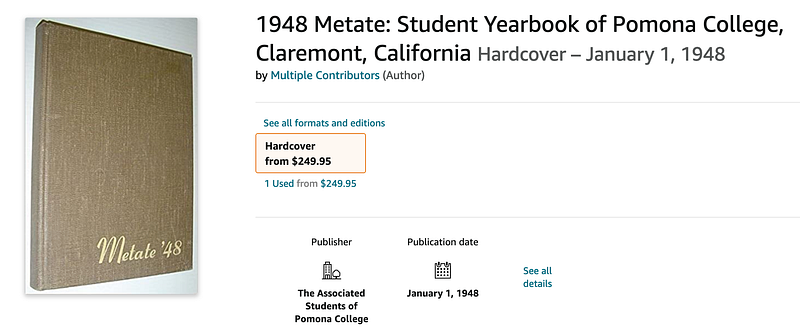
Yeah, better stick to the PDFs.
Now you know. Next time you’re in a Mexican restaurant, ask them if they’re authentically grinding their corn on metates. Don’t be surprised if you’re kicked out, though. Not because that’s a rude remark… but because the editors of the Spelling Bee decided that metate is a dord*.
You can check out my previous entry on another dord* here: