
Mano
There’s more to this word than the expression “mano a mano”

Yesterday’s New York Times Spelling Bee letters:
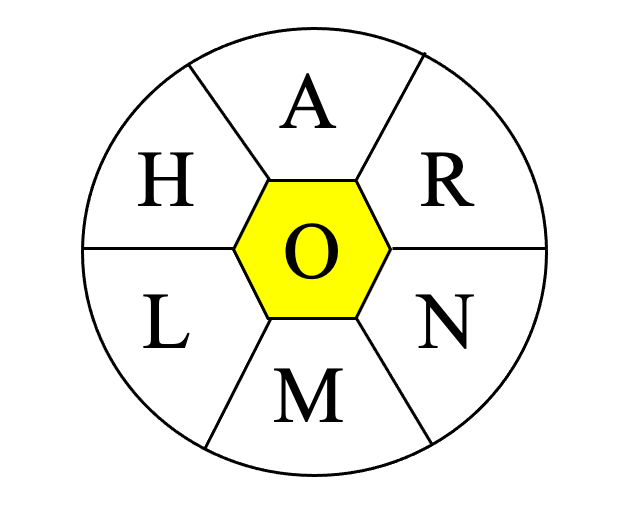
A, H, L, M, N, R, and center O (all words must include O)
Merriam-Webster says…
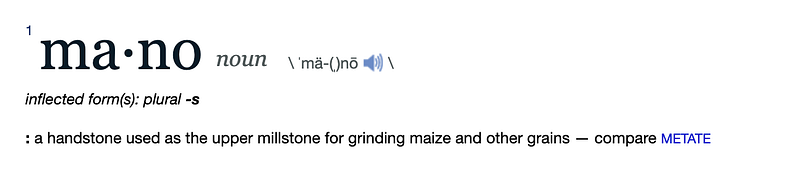
Silly little dictionary! Don’t you know mano can’t possibly be a word if the New York Times says it ain’t?
For further fascinating facts, check out the Spelling Bee Master.
What’s your favorite dord* from today’s puzzle?
My Two Cents
The word mano is borrowed from Spanish and means “hand” in many of the senses that it does in English. That is, not just as a term to describe the terminal part of the human forelimb, but also in idiomatic expressions such as “give a hand” (when assisting someone) and as the big and little “sticks” on the face of a clock that help you tell time.
There are a ton of definitions and expressions with hand in both English and Spanish — and I’m sure in many other languages, as well.
Interestingly, our daily dord*, mano, can also refer to a handstone used to grind corn.
Me? Tate?
Merriam-Webster asks us to compare the word metate to mano, so I followed directions and looked metate up:
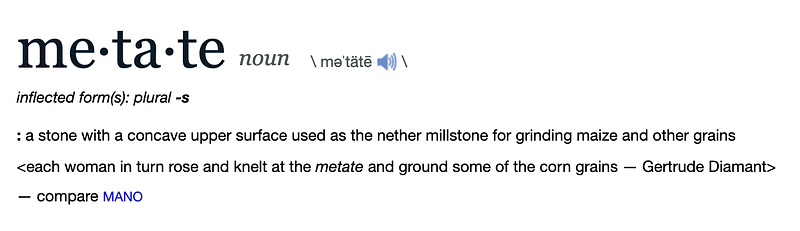
Metate comes from the Nahuatl word metatl, Nahuatl being part of the Aztec family of languages. You probably use Nahuatl-borrowed words on an almost daily basis… that is, if you happen to be one of those people who say the words chocolate, tomato, avocado, or chili on a daily basis. On the other hand, if you combine the four ingredients in a tasty dish, well, then, please invite me over because I sure as heck want to sample that!
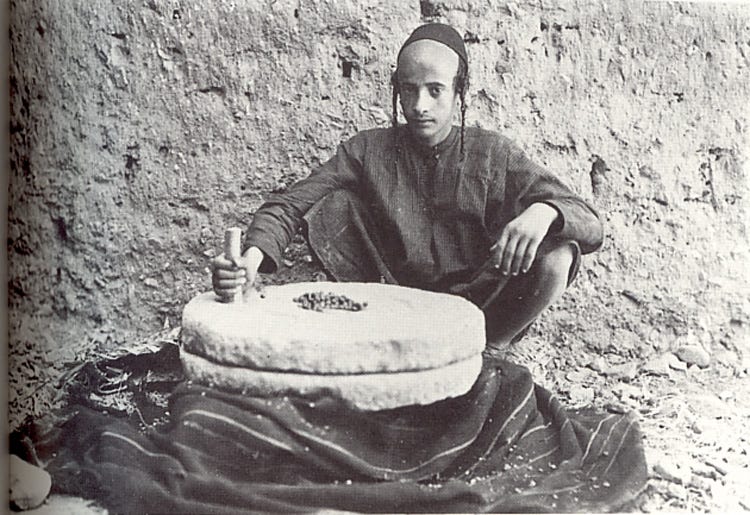
Metate/mano combos are very similar to quern-stones, which are also used in pairs. The lower stone, or base, is known as the saddle quern; the upper stone, the one that was moved by hand, is known as the… handstone! Surprise. (The handstone of the quern is equivalent to the mano.)
Here is a photo of a youth (or yute, if you’re from Brooklyn) grinding coffee on a quern in 1934 Yemen. (You can tell the year and location by the look on the youth’s face, which clearly says, “What the heck are you doing here in Yemen in 1934, Mr. Photographer?”)
Below is a short video showing how a quern stone is traditionally used.
The metate/mano combos have a simpler design, and many are conveniently “travel size”. The bowl is a good reference for size in the photo below:
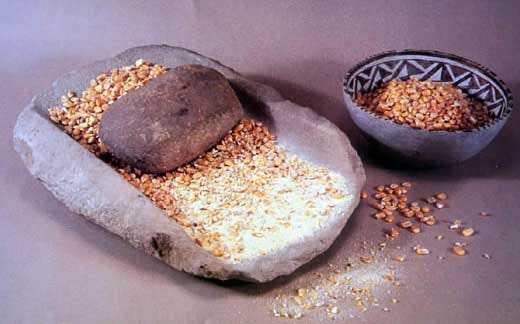
The stone with the vaguely-rectangular-prism shape in the middle of the metate is the mano.
Sometimes metates and manos can be larger, though, as in this example from Central Mexico exhibited at some museum. (Here, the little placard at the bottom right can help you get an idea of the size of the tools.)
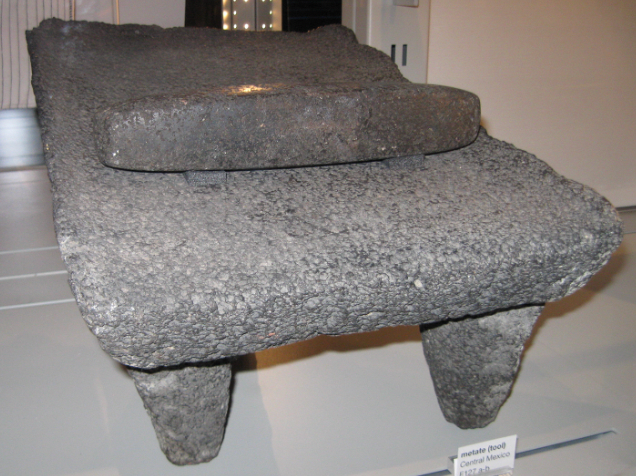
It kinda looks like a bed with a really hard mattress whose really hard pillow rolled down a bit…
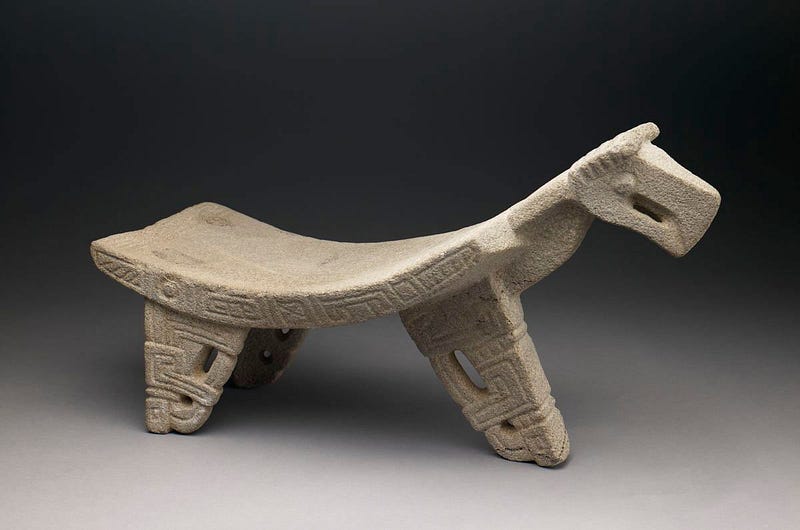
Some metates had really creative designs, like this one from Costa Rica:
It’s likely the mano came before the metate and was a one-handed tool in its earliest incarnation. It was used in prehistoric periods to grind wild seeds, nuts, and plants, perhaps against the ground or a log. Later, once corn became a staple of early civilizations in the Americas, the metate was incorporated to grind the maize more efficiently.
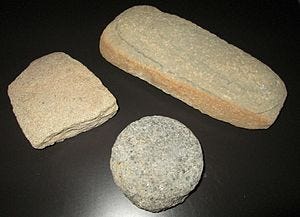
Here are a few Native American manos from Arizona.
The mano would be pressed against metate with the seeds between the two stones. The grinding motion could be circular, rocking, or grinding, depending on the type of mano and type of metate being used, and if one or both hands were involved. Some communities would set up specific rooms in order to establish mass grinding for their needs.
Manos and metates — or modern variations of them — are still in use today by some indigenous people across the Americas.
Hand to hand
The Spanish expression “mano a mano” appears to have come from the bullfighting ring. Now, the phrase translates literally as “hand to hand”, and describes a type of bullfight in which only two matadors compete against each other. Typically, both would be very famous bullfighters, which would attract a large crowd willing to shell out some moola for the pleasure of viewing this duel. Sort of like modern boxing pay-per-view.
In 1946 the Californian Napa Journal described one such duel between matadors and explained: “If Manolete and Arruza appear mano a mano, front row tickets probably will be sold at $100 apiece.” One hundred buckaroos! In 1946! That’s like 3 million dollars in today’s money… I think.
Those who did pay got their money’s worth, I assume, as the Spaniard Manolete died the next year in the ring. Carlos Arruza, from Mexico, wasn’t killed by a bull; he died in a car accident in his native country almost two decades after Manolete was gored. But not before playing a small role as Lt. Reyes in the 1960 John Wayne classic, The Alamo.
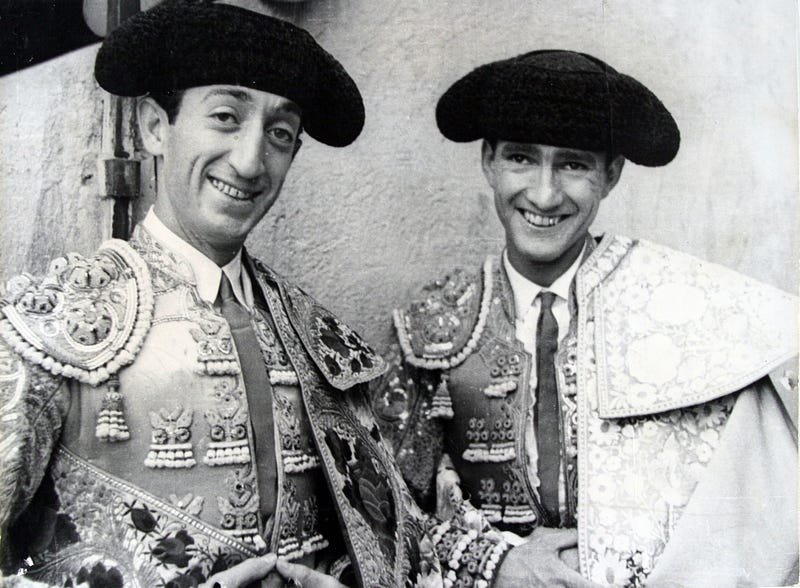
One could say that in the “mano a mano” of life, Arruza beat Manolete. One could say that, but this being Medium… I wrote it, instead. (Cue rimshot!) Here are the two bullfighters — Manolete is on the left — clearly smiling because they have no idea they will both die young.
Circling back to the “mano a mano” term, Merriam-Webster clarifies this:
…in part because of the Spanish word for hand (mano) resembling the English word for man (man), some people assume that mano a mano means something closer to man-to-man… Man-to-man carries a different meaning in English than mano a mano; it is defined as “characterized by frankness and honesty — usually used of a discussion between two men,” or “of, relating to, or being a system of defense (as in football or basketball) in which each defensive player guards a specified opponent.”
Interestingly, although in Spanish the expression usually does have the same connotation as it does in English — that of a competition — it can also mean the exact opposite: working side-by-side, or together as a team.
So, what can we conclude about our word of the day? Well, for one thing, that the editors of the Spelling Bee refused to give us a hand (bad pun intended) and declared that mano is a dord*.
You can check out my previous entry on another dord* here:
*What the heck is a dord, you ask? Here’s the answer: