
Morbilli
Historic proof vaccination works and saves lives
Yesterday’s New York Times Spelling Bee letters:
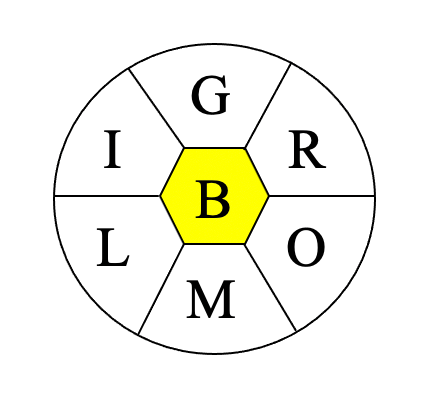
G, I, L, M, O, R, and center B (all words must include B)
Merriam-Webster says…

Silly little dictionary! Don’t you know morbilli can’t possibly be a word if the New York Times says it ain’t?
For further fascinating facts, check out the Spelling Bee Master.
What’s your favorite dord* from today’s puzzle?
My Two Cents
I can talk freely about yesterday’s Spelling Bee since it was, well, yesterday. If you’re still not done solving it, however, you can skip down to where I discuss today’s daily dord*.
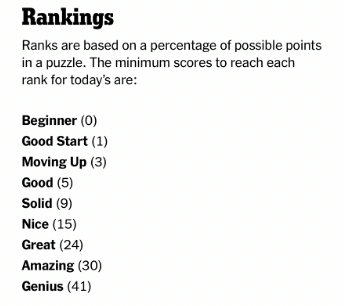
The August 6, 2021 Spelling Bee was probably a rare one, in that it took only 6 words to reach the Genius level. The way the game works is that there are several levels, from Beginner (0 points) to Queen Bee (all the words and possible points, which are not disclosed beforehand). In yesterday’s game the maximum word count was 23 and the total points were 59. The next-to-last level, Genius, is usually around 70% of the maximum points; in this case, 41.
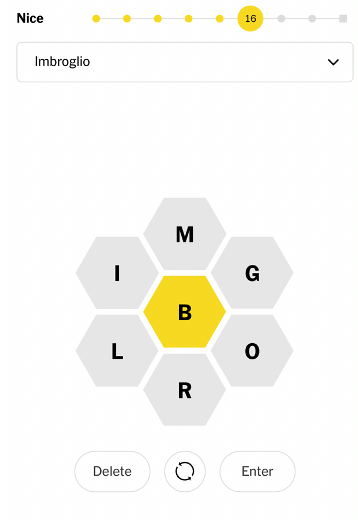
Here’s an interesting thing: the pangram, or word that contains all seven letters — there is always at least one in every game — was imbroglio, which awarded 16 points: one point per letter (nine) plus seven bonus points for getting the pangram. (Pangrams are always worth at least 14 points.)
I figured I might as well try to move up six levels (Beginner to Nice) right from the start with a single word, something very rare indeed. This happened in yesterday’s game because the maximum point score was very low. As a comparison, in order to reach Nice in today’s Spelling Bee, you need 36 points. In many games you need 50 or more.
My instincts were correct and I found the one and only pangram:
The next challenge was seeing what was the least amount of words I could use to get to genius. Typically you need at least 12 or 15 words, but sometimes it takes as many as 25 or 30… or more. The higher the Genius score, the more words it will take, unless most of the words have five or more letters.
See, the Spelling Bee point system is a bit uneven. Words must be at least four letters long and must include the center letter (yesterday it was B), but four-letter words award only one point each. Starting with five letters, you get a point per letter. So, for example, in yesterday’s game, the word boom is worth 4 points, but add an “r” after the “b” — broom — and you get 5 points.
In order to use the fewest number of words to reach Genius (at least 41 points), I had to avoid the four-letter words as much as possible. It was an interesting challenge, and proved very rewarding when I was able to do it:
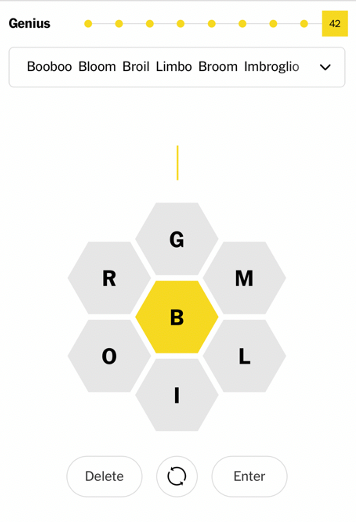
That’s it: six words! They are all there, in the top row, which lists them from left to right starting with the most recent one you found. All of them have at least five letters. One, imbroglio, has nine, and another, booboo, has six letters. Six words, 42 points, Genius level.
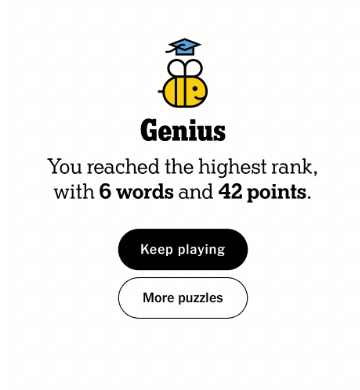
All that was left was finding the remaining words and points to get the Queen Bee, a rare thing for me to do. But yesterday was a good day.
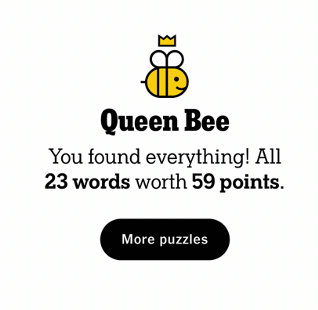
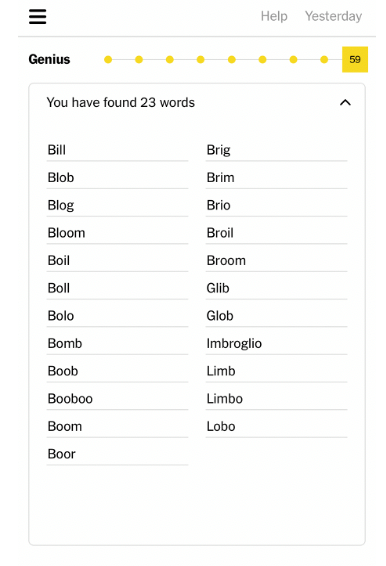
And here they are:
You measly virus!
The term morbilli for the measles infection is related to the genus of the measles virus itself, Morbillivirus, related to word morbus, meaning “disease”. (Measles, on the other hand, comes from Middle English meseles, plural of mesel, “spot characteristic of measles”, alteration (influenced by mesel leper) of masel; akin to Middle Dutch masel, “spot characteristic of measles”, and probably to Old High German masar, “gnarled excrescence on a tree”.)
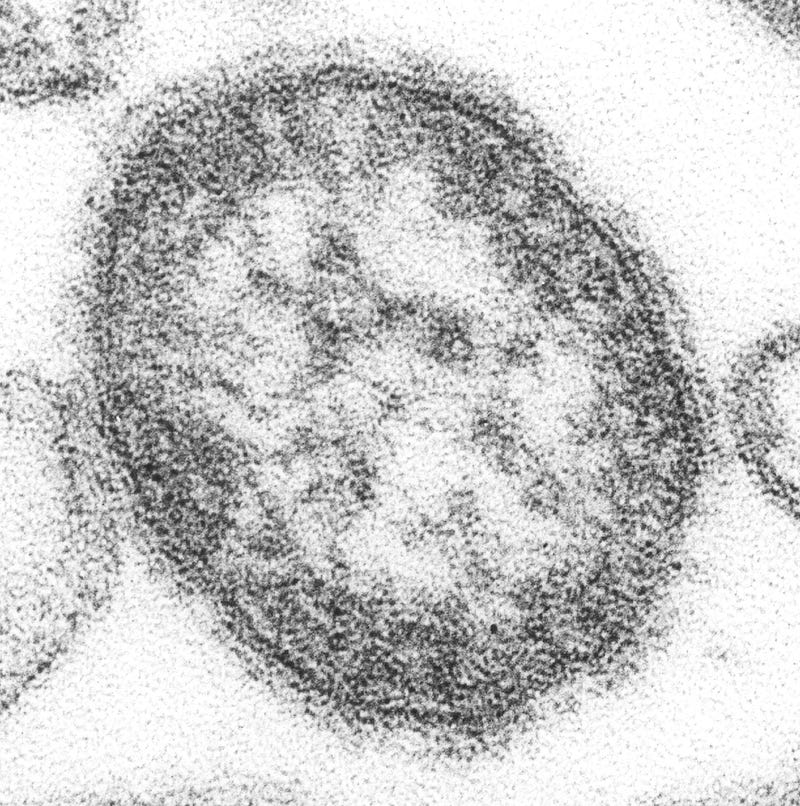
The photo at the top of today’s column shows the little scoundrel, courtesy of an electron microscope from the CDC. Here it is again, so you don’t need to scroll back up:
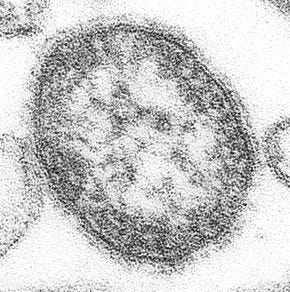
The virus is very very very contagious, and is spread by coughing and sneezing via close personal contact or direct contact with secretions. Measles is the most contagious transmissible virus known. It stays contagious for up to two hours in that airspace or nearby surfaces. Measles is so damn contagious that if one person gets it, 90% of nearby non-immune people will also become infected. And when I say “non-immune” I mean “vaccinated”, a medical term that has sadly become a four-letter word for many people.
Humans are the only natural hosts of the virus, and no other animal reservoirs are known to exist. However, the theory is it evolved the currently eradicated but formerly widespread rinderpest cattle virus.
As the WHO explains:
The first sign of measles is usually a high fever, which begins about 10 to 12 days after exposure to the virus, and lasts 4 to 7 days. A runny nose, a cough, red and watery eyes, and small white spots inside the cheeks can develop in the initial stage. After several days, a rash erupts, usually on the face and upper neck. Over about 3 days, the rash spreads, eventually reaching the hands and feet. The rash lasts for 5 to 6 days, and then fades. On average, the rash occurs 14 days after exposure to the virus (within a range of 7 to 18 days). Most measles-related deaths are caused by complications associated with the disease. Serious complications are more common in children under the age of 5, or adults over the age of 30.
Treatment? Cure? Nope, not really. There is no specific antiviral medicine that can kill the virus; the aim of treatment is to support the patient as they “wait it out” and treating any bacterial infections that result.
Measles kills about 1 or 2 patients per 1,000 infected. So it’s not as deadly as, say, the Covid virus, which kills at ten times that rate. Still, if you do the math, for every million children that get measles, you’re talking about 1,000 of them dying. Horrible, if you ask my opinion.
Enter the current boogeyman: vaccination.
A roller-coaster of deaths
In the 1950s and early 1960s, polio was on its way to no longer being the horrific threat it had been for thousands of years. This was due to the efforts of three scientists — Hilary Koprwoski, Jonas Salk, and Albert Sabin — who independently developed vaccines for the virus.
The unintended consequence was bringing measles to the forefront, as more children started dying from that disease. John Franklin Enders, who had already shared the Nobel Prize in Medicine for work on the polio virus, was able to use a cultivated virus to create a vaccine against measles. The vaccine went through several live human trials starting in 1960 before being licensed in the United States in 1963.
Five years later an improved version of the measles vaccine was developed by Maurice Hilleman at Merck & Co., and in 1971 it was grouped with the vaccines against mumps and rubella (German measles) in the MMR vaccine. The measles vaccine is considered to be extremely safe, and booster shots help make it highly effective.
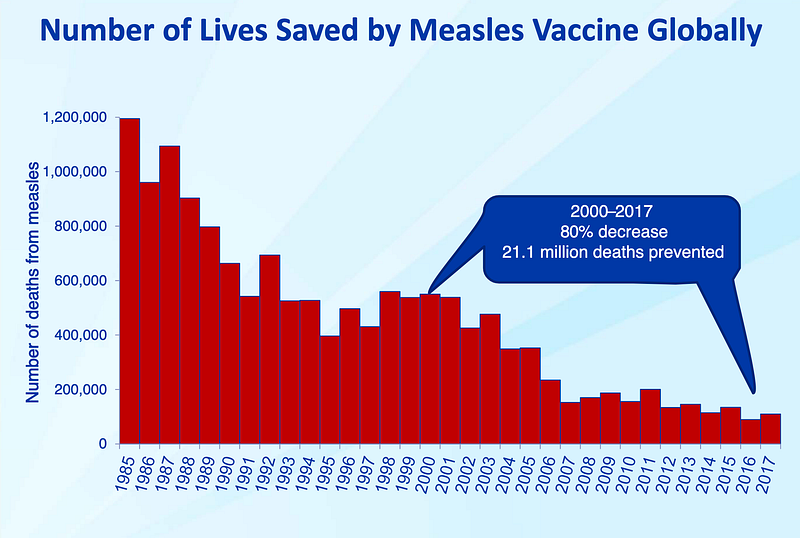
Worldwide vaccination campaigns starting in the 1970s helped reduce cases of measles and, more importantly, deaths, by millions. We’re talking about billions of children vaccinated over the last fifty years. Here is a CDC chart showing the effect from 1985 to 2017.
But epidemiologists started noticing an uptick around the time the above chart ends:
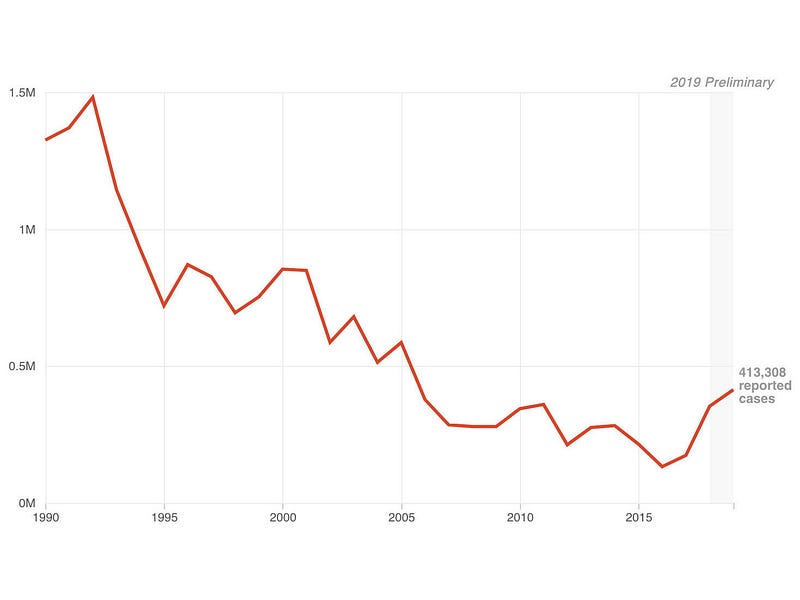
And unfortunately, in 2019 the cases and deaths hit a 23-year high. More than 200,000 people died that year of a very preventable disease. And most of these cases were in… you guessed it: unvaccinated people.
Because of the isolation Covid provoked in 2020 and 2021, the measles cases went down again. But again, not because people got smart about vaccines and decided to get them for their kids or themselves.
In 2019 the CDC reported more than 1,200 measles cases in the U.S. In 2020 they confirmed only 13. In 2021, as of July 9th, there has been only 1.
Conclusion: get vaccinated!
And yet, despite all we’ve discussed today, the editors of the Spelling Bee still declared that morbilli is a dord*.
You can check out my previous entry on another dord* here:
*What the heck is a dord, you ask? Here’s the answer:


