
Nyala
Be it in the lowlands or highlands, this antelope is always ignored by the Spelling Bee
Yesterday’s New York Times Spelling Bee letters:
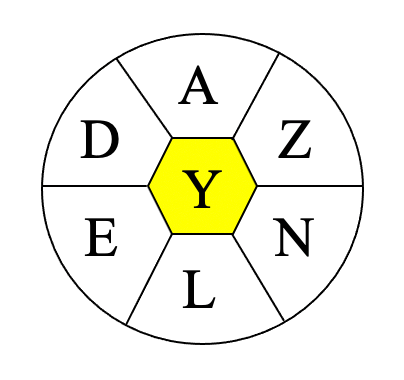
A, D, E, L, N, Z, and center Y (all words must include Y)
Merriam-Webster says…
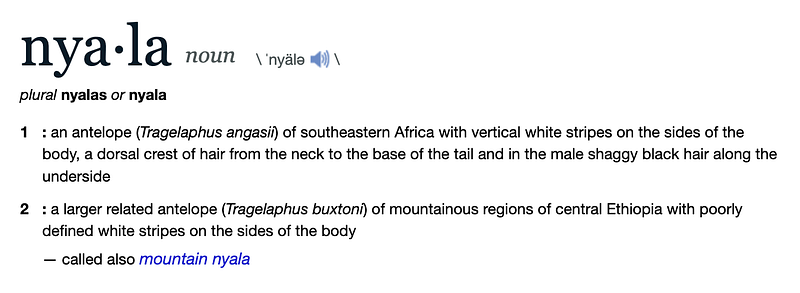
Silly little dictionary! Don’t you know nyala can’t possibly be a word if the New York Times says it ain’t?
For further fascinating facts, check out the Spelling Bee Master.
What’s your favorite dord* from today’s puzzle?
My Two Cents
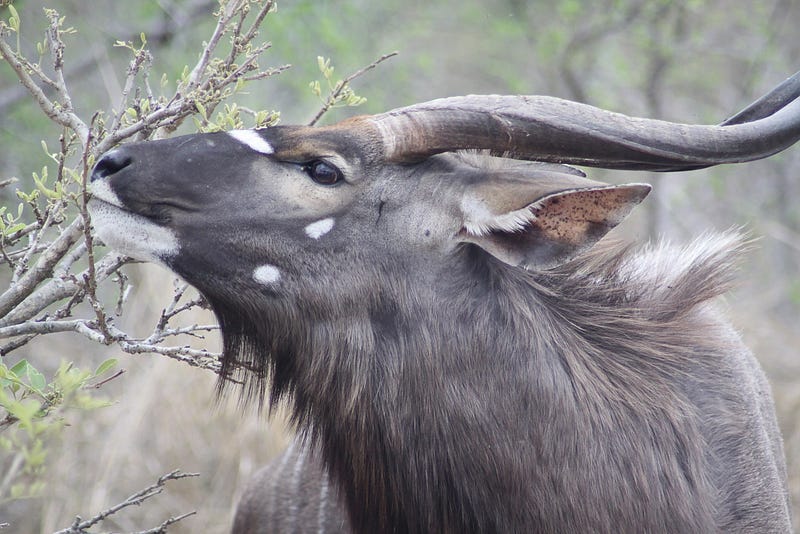
The beautiful, crisp, close-up photo–-you can practically feel the texture of the nyala’s hair and horns — was taken by Dianne Gibson, who has a couple dozen more wonderful pictures of animals on her Unsplash page. Check them out!
Valleys and mountains
Merriam-Webster tells us the word nyala is borrowed from the Tsonga language, part of the family of Bantu languages spoken by millions of people mostly in the southern half of the African continent. Specifically, Tsonga is spoken in what is now the nation of South Africa, especially in the northeastern part of the country, which coincides, logically, with the geographical range of the nyala.
The lowland nyala was first described in 1849 by George French Angas, an English explorer, naturalist, and artist who liked to go by the acronym G.F.A…. a sort of 19th-century YSL, I guess. Now, when I say “first described” I mean “first described formally to Europeans”, as the Bantu, Zulu, and Tsonga people had likely been talking about the nyala for hundreds of years before GFA ever laid eyes upon one.
The species name, Tragelaphus angasii, is said to have been given in his honor or in honor of GFA’s dad, another GFA (but with Fife instead of French) who was a banker and businessman and played a prominent role in establishing the Province of South Australia.
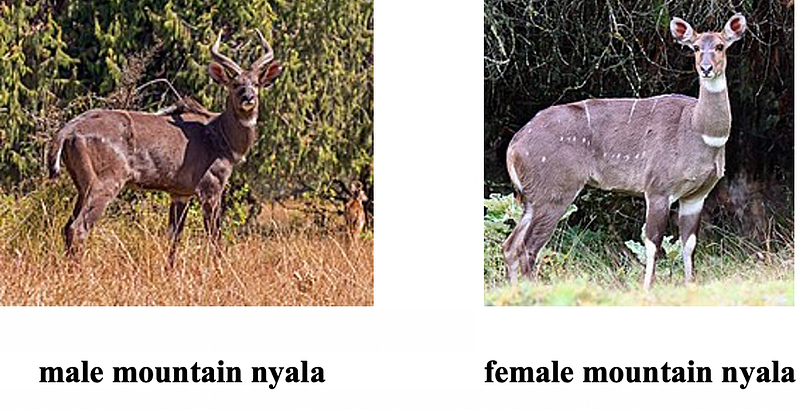
Lowland nyalas present extreme sexual dimorphism; this means the two sexes looking very, very different. They do share a few similarities, however: both males and females have a white chevron between the eyes and a bushy tail that is white on the underside. Females and all young nyalas have a chestnut-colored coat with several vertical white stripes on the sides. There are white spots across several parts of their bodies.
But when the male antelopes become adult, their coats turn dark gray, longer, and shaggier. Males also develop horns, a mane on the neck, and a white crest of hair across the back. Males are also much bigger than females, sometimes outweighing them by a 2-to-1 factor.
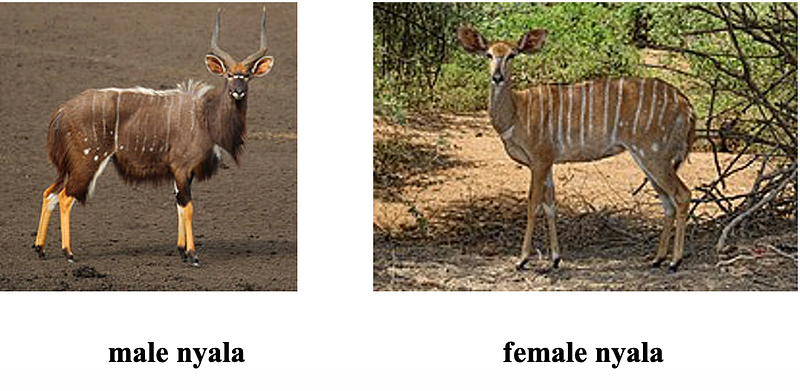
In the above photos the female appears bigger because Iva Reztok sucks at making adequate screenshot collages.
The highland, or mountain nyala (Tragelaphus buxtoni), a sort of cousin of the lowland nyala, is named after Major Ivor Buxton, who in 1908 shot one for sport in Ethiopia and brought it over to England for renowned British taxidermist Rowland Ward to taxidermize. In my opinion they should have named the antelope after Richard Lydekker, who proceeded to describe it (and never killed any nyalas, as far as I know). Lydekker was a naturalist and geologist who made this detailed drawing of a mantis shrimp:
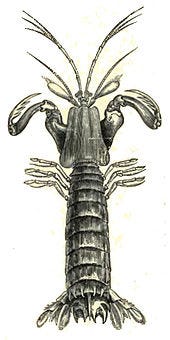
The Encyclopedia Britannica explains (about the mountain nyala, not the mantis shrimp):
The related mountain nyala… is much more like a greater kudu than another nyala in size, proportions, and social organization. Both sexes are gray-brown with faded stripes but have two conspicuous white throat patches, nose chevron, cheek spots, and underside of the bushy tail and a brown-and-white spinal crest. Coat length varies seasonally. Senior males are sepia-coloured, with open spiral horns up to 120 cm (47 inches) along the curve. Males, nearly as big as the greater kudu, stand up to 130 cm (51 inches) and weigh up to 300 kg (660 pounds); females weigh 150–200 kg (330–440 pounds).
Although the lowland antelope is thriving, the highland nyala is officially considered an endangered species. Although its habitat is at elevations past 10,000 feet (3,000 meters), the highland nyala’s range is limited and it is vulnerable to diseases spread by livestock. Because of human encroachment, the species has been reduced to “remnant groups outside of Ethiopia’s Bale Mountains National Park”.
So if you see a mountain nyala, please don’t be an a-hole like Major Buxton and don’t shoot it.
Mythical creatures
The genus of both types of nyalas is Tragelaphus, which comes from the tragelaph, a legendary half-goat, half-stag creature also known as a hircocervus.
According to World Wide Words, “the idea of the goat-stag goes back at least to Plato, who used it as an example of a thing that was knowable even though it didn’t exist.”
Interestingly, the Talmud mentions an animal alternatively called the koy or the kvi, an animal that is “intermediate” between cattle (kosher) and wild beast (non-kosher). The principal argument revolves around the kosher status of the koy itself. There is also the issue of whether or not the rabbis arguing the point actually believe this is a real animal or are using it as a hypothetical case.
Edward Topsell is an English cleric and author best remembered for his bestiary (a book about beasts, real or imagined). He published The History of Four-footed Beasts (1607) and The History of Serpents (1608) via William Jaggard, and both tomes were reprinted in 1658 as a massive 1,100 page volume called The History of Four-Footed Beasts and Serpents. One of the beasts featured was the tragelaph:
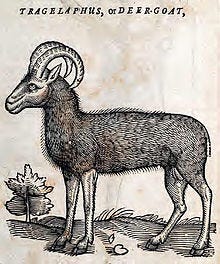
Topsell was not a naturalist — or any other type of scientist, for that matter — so he simply limited himself to repeating old rumors and legends about actual animals… while writing freely and loosely about made-up creatures. Here are some of the claims he made:
- True toads have a toadstone in their heads that protects people from poison.
- Weasels give birth through their ears.
- Lemmings graze in the clouds.
- Elephants worship the sun and the moon and become pregnant by chewing on mandrake.
- Apes are terrified of snails.
The last one I know for a fact is the other way around. Snails are very scared of gorillas. I think…
Topsell’s book includes many illustrations, among them the famous woodcut of a rhinoceros made in 1515 by printmaker, painter, theorist, and generally awesome Albrecht Dürer.
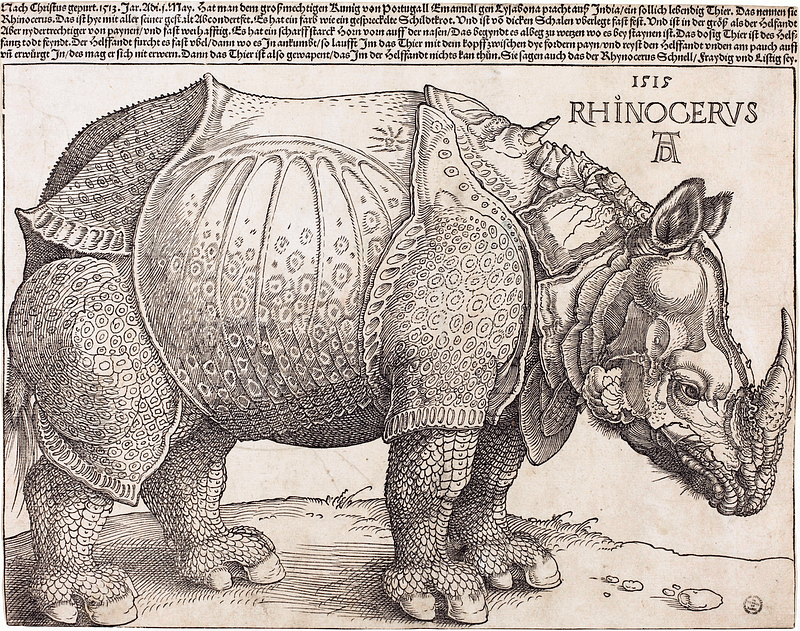
I’ve placed a large version of the image so you can admire all its glorious details.
The most impressive thing about this illustration is that Dürer never actually saw a rhinoceros. He drew it based only on a written description and a sketchy sketch by an unknown artist!
There are obvious inaccuracies. For one thing, the rhino looks like it’s wearing armor, reminiscent of Hulk in Ragnarok. Then there’s that tiny, twisted horn right where the front shoulders start, and the scaly legs. But still, quite a remarkable illustration from an artist already known for his Praying Hands and Young Hare.
Dürer’s woodcut became very popular in Europe and was regarded by the Western World as a true representation of a rhino for the next three centuries. It was also copied many times and appeared in many books… including Topsell’s The History of Four-Footed Beasts and Serpents, as mentioned before.
Well, that’s it for today. We’ve covered plenty of ground, unlike the endangered mountain nyala, which has less and less ground to claim. Speaking of which, the editors of the Spelling Bee did not think that this antelope’s precarious status gave it enough merit, and declared that nyala is a dord*.
You can check out my previous entry on another dord* here:
*What the heck is a dord, you ask? Here’s the answer:


