
Koel
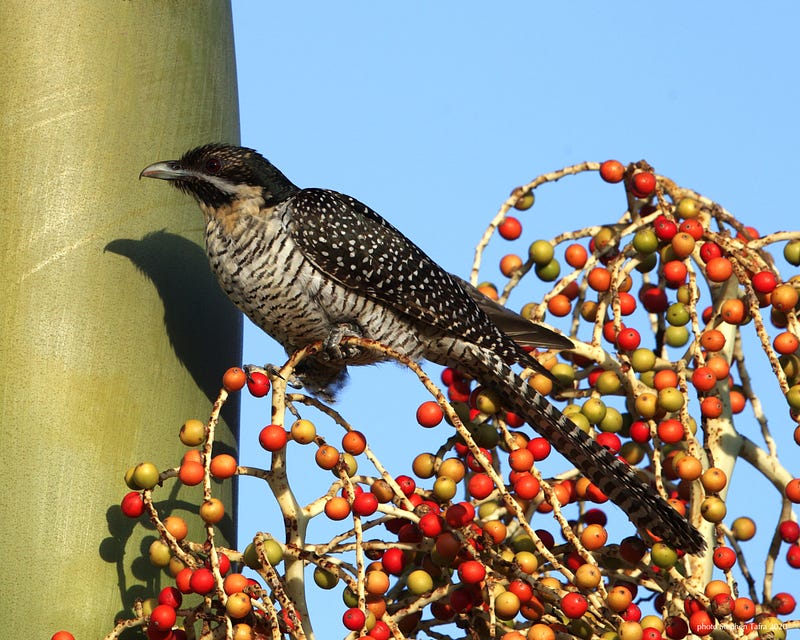
This long-tailed brood parasite is truly cuckoo!
Yesterday’s New York Times Spelling Bee letters:
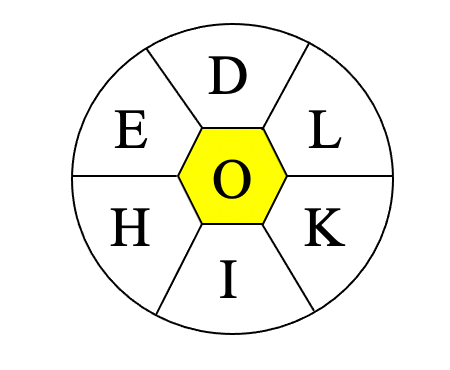
D, E, H, I, K, L, and center O (all words must include O)
Merriam-Webster says…
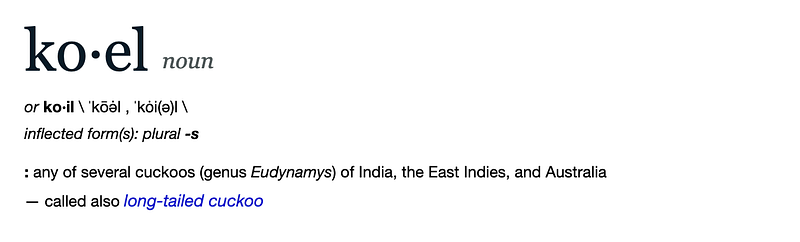
Silly little dictionary! Don’t you know koel can’t possibly be a word if the New York Times says it ain’t?
For further fascinating facts, check out the Spelling Bee Master.
What’s your favorite dord* from today’s puzzle?
My Two Cents
I was pleasantly surprised to find not one, but seven photos related to koel when I searched for the word in Unsplash. What was also surprising is that only six of them were birds. The first one showed what appears to be a church tower with a bell and a cross at the top. Not sure how that’s related. Koel with a capital “K” can refer to several radio stations, a stadium in the Netherlands, and two rivers in India. Hmmmm…
Cheating bird
Although Merriam-Webster lists the “long-tailed cuckoo” as a synonym of koel, a 2005 study by Michael D. Sorenson and Robert B Payne called "A molecular genetic analysis of cuckoo phylogeny" determined that the long-tailed cuckoo (Urodynamis taitensis) was distantly related and did not belong to the same genus, Eudynamys, as the true koel.
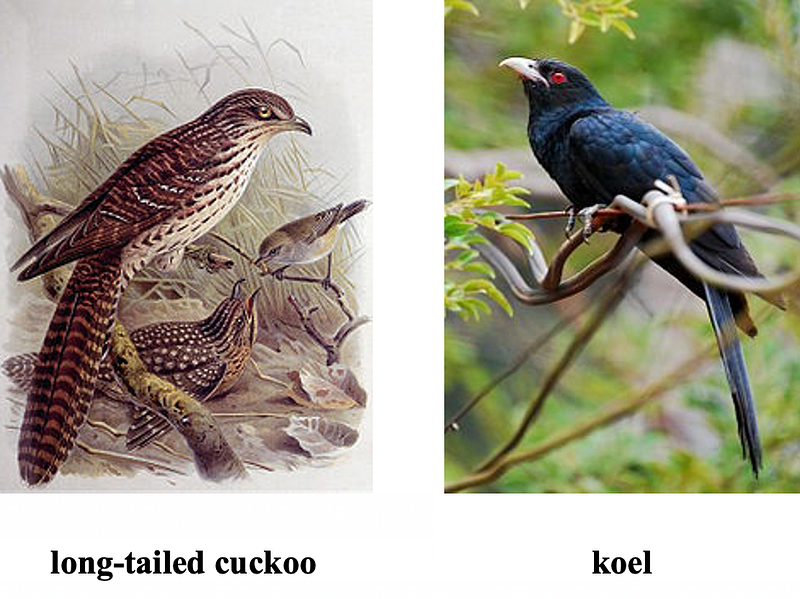
Apparently the taxonomy of the species of koel is complicated and subject to much dispute. This has led to several physical confrontations by ornithologists over the past few decades, including an incident in which one birdwatcher repeatedly shushed another one while threatening them with ten-pound binoculars.
The sad fact remains that currently some scientists insist there is only one species, the common koel (Eudynamys scolopaceus), shown above; others claiming there are two species, common koel, and black-billed koel (Eudynamys melanorhynchus); and a third group saying there are three species… just for the heck of it.
No one has the koels what they think, which I think is completely unfair.
The male and female koels are not really birds of a feather, since their plumage is quite different. Male birds (again, shown above) have black feathers like a raven and are of a similar size to ravens. This is useful because (1) their territories sometimes overlap with those of ravens, and (2) they can thus distract raven flocks so that their female counterpart can approach the nest and lay her eggs.
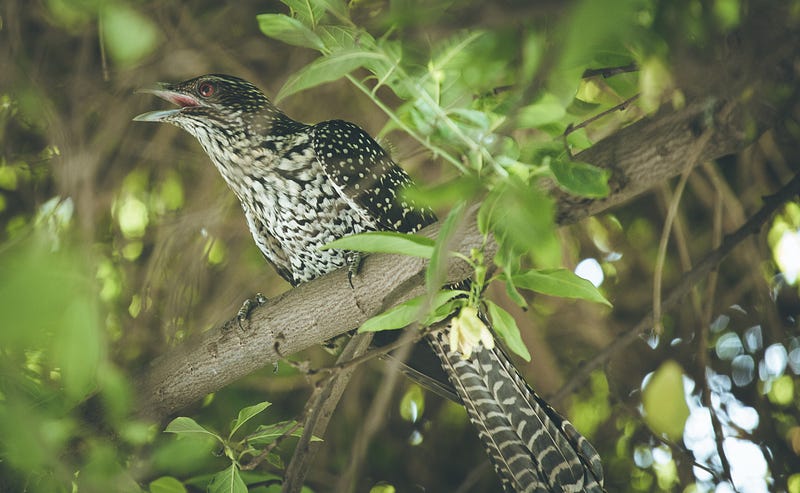
Yep, that’s the female koel. Although she is clearly not laying eggs in the above photo. Perhaps she’s checking out the nest where she plans to do so.
You’ll notice her feathers are brown and speckled. This works as camouflage when she does her dirty deed. As you may already know, that’s one of the things cuckoos are famous for, the other being their regular appearances in Swiss wooden wall clocks.
The technical term is “brood parasitism”, which is a fancy way of saying that koels (and other cuckoos) rely on others to raise their young. This also happens with some insects, fish, and birds that are not cuckoos.
The basic premise is that cuckoos can lay eggs that are very similar to other birds’ eggs, so said birds won’t realize that they are spending their time sitting on an egg-covered baby that isn’t theirs. Once the egg cracks open, the mommy bird considers the hatchling to be hers and spends her energy on it, allowing the real mother, Ms. Cuckoo, to keep vegging on the couch while watching Netflix and munching on popcorn.
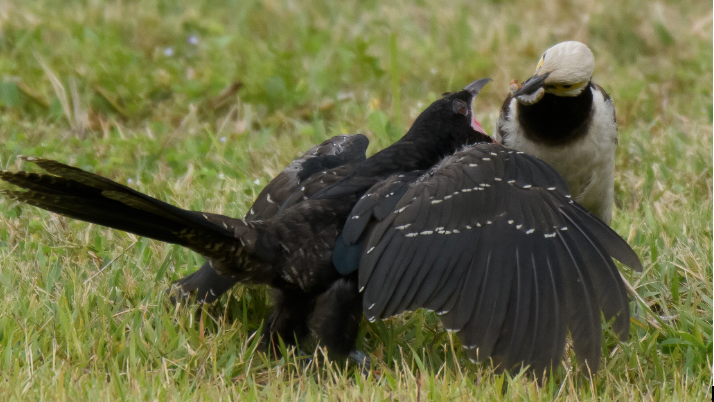
The above photo shows a black-collared starling (on the right) feeding a koel.
Cheating partner
Being that the cuckoo is one of the most famous cuckolders out there, the bird helped coin the term… well, um, of course, cuckold.
When applied to humans, a cuckold is the husband of an adulterous wife. The wife of an adulterous husband has her own term, cuckquean, but one hears cuckold a lot more often.
Supposedly its first English usage was in 1250 in the medieval debate poem The Owl and the Nightingale.
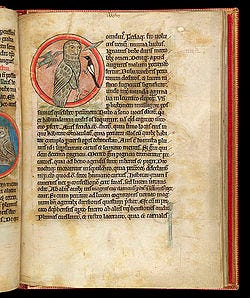
Can you see the word right there, in the fifth paragraph? What? There’s only one long and illegible paragraph, you say? Shame on them!
The word cuckold often implies not just sexual deception, but rather a deeper betrayal of the husband: he may not find out the child is not his until it arrives or becomes older (as with cuckoo birds).
Modern times have given cuckold an additional connotation. As a sexual fetish, this term (also called wife watching) refers to a man who is a willing participant in his partner’s sexual “infidelity”. The girlfriend or wife who enjoys cuckolding her husband is called a cuckoldress, a term that, much like mistress, indicates her domination over her submissive man. Usually it is that submissive man who proposes the arrangement and enjoys the humiliation, though some cuckolds may prefer their lover to initiate the situation.
Of course, the entire sex fantasy will not work at all if the man is being humiliated against his will. It’s a fantasy that’s much less common with heterosexual women in the subservient role.
According to Wikipedia:
Psychology regards cuckold fetishism as a variant of masochism, the cuckold deriving pleasure from being humiliated… In his book Masochism and the Self, psychologist Roy Baumeister advanced a Self Theory analysis that cuckolding (or specifically, all masochism) was a form of escaping from self-awareness, at times when self-awareness becomes burdensome, such as with perceived inadequacy. According to this theory, the physical or mental pain from masochism brings attention away from the self, which would be desirable in times of “guilt, anxiety, or insecurity”, or at other times when self-awareness is unpleasant.
Or perhaps some men just get off on this arrangement. Hey, whatever floats your consenting boat.
Shannon Ashley has an interesting article about the cuckolding sex scandal of Jerry Falwell, Jr.
Yet, despite the interesting lives of cuckoos (the birds) and cuckolds (the fetishers), the editors of the Spelling Bee decided that koel should remain a dord*.
You can check out my previous entry on another dord* here:
*What the heck is a dord, you ask? Here’s the answer: