
Firman
No, not the Christmas tree superhero you’re thinking of
Yesterday’s New York Times Spelling Bee letters:
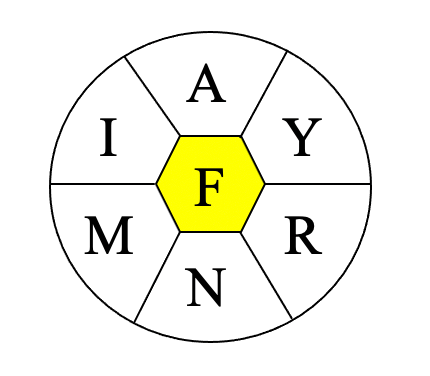
A, I, M, N, R, Y, and center F (all words must include F)
Merriam-Webster says…
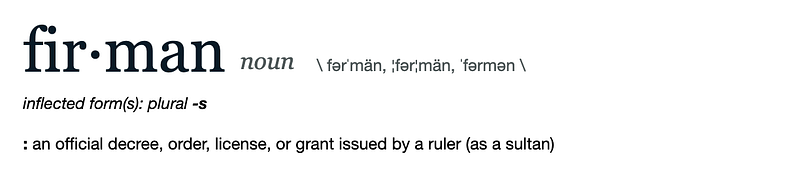
Silly little dictionary! Don’t you know firman can’t possibly be a word if the New York Times says it ain’t?
For further fascinating facts, check out the Spelling Bee Master.
What’s your favorite dord* from today’s puzzle?
My Two Cents
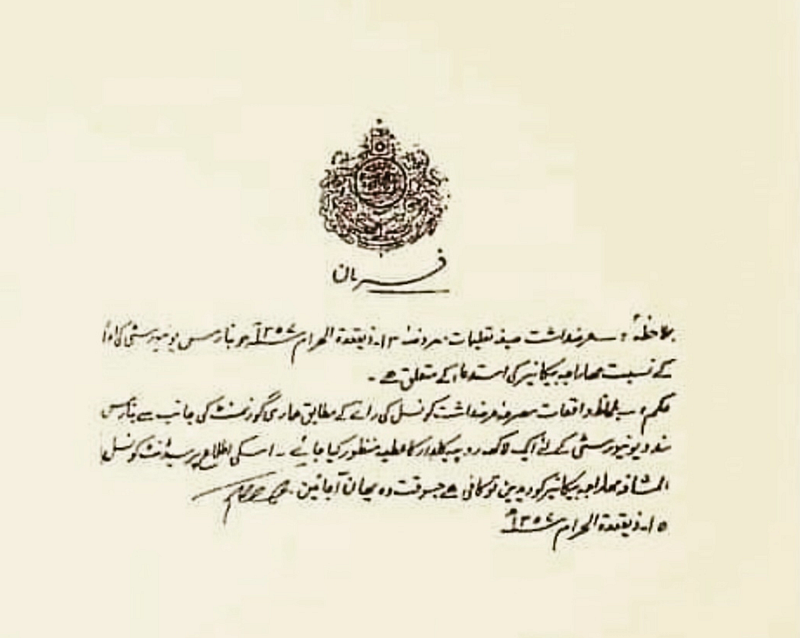
The photo at the top of today’s column shows the firman (also sometimes called farman) signed by the 7th and last Nizam (ruler) of the Princely State of Hyderabad. This kingdom was annexed by India in 1948, right after said county’s independence. The firman Mir Osman Ali Khan signed in 1939 granted the Banaras Hindu University the amount of one lakh rupees. (A lakh is a unit in the Indian numbering system equal to one hundred thousand.)
Royal decree
Merriam Webster explains that firman comes from the Turkish ferman, from the Persian fermān, from the Old Persian framānā. Yeah, I agree. It’s not a very helpful explanation at all.
The 1911 edition of the Encyclopedia Britannica says this:
FIRMAN (an adaptation of the Per. fermān, a mandate or patent, cognate with the Sanskrit pramāna, a measure, authority), an edict of an oriental sovereign, used specially to designate decrees, grants, passports, &c., issued by the sultan of Turkey and signed by one of his ministers. A decree bearing the sultan’s sign-manual and drawn up with special formalities is termed a hatti-sherif, Arabic words meaning a line, writing or command, and lofty, noble. A written decree of an Ottoman sultan is also termed an irade, the word being taken from the Arab. irādā, will, volition, order.
A lot of the older firmans are beautiful works of art. Here is a firman signed in January of 1831 by Fat’h Ali Shah Qajar (the second Shah, or king, of the Persian empire during the Qajar dynasty.
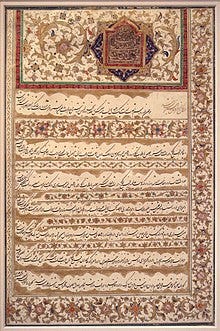
And here is a firman signed by Taj ud-Din Firuz Shah (also known as Firuz Shah Bahmani), ruler of the Bahmani Sultanate. Probably around the early 15th century.
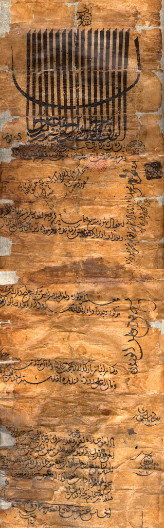
Today a firman is any written permission granted by the appropriate Islamic official at any level of government. You may have heard of firmans as permissions to travel in countries or approvals to conduct scholarly research in the country; for example, archaeological excavations. Firmans may or may not be combined with various types of passports.
Fiiiiiiiiir–man!
The above should be read like the cry emitted by Birdman, the 1960s Hanna-Barbera cartoon hero who constantly needed assistance from his much more capable purple eagle pet. For those too young to remember, here is the intro. Birdman’s shout-out to himself happens around 0:44.
Remember at the very top of the article when I said Firman was not a Christmas tree superhero? He wasn’t, but there was a guy named Firman in the 9th century who tried to fly like a bird.
That guy was Abu al-Qasim Abbas ibn Firnas ibn Wirdas al-Takurini, also known as Abbas ibn Firnas (Arabic: عباس بن فرناس), and latinized as Armen Firman. Fiiiiiiiir–man!
He lived in the Andalusian Caliphate of Cordoba, present day Córdoba, in Andalusía, España. Back then, in that 9th century, the caliphate included all but a northern strip of current Spain and Portugal. This was the golden age of Islamic art and science. Córdoba and Baghdad were considered the twin cultural centers of the entire world, or at least the world as known by euro-centric Europeans.
Firman was a polymath who, besides spending a large chunk of his life dedicated to writing his very long name, dabbled in inventions, astronomy, medicine, chemistry, engineering, Andalusi music, and Arabic-language poetry. And when I say dabbled, I mean he kicked ass. For example, he came up with a way to manufacture colorless glass to make magnifying lenses for reading.
Algerian historian Ahmed Mohammed al-Maqqari wrote the following about Firman:
Among other very curious experiments which he made, one is his trying to fly. He covered himself with feathers for the purpose, attached a couple of wings to his body, and, getting on an eminence, flung himself down into the air, when according to the testimony of several trustworthy writers who witnessed the performance, he flew a considerable distance, as if he had been a bird, but, in alighting again on the place whence he had started, his back was very much hurt, for not knowing that birds when they alight come down upon their tails, he forgot to provide himself with one.
I don’t think al-Maqqari meant a literal tail, of course.
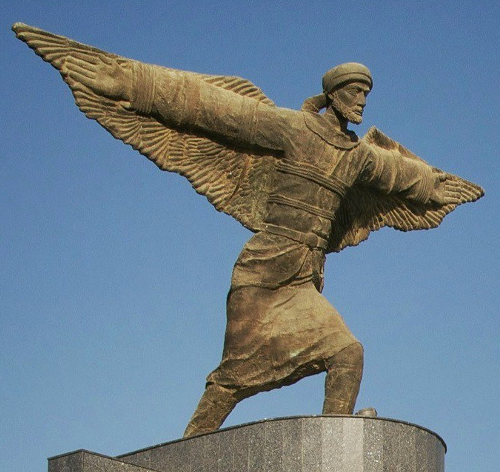
Above is a photo of the statue of Armen Firman, or Ibn Firnas, outside Baghdad, Iraq.
Undeterred, Firman built himself a glider and launched himself from a tower. This flight was more successful than the previous one, but he again landed badly. Yep… still no tail.
There is actually a mild controversy about whether Firman and Ibn Firnas were two different people or the same person. Some sources claim Firman was the one who flew with the bird wings, an event that Ibn Firnas witnessed as a kid. Then Ibn Firnas went on to build the glider.
Others argue it was the same person who performed both jumps, and that secondary sources confused the two events as happening to two individuals. Considering that sometimes Firman’s “wings” are described as a “cloak with feathers” (which might resemble a glider), and that both accounts end with a disastrous landing, I’m inclined to believe Firman and Ibn Firnas are one and the same.
Or perhaps Firman was Ibn Firnas’s alter ego superhero. Fiiiiiiiiir–man!
In 1976, a lunar impact crater on the far side of the Moon was named Ibn Firnas to honor his invention of a chain of rings that could be used to simulate the motions of the planets and stars.
I told you he kicked ass!
Despite all the beautiful photos of firmans and Armen Firman kicking ass, the editors of the Spelling Bee decided that batt should remain a dord*.
You can check out my previous entry on another dord* here:
*What the heck is a dord, you ask? Here’s the answer:


