
Medium Writing Tips
Medium Views by Traffic Source
Understanding Medium’s external referral section and article traffic sources
Traffic and reader statistics are available for stories you publish on Medium. In previous articles, I’ve focused on the various metrics that Medium uses to measure traffic and reader engagement:
All of these metrics are useful in their own way. However, understanding these metrics means very little unless you can identify the source of traffic.
That is where Medium’s Views by Traffic Source section comes in handy.
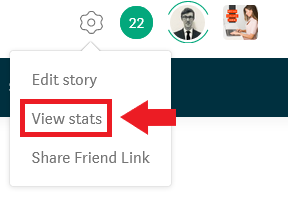
The Views by Traffic Source section can be accessed by going to the stats section of your profile and selecting an individual article or by navigating to a published article and click the view stats button in the top right hand corner.
Below is an example of the views by traffic source section for my Medium article: How to Bypass Virtually Every Paywall.
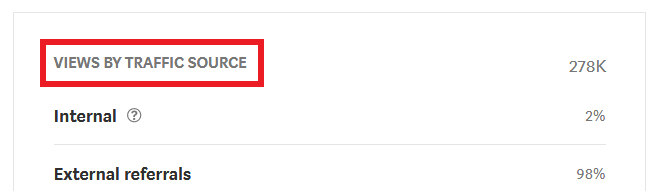
As you can see from the chart below, the article currently has about 278,000 views. Only about 2% of the traffic for this article is internal. 98% of the article’s traffic is external.
Internal traffic refers to the views from Medium article distribution. This can include stories featured on the homepage, views through the Medium mobile app, emails sent from Medium, and from Medium’s own social media accounts.
External traffic refers to all traffic your article receives not through Medium’s distribution channels. This can include stories shared on social media, articles found through a Google search, or accessing the article through a direct link in a writer’s newsletter.
How is this useful to Medium writers?
It is useful because it provides writers with a quick way to gauge whether their article is gaining traction internally on Medium or whether views are originating from third party sources.
Since Medium pays its writers based on member reading time, it is generally more profitable to have high internal traffic (assuming a low bounce rate).
But the true value of the views by traffic source section is the list of specific referring websites, listed below external referrals. By breaking down the major sources of traffic, writers can better understand how readers are finding their work and adjust their marketing strategy accordingly.
Using the same article referenced above, we can learn a lot about the article’s traffic sources.
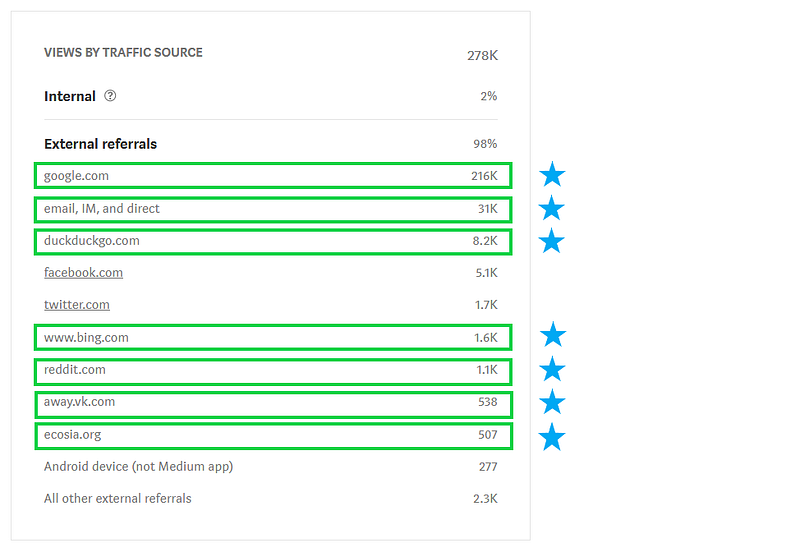
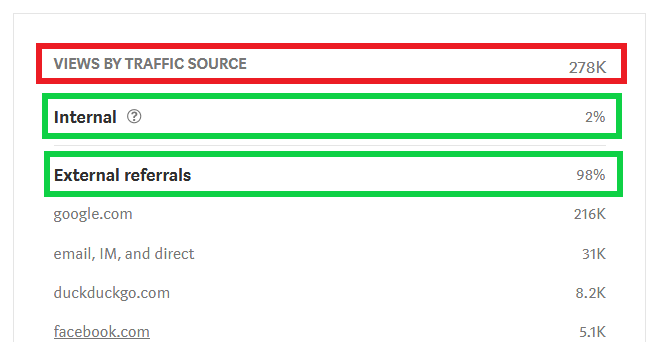
As indicated in green, many of the major sources of traffic are search engines. Specifically:
- Google — 216,000 views
- Bing — 1,600 views
- VK — 538
- DuckDuckGo — 8,200 views
There were also a decent amount of views from Reddit and email, IM, and direct. Email, IM, and direct is a valuable metric, in this case.
Since I hardly shared the article (other than using Signal to auto tweet on Twitter), this means that this article was shared by hundreds if not thousands of people to build momentum.
Email, IM, and direct refers to traffic not originating from Medium’s site, including email links (i.e. me, sending you an email with a link to my article), IM would be links sent through chat functions or messengers (Google Chat, Slack, etc.) and direct is someone going straight to the article, which could be someone manually entering the URL, finding the article in their history/browser suggestions, or through their page bookmarks.
Social media sites also played a vital role.
- Facebook — 5,100 views
- Twitter — 1,700
I shared the article a few times on Twitter and Facebook, but did not do any major promotion. This means the article was widely shared by others on social media.
The cool thing about select sites and posts noted in the Medium external traffic sources, is that you can click on the source and see the actual post that contributed to this growth.
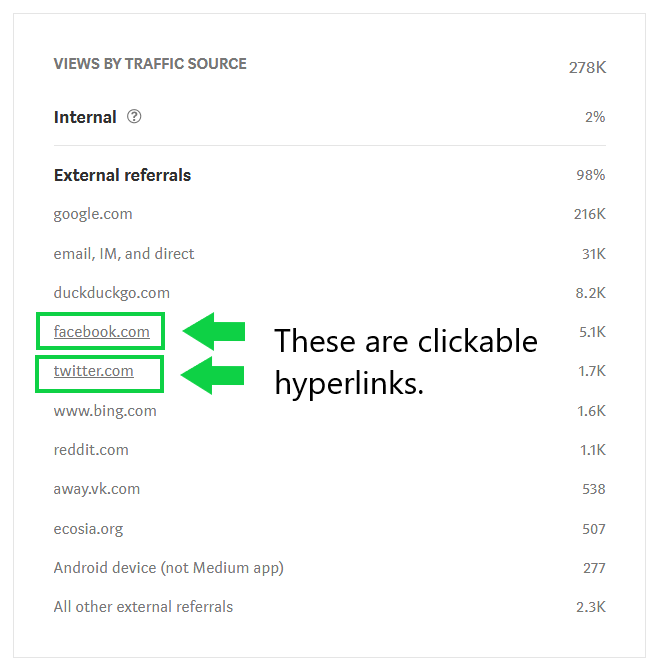
For example if I click on the Twitter hyperlink, I will see the following:
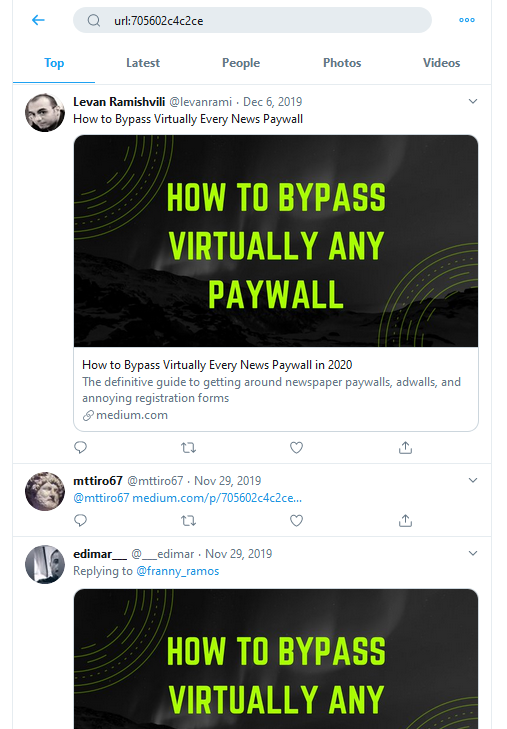
If I scroll down, I can see the complete list of people who retweeted or engaged with my article.
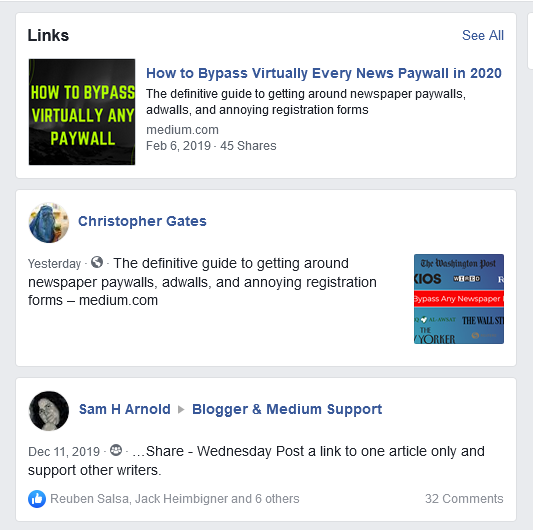
This is also true when I click on the Facebook hyperlink:
If I scroll down on my story’s stat page, I can also see how many of the views originated from Medium’s Friend Link:

This minuscule number of views (10/278,000) further confirms that people other than my immediate friend circle were sharing this (since I gave them the Friend Link). This is another good reason to use Friend Links — to track article views and their sources!
Other Common Traffic Sources:
There are some common, yet confusing traffic sources you may also see.
For example you may see the following source generating a lot of views:
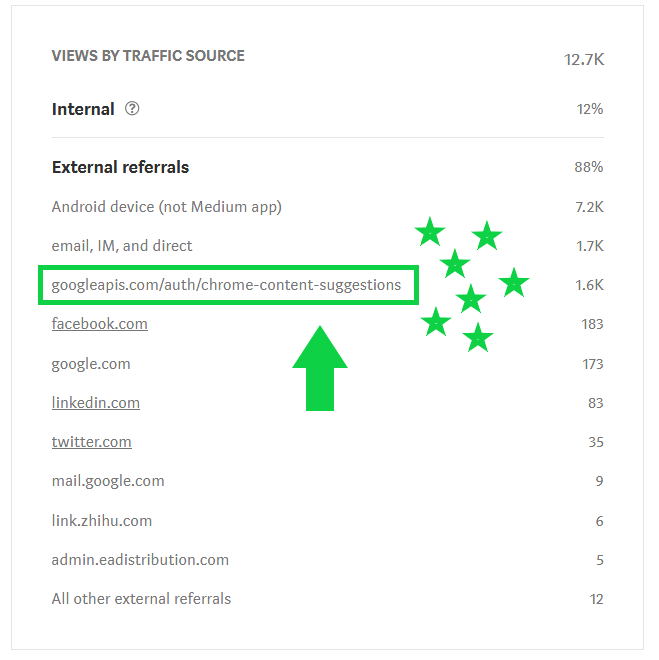
googleapis.com/auth/chrome-content-suggestions
This source actually means that your article is being featured by Google Chrome content suggestions (also known as “Articles for You”).
As explained by Boost Medical:
Google Chrome content suggestions (also known as “Articles for You”) are a relatively new feature to Google that you might notice on your mobile phone.
For Android phones, Chrome is the default web browser. When you launch Chrome, you’ll notice a list of articles below the widgets for sites you frequently visit. These are Chrome “Articles for You” suggestions, and they are responsible for generating more traffic than you think. Chrome unveiled “Articles for You” on Android phones first, but iOS users can also swipe up to see more recommendations through the Chrome app.
The purpose of this feature is to capture the attention of the nearly three billion people worldwide using smartphones. The entire experience is geared towards faster mobile browsing that is tailored to each user’s time on the internet. More and better content keeps people engaged for more time.
In terms of traffic, Google Chrome content suggestions is nipping at the heels of other strong sources of referral traffic. Ranked 4th behind Google search, Facebook, and Twitter for some sites, “Articles for You” traffic for mobile searches alone has grown 2,100% since 2017 (increasing from an estimated 15 million visits per month to 341 million).
It is also important to note that the Google Chrome web browser gets 62% of the market share (over other browsers like Firefox and Mozilla). This means that it makes good sense to optimize your mobile site for Google Chrome content suggestions.
Similarly I suspect that the traffic source:
Android device (not Medium app)
is actually the mobile views from Chrome’s recommendations mixed with general Google search results:
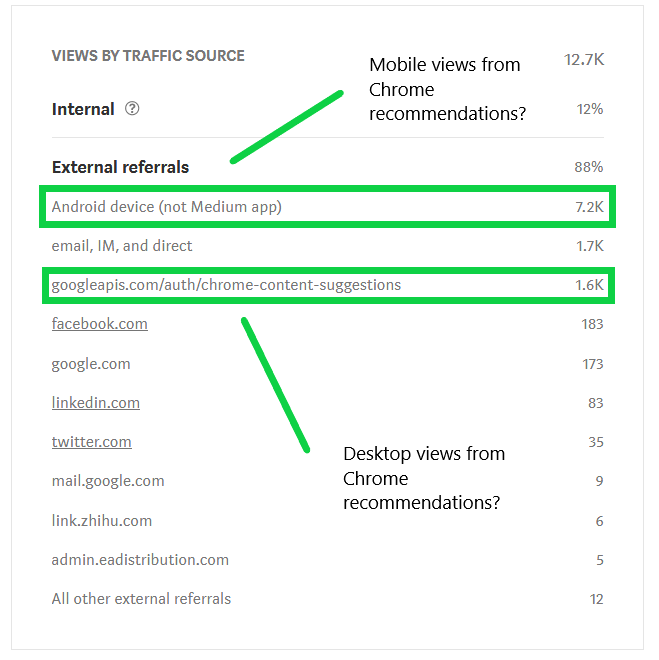
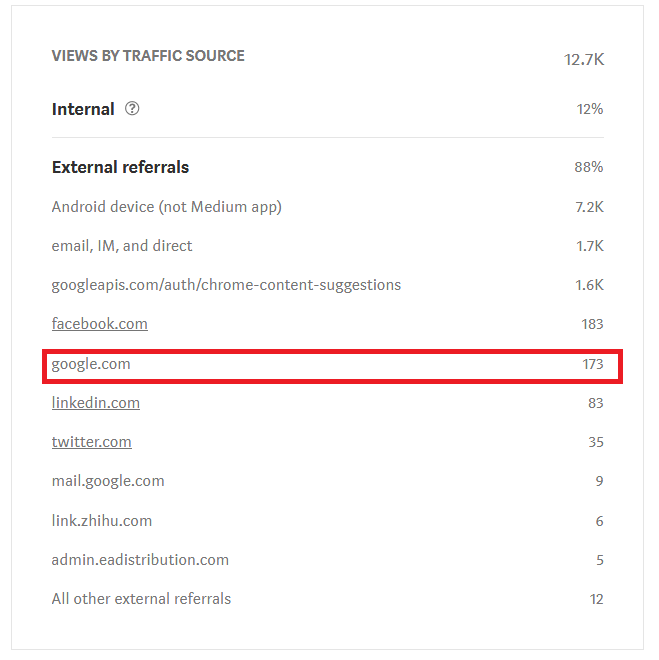
I believe this because it seems unlikely that for an article featured prominently in Google search results, that it only received 173 views from all Google search results (Medium is likely not able to break down this data correctly).
Notes on Views by Traffic Source Section
- It can be hard to compare the change in external sources over time because it is so heavily distorted by the height of the Medium source graph at the bottom.
- The tracking is not perfect for each source, and many times the results are rounded and in some cases, erroneously lumped together.
- Views by traffic source are useful for a high level understanding of your stats, but as illustrated above, there are limits to the specificity of the sources of data, so don’t obsess over those nuances.

Thanks for reading this article! Leave a comment below if you have any questions. Be sure to sign up for the Blogging Guide newsletter, to get the latest tips, tricks, and news about writing on Medium and to join our Facebook group, Medium Writing, to share your latest Medium posts and connect with other writers.
If you liked this article, here are some other articles you may enjoy:

Casey Botticello is a partner at Black Edge Consulting. Black Edge Consulting is a strategic communications firm, specializing in online reputation management, digital marketing, and crisis management. Prior to founding Black Edge Consulting, he worked for BGR Group, a bipartisan lobbying and strategic communications firm.
Casey is the founder of the Cryptocurrency Alliance, a Super PAC dedicated to cryptocurrency and blockchain advocacy. He is a graduate of The University of Pennsylvania, where he received his B.A. in Urban Studies.
You can connect with him on LinkedIn, Twitter, Facebook, or by following his Medium publication, Blogging Guide.


