
Medium Writing Tips
How is Medium Article Read Time Calculated?
Medium Read Time vs. Medium Member Reading Time
This article will address two major questions:
1. How is Medium Article Read Time Calculated?
2. What is the Difference Between Medium Article Read Time and Medium Member Reading Time?
I was actually in the middle of writing about how article read time was calculated when Medium made their announcement about using “Member Reading Time” to primarily determine earnings.
Although it is a subtle difference, given the massive impact this will have on writers, and the confusion this will likely lead to given the similarity of the terms, it seemed worth an explanation (based on what was previously known on “Article Read Time” and what appears to be the meaning of the new and critically important “Member Reading Time.”
How is Medium Article Read Time Calculated?
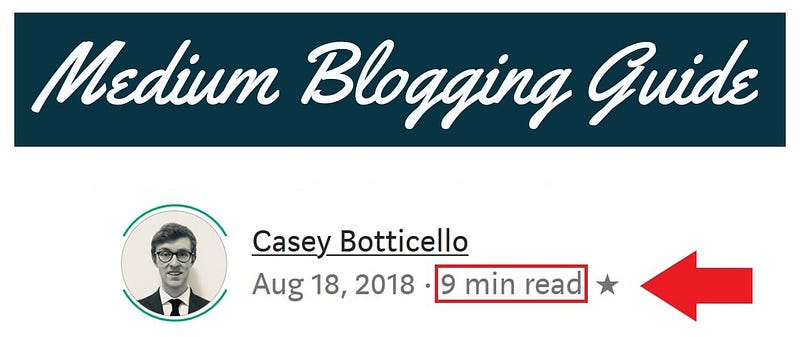
Read Time or Article Read Time, appears at the top of any Medium article, and is an estimate of how long it will take the reader to complete an article.
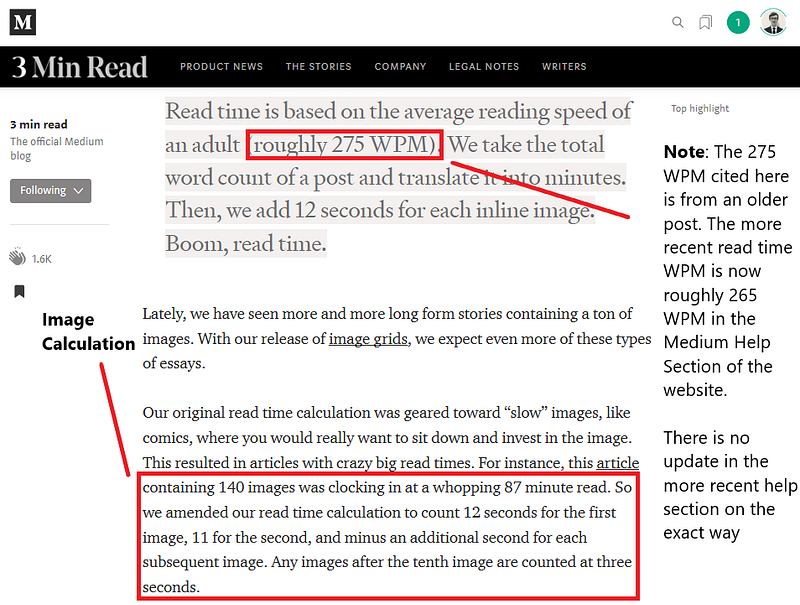
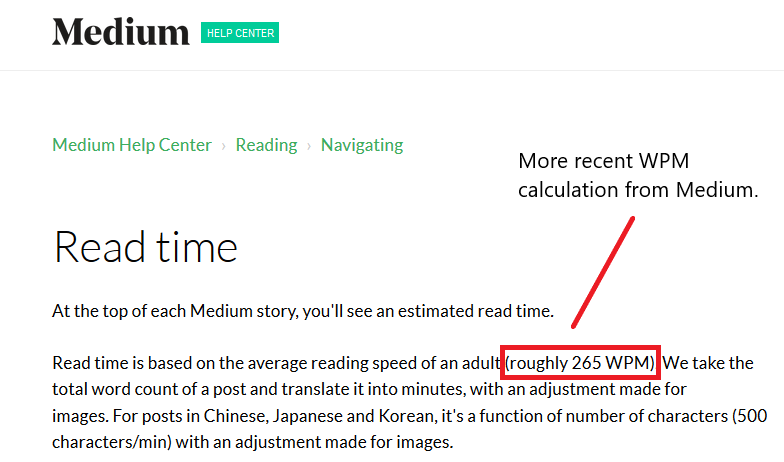
Read time is based on the average reading speed of an adult (roughly 265 WPM). Medium takes the total word count of a post and translate it into minutes, with an adjustment made for images.
Images add an additional 12 seconds for the first image, 11 seconds for the second image, and minus an additional second for each subsequent image, through the tenth image. Any images after the tenth image are counted at three seconds.
For posts in Chinese, Japanese and Korean, read time is a function of the number of characters (500 characters/min) with a similar adjustment made for images.
What is the Difference Between Medium Article Read Time and Medium Member Reading Time?
As described above, Article Read Time is the time medium estimates it will take a reader to finish your article.
Member Reading Time is the Medium’s way of measuring how long a reader actively engages with an article. As Medium described in their post on the earnings update:
As a user reads, we measure their scrolls and take care to differentiate between short pauses (like lingering over a particularly great passage) and longer breaks (like stepping away to grab a cup of coffee). Reading time incorporates signal from your readers without hurdles. You don’t need to ask your readers to remember to clap, or click, or do anything other than read.
The difference between Article Read Time and Member Reading Time may seem like semantics, but the two terms are unique.
Will Medium use this exact phrasing (Member Reading Time or Reading Time) in the updated dashboard statistics? We will find out on October 28th. For now I am simply going off of the information in their new update posts. If this turns out to be incorrect or incomplete, once Medium roles out the new dashboard, I will update this article accordingly.

Thanks for reading this article! Leave a comment below if you have any questions. Be sure to sign up for the Blogging Guide newsletter, to get the latest tips, tricks, and news about writing on Medium and to join our Facebook group, Medium Writing, to share your latest Medium posts and connect with other writers.
If you liked this article, here are some other articles you may enjoy:

Casey Botticello is an internet entrepreneur and the founder of Blogging Guide, an online community of writers with an award-winning newsletter. He is also the creator of the popular Medium Writing Course and the Substack Newsletter Course.
Casey previously worked at several tech startups, a lobbying & strategic communications firm, and has created several businesses of his own. He is a graduate of The University of Pennsylvania, where he received his B.A. in Urban Studies.
You can connect with him on LinkedIn, Twitter, Facebook, follow his Medium publications, Digital Marketing Lab and Medium Blogging Guide, or reach out to him directly on his personal website.


