
MEDIUM | ILLUMINATION | GUIDE
Medium Stats Explained: What’s the Difference Between Views, Reads, and Fans?
Flummoxed? I was too. Here’s the definition for each Medium metric.

Data, data, data. It’s become the most valuable commodity in our ever-increasing digital world, but it’s flung around as a buzzword day in, day out. So when it comes to Medium data for its average users, what does that even mean? Here’s a quick-fire guide to what your Medium Stats actually mean, and how you can make sense of them to ensure you can see which of your stories are making the most meaningful impact.
What do your Medium stats mean?
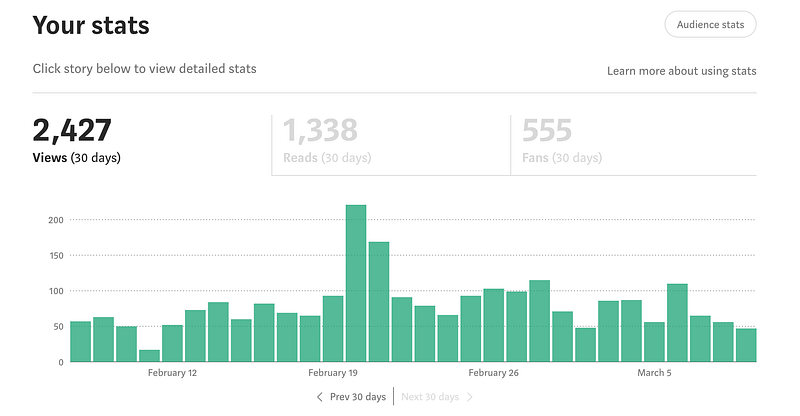
You’ve navigated to your Stats page (profile icon>Stats) and now see your total number views per day, displayed in a handy bar graph. Self-explanatory, right?
But what about underneath that — it’s not quite as self-explanatory, is it? You’ll see a list of your published articles to date on the left-hand side, with their respective results on the right-hand side. Below you’ll find the definitive answer on what the differences are between views, reads, read ratio and fans.
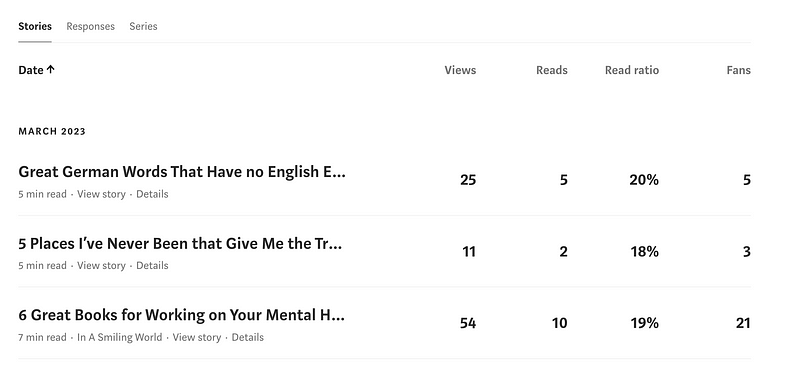
- Views: The number of times any given article has been viewed by users. Medium counts a ‘view’ whenever a user lands on your article page, even if they don’t read the article in its entirety.
- Reads: This is the number of times your article has been read through. Medium considers an article ‘read’ when a user has spent enough time on the page to indicate that they’ve engaged with the content. The exact amount of time required for an article to be counted as ‘read’ is not publicly disclosed, but this is the all-important metric for all members of the Medium Partner Program to keep an eye on, and the number which you really want to drive up! Why? Because every genuine ‘read’ is what will generate income on your metered articles.
- Fans: The number of unique readers who clapped for this story. Although each user can clap up to 50 times for a story, they will be counted as one fan. The number of fans you have per article is a useful metric for understanding how engaging your content is. If an article has a high number of fans, it suggests that it has resonated well with readers and has the potential to attract more followers and readers in the future.
[NB: Fans are not the same as followers. Followers are the total number of Medium users who have chosen to follow your account, while fans are specifically those who have followed you after reading any one of your articles.]
- Read ratio: The percentage of Medium users who started reading an article and completed it, calculated by dividing the number of reads by the number of views and multiplying by 100. For example, if an article had 1,000 views and 500 reads, the read ratio would be 50% ((500/1,000) * 100). As you can imagine, Medium uses various factors to determine when an article has been fully read, but does not disclose the exact algorithm. It’s worth noting however that reads are only counted for logged-in users who have read at least 30% of the article. Anything under 30% is not counted as a ‘read’. These stats are useful for understanding how engaging an article is; a high read ratio suggests that readers found the article interesting enough to read all the way through. A low read ratio may indicate that the article is failing to hold the reader’s interest, or reaching the wrong audience.
[NB: Bear in mind, the read ratio is just one of many metrics that Medium uses to evaluate the performance of articles. Other factors such as recommendations, comments and time spent on the article may also be taken into account.]
Monitor your monthly growth
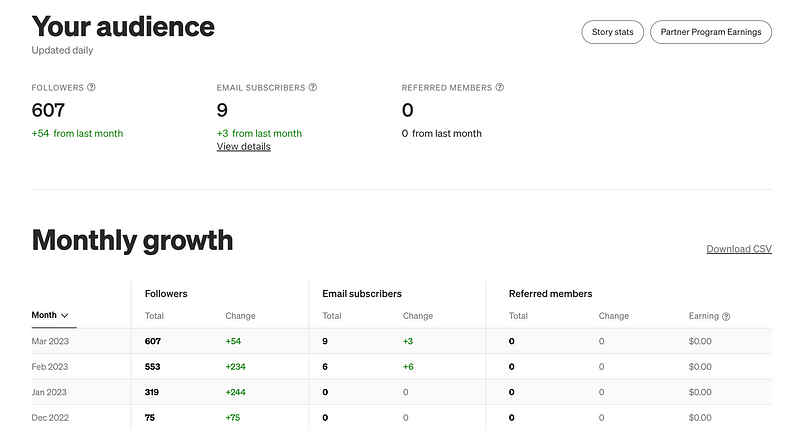
Of course, there are more options than just the above to keep your eye on your articles’ continuing performance. You can get a useful snapshot of your audience growth over time (profile icon>Stats>Audience stats), and this page highlights key areas such as volume of follower growth per month, rise in email subscribers (if you’ve not set this feature up yet — do it NOW!) and even if you successfully referred any Medium members (along with the earnings that these have generated for you).
And that’s the basics covered! Make it part of your general Medium housekeeping to take a short look at your stats week-on-week to see areas in which you can improve — and celebrate your achievements!
If you’d like to support my writing, you can join Medium as a member. For every member who signs up using my link will allow me to get a small portion of your membership fee. Thank you!


