
Meaning Discovery: Two Thematic Triangles
One small talk and Two case studies
This post is part of the “Meaning Discovery” series. You can find more related posts below:
- The Thematic Matrix Canvas and Meaning Discovery Canvas
- Meaning Discovery: The “Moment — Present — Future” Thematic Space
- Meaning Discovery: The “Object — Self — Other” Thematic Space
- Oliver Ding: My Twelve Creative Moments of 2023
- Life Discovery: Significant Insights Analysis
- The Art of Situational Note-taking (Introduction and Index)
- The Curated Mind Toolkit (v1.0)
In the previous posts, I introduced one thematic triangle which is a three-theme thematic space in one post. Today, I will use one material to introduce two thematic triangles:
- The “Connection — Uniqueness — Relevance” Thematic Space
- The “Thing — End — Means” Thematic Space
1. Materials and Models
For my case studies, Materials are pieces of experiences found from my real-life events.
The Meaning Discovery Canvas is a knowledge framework or knowledge Model.
Each case study happens within a Thematic Space between Materials and the Model.
How to represent the Thematic Space?
I selected one theme from the Materials and two themes from the Model to make a thematic triangle to frame the thematic space. The diagram below is an example.
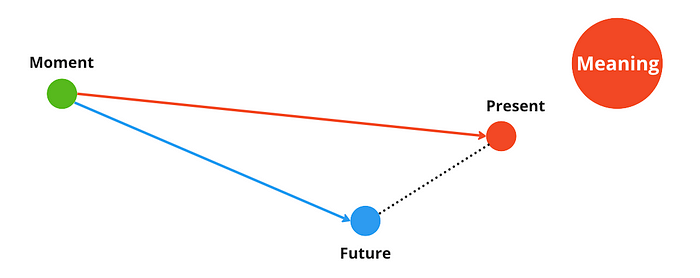
“Moment” refers to a short indefinite period. I used it to refer to the Immediate Situational aspect of Materials.
“Present” and “Future” are two blocks of the Meaning Discovery Canvas.
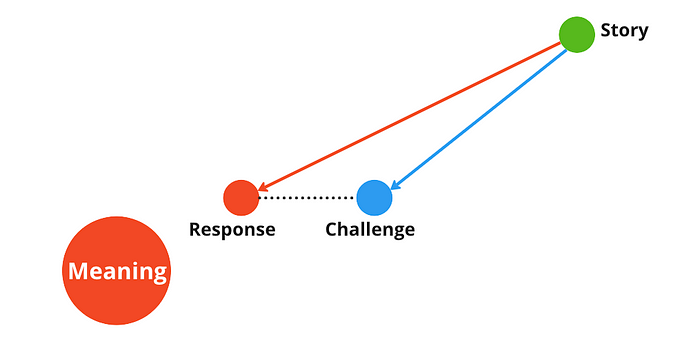
For some case studies, the immediate situational aspect is not the primary focus. For example, Life Meaning Discovery tends to engage with the long-term development of stories and themes. We could use “Story” to frame a new thematic space. See the example below.
This article will talk about the following two thematic triangles.
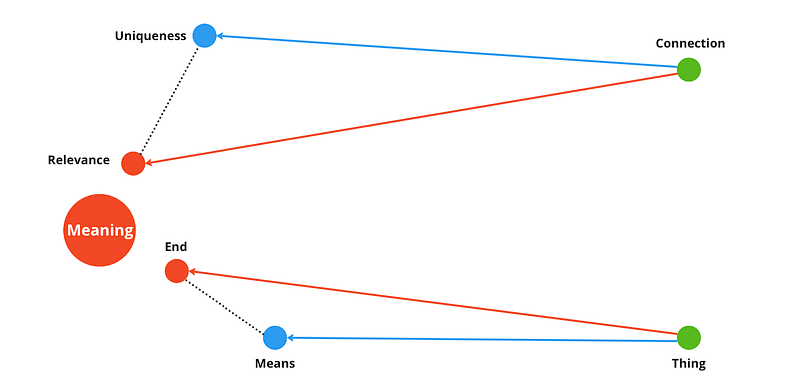
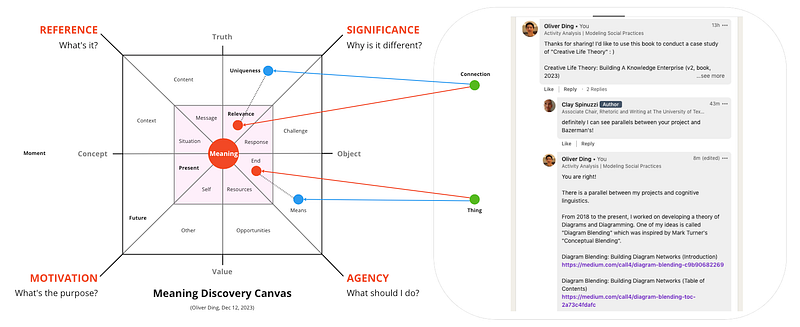
The “Connection — Uniqueness — Relevance” thematic space is located in the SIGNIFICANCE Area.
The “Thing — End — Means” thematic space is located in the AGENCY Area.
2. A Small Talk
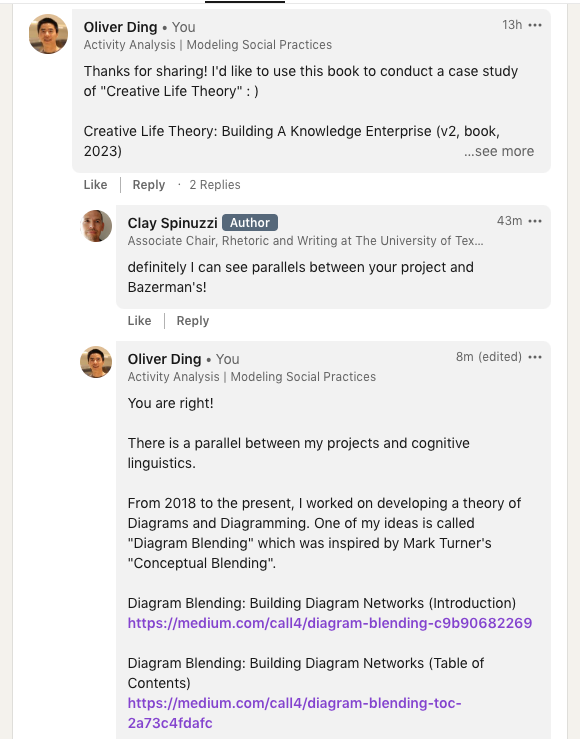
Yesterday my friend Clay Spinzzi shared the link to his newest book review on Linkedin.
I just reviewed Charles Bazerman’s autoethnography How I Became the Kind of Writer I Became. An interesting and revealing account of his development as a writer, including background on his scholarly works.
Charles Bazerman is a leading researcher of writing as a cultural practice. I have read his several books including The Languages of Edison’s Light. The new book is unique because it is about Bazerman’s own life course.
Immediately, I made a short comment.
Thanks for sharing! I’d like to use this book to conduct a case study of “Creative Life Theory” : )
Creative Life Theory: Building A Knowledge Enterprise (v2, book, 2023) https://readmedium.com/creative-life-theory-v2-book-2023-03b569e20910
This morning Clay replied to me with the comment below.
definitely, I can see parallels between your project and Bazerman’s!
This was a small talk!
However, it was turned into a meaningful moment.
Finally, a significant insight was born from this talk.
This is an amazing experience!
3. The “Connection — Uniqueness — Relevance” Thematic Space
The theme of “Connection” was an aspect of the above Material. Clay quickly identified “Parallels” between my project Creative Life Theory and Bazerman’s because both adopt the lifespan perspective.
“Parallel” is a special type of “Connection” which is used to describe the relationship between two things.
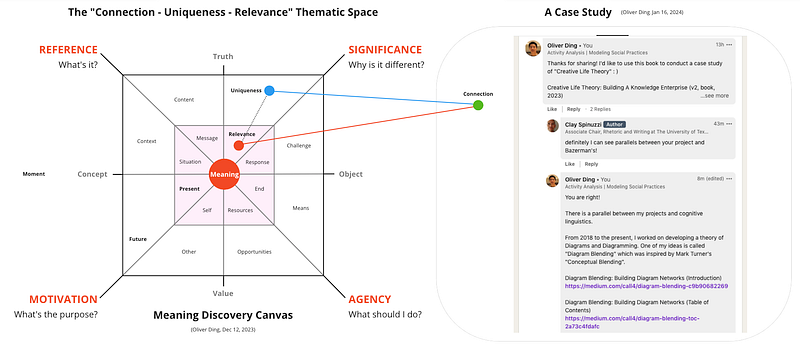
If we see a “Connection” in a “Material”, then it’s easy to discover the “Uniqueness — Relevance” mapping.
In this case, Clay captured the “Uniqueness” behind my comment.
After reading Clay’s comment, I detached my mental focus from the “Uniqueness” block and attached it to the “Relevance”.
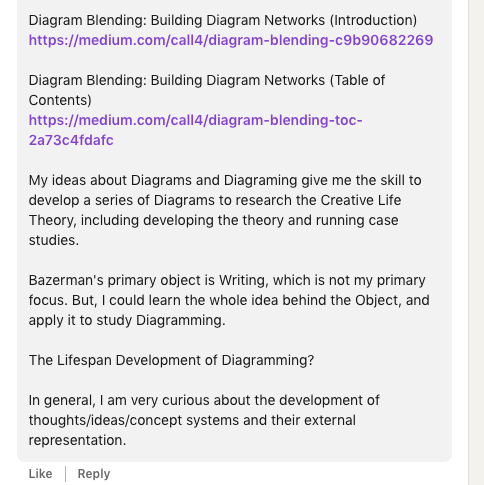
In the “Relevance” block, I expanded the “Parallels” into a more advanced version.
- A Parallel between my “Diagram Blending” project and Mark Turner’s “Conceptual Blending” project.
- A Parallel between Diagrams/Visuals and Concept/Language/Text.
- A Parallel between my “Diagramming” project and Charles Bazerman’s “Writing” project
In 2018, Charles Bazerman and other authors edited a book titled The Lifespan Development of Writing which is the outcome of a four-year collaborative project. You can find Bazerman’s chapter below:
In general, I am very curious about the development of thoughts/ideas/concept systems and their external representation. Writing and Diagramming are two different ways of making external representation. You can find more details in The Slow Cognition Project and related methods.
4. The “Thing — End — Means” Thematic Space
A “Material” could have various aspects. In this case, we can use the theme of “Thing” to discuss the “Means—End” mapping.
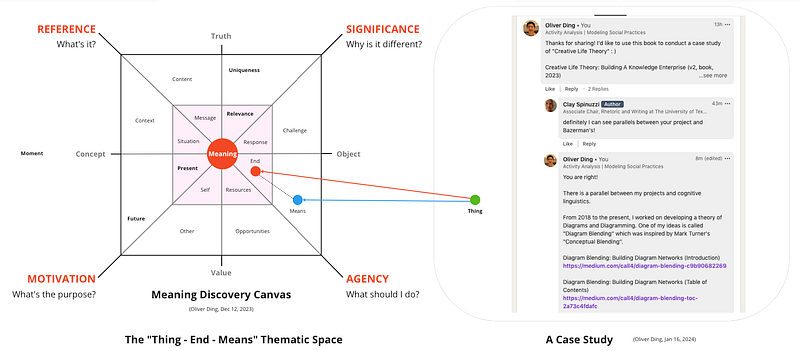
The “Means — End” Mapping was inspired by Activity Theory.
Activity Theory or the “Cultural-historical activity theory (CHAT)” is an interdisciplinary philosophical framework for studying both individual and social aspects of human behavior. You can find more details in The Landscape of Activity Theory and CHAT.
According to Kaptelinin and Nardi (2006), there are five basic principles of Activity Theory:
- Object-orientedness
- Tool mediation
- Internalization — externalization
- The hierarchical structure of activity, and
- Development
The Activity Checklist applies the principle of tool mediation with other principles and develops four sections of a checklist to design and evaluate technologies and tools.
- Means and ends: the extent to which the technology facilitates and constrains attaining users’ goals.
- Environment: the integration of target technology with other tools and resources.
- Learning, cognition, and articulation: internal versus external components of activity and support of their mutual transformations.
- Development: the transformation of components over time.
The Activity Checklist is developed for HCI (Human-computer interaction) researchers and designers. For the present discussion, we don’t have to directly apply it.
In the above case, I initially perceived Charles Bazerman’s creative life and the book How I Became the Kind of Writer I Became as a “Material” for conducting a case study of Creative Life Theory. It means I placed them at the “Means” block. The corresponding “End” is developing Creative Life Theory.
Later, I moved to the perspective and the method behind Charles’ creative life, such as the lifespan development perspective. In this mental move, the “Means — End” mapping changed.
What’s the new “END”?
- To learn Charles Bazerman’s perspective and method.
What’s the new “Means”?
- Tools and methods of reading and learning. For example, Clay Spinuzzi’s book review.
Two “End — Means” Mapping could lead to two different and related projects.
5. The Insight
What kind of insight can we learn from these two case studies?
- The thematic triangle (a three-theme thematic space) is dynamic because it was formed with one theme of a “Material” and two themes from the “Inner — Outer” Mapping.
- A “Material” (the real-life experience) has various aspects.
- The “Inner — Outer” Mapping is dynamic.
This is a powerful way to use a simple canvas to understand the complicated human mind and social behavior.
Related Articles
- Situational Note-taking: The idea of “Meaning Matrix” — Oct 17, 2023
- Situational Note-taking: The Thematic Matrix Canvas and Meaning Discovery Canvas — Oct 25, 2023
- Situational Note-taking: The idea of “Thematic Matrix +” — Nov 19, 2023
- [Creative Diagramming] Graphic Space Affordances, Thematic Space, and Possible Paths — Oct 31, 2023


