avatarDaniel Hopper

Free AI web copilot to create summaries, insights and extended knowledge, download it at here

5243

Abstract

significant muscle damage through an increased absolute load/force and mechanical tension that overloads the targeted muscle. This leads to increased fascicle and muscle length and <a href="https://bjsm.bmj.com/content/early/2008/11/04/bjsm.2008.051417?versioned=true">enhanced muscle girth potential</a>. The <a href="https://pubmed.ncbi.nlm.nih.gov/28486337/">eccentric contraction having more impact on increasing muscle length</a> is likely because of the increased localised muscle damage along muscle fibres<b> </b><i>“produced by non-uniform muscle activation of eccentric contractions”.</i></p><p id="994d" type="7">“…Mechanical stress placed on the eccentrically contracted muscles triggers a progressive activation of genes responsible for cellular growth and development, which is not possible by concentric or isometric actions.” — Hody et al., 2019</p><p id="3c93"><a href="https://pubmed.ncbi.nlm.nih.gov/32581845/">Eccentric contractions preferentially recruit high-threshold motor units</a>. These motor units contain a higher proportion of type II fibres, also known as <a href="https://blog.nasm.org/fitness/fast-twitch-vs-slow-twitch">fast-twitch muscle fibres</a>, which support speed and powerful movements like weightlifting and sprinting.</p><p id="9da9">Another <a href="https://pubmed.ncbi.nlm.nih.gov/22344059/">result of the increased muscle damage from eccentric contractions</a> is <a href="https://onlinelibrary.wiley.com/doi/abs/10.1111/apha.12225">improved protein synthesis and increased anabolic signalling</a>, enhancing our ability to recover from intense physical activity.</p><p id="7c87">Concentrating on eccentric contractions could also have <a href="https://www.ncbi.nlm.nih.gov/pmc/articles/PMC8669760/">lower physiological demand than traditional resistance training</a>, which often uses heavier loads. This makes it more metabolically efficient, crucial for <a href="https://readmedium.com/2391e8e3df30">minimising fatigue and maximising stimulus</a>. Systemic fatigue will reduce our ability to progress with our training, sometimes even reducing our performance.</p><p id="dce3" type="7">“The increase in time under tension by extending the eccentric contraction is thought to be an important factor for promoting muscular hypertrophy and indirectly affecting strength.” — Wilk et al., 2021</p><p id="4758">Finally, by extending the time of each eccentric rep, we’re increasing the <a href="https://readmedium.com/38e19f988929">time under tension</a> and the potential for metabolic stress of the target muscle, which is a crucial driver of hypertrophic adaption. When our muscles adapt to a stimulus, they grow bigger and stronger.</p><figure id="564c"><img src="https://cdn-images-1.readmedium.com/v2/resize:fit:800/1*Q47UdRn_KUjrR2r-AYjq1g.jpeg"><figcaption>Photo by <a href="https://unsplash.com/@aloragriffiths?utm_content=creditCopyText&amp;utm_medium=referral&amp;utm_source=unsplash">Alora Griffiths</a> on <a href="https://unsplash.com/photos/woman-seriously-performing-gym-exercise-LOnMc8Rp1Qs?utm_content=creditCopyText&amp;utm_medium=referral&amp;utm_source=unsplash">Unsplash</a></figcaption></figure><h1 id="b1b9">How to maximise the hypertrophy benefits of a stretched muscle</h1><p id="e61f">We have just learnt why the eccentric contraction is so crucial to muscle growth. In this section, I will outline some tips to optimise your training to recieved the full benefits of exaggerated eccentric contractions.</p><h2 id="3b5f">Control all repetitions</h2><p id="9fc7">This is a big mistake many people make with their training — do not let the weight drop on the eccentric! Your technique is so important here.</p><p id="e0c4">Provide some force against the weight/load to control each repetition as your muscles lengthen to resist gravity/the resistance.</p><h2 id="99e5">Rep range</h2><p id="6c1c">Use a moderate rep range of 10 to 20 reps on most sets. This is because it provides the best trade-off between variables such as stimulus, fatigue, the risk of injury, type I and II (slow/fast) fibre specificity, and the mind-muscle connection. Aim to have around 25 percent of your sets in the heavy (5–10 reps) or light rep ranges (20–30 reps).</p><h2 id="f1f7">Tempo</h2><p id="6fe9">How long each repetition/set takes often depends on the exercise, but we can set a general guide.</p><p id="75e1">A set is split into four portions: it has the moving parts of the concentric and eccentric, and then the isometric and isotonic pauses. Aim for 3–5 second eccentrics and an ‘explosive’ concentric of around 1 second. We pause between each of these contractions for a second or two.</p><p id="6f9e">For an exercise starting with the eccentric, such as a squat or bench press, this tempo would be written like 3/1/1/2 to indicate a slow descent (eccentric), pause, explosive concentric, and pause before the next rep. For an exercise that starts at the bottom (stretched) position, like a deadlift or bicep curl, this would be written 1/1/4/2.</p><figure id="0652"><img src="https://cdn-images-1.readmedium.com/v2/resize:fit:800/1*s0XzotOl6M077534pglN6Q.jpeg"><figcaption>Photo by <a href="https://unsplash.com/@visualsbyroyalz?utm_content=creditCopyText&amp;utm_medium=referral&am

Options

p;utm_source=unsplash">Anastase Maragos</a> on <a href="https://unsplash.com/photos/topless-man-in-black-shorts-carrying-black-dumbbell-7kEpUPB8vNk?utm_content=creditCopyText&amp;utm_medium=referral&amp;utm_source=unsplash">Unsplash</a></figcaption></figure><h2 id="c2ff">Use less weight</h2><p id="2232">It is far more difficult to actively resist the force and slow the eccentric portion of an exercise to 3–5 seconds than to let gravity/ machine do the work.</p><p id="3bd5">To maximise the potential of the eccentric, You must use less weight to perform the same number of repetitions as you usually would. Put your ego aside, friend.</p><h2 id="649e">Exercise selection</h2><p id="573b">Not all exercises will be appropriate for slow eccentric repetitions, such as some strength-focused exercises like the deadlift. This is because the emphasis is a quick and efficient concentric to lift a heavy load.</p><p id="6358">It is asking for a back injury by trying to lower 300-plus pounds slowly for multiple repetitions. Isolation exercises and machines are far better to stretch out each eccentric contraction.</p><h2 id="46de">Variation</h2><p id="15e5">It is beneficial for progression to include some variation in our training. One way we can do this is through eccentric-only training. We are typically<b> </b>stronger during the eccentric portion, meaning we can control more weight when lowering it than when pushing/pulling it back up.</p><p id="9e43">Therefore, only doing the eccentric portion allows us to load more weight than usual. However, we need spotters to help bring the weight to the top position after each rep.</p><p id="5f23">By using spotters, we can use more load than usual to really stretch and damage our muscle fibres for these eccentric-only repetitions.</p><h1 id="b596">Benefits of a restricted range of motion — lengthened partials</h1><p id="8219">Emerging research now suggests that the shortened portion of an exercise (like flexing your bicep) has less influence on stimulating muscle growth than previously thought. A full range of motion is widely considered optimal for muscle growth. However, this might not be the case according to a <a href="https://pubmed.ncbi.nlm.nih.gov/33977835/">recent study</a> comparing partial reps to a full range of motion. Furthermore, <a href="https://www.researchgate.net/profile/Milo-Wolf-2">Dr Milo Wolf</a> just completed his PhD on this topic, and you can <a href="https://www.researchgate.net/publication/368925927_Partial_Vs_Full_Range_of_Motion_Resistance_Training_A_Systematic_Review_and_Meta-Analysis">check out the subsequent systematic review and meta-analysis here.</a></p><p id="7f60">The researchers found that the group who did a partial range of motion with lengthened muscles built more muscle than those who did a full range of motion and those who did partial reps with a shortened muscle.</p><p id="1d87">In the below article, I explore using partial reps for hypertrophy.</p><div id="60b4" class="link-block"> <a href="https://readmedium.com/will-we-build-more-muscle-with-a-partial-range-of-motion-e322d5da923e"> <div> <div> <h2>Build More Muscle With Half Reps?</h2> <div><h3>A partial range of motion might have its place in the gym after all, according to new research…</h3></div> <div><p>medium.com</p></div> </div> <div> <div style="background-image: url(https://miro.readmedium.com/v2/resize:fit:320/1*fzlbkDhZU53UnB9BQDMDRA.png)"></div> </div> </div> </a> </div><h1 id="2271">Final Thoughts</h1><p id="ebd9">In conclusion, the stretch is the eccentric portion of an exercise. this article explores the positive relationship between the eccentric and building muscle.</p><p id="a741">Slower eccentric movements paired with faster concentric movements are most effective for building muscle.</p><p id="7a84">I discuss the scientific evidence and provide best practice tips to maximise the stretch on exercises and increase their hypertrophy potential.</p><p id="d6c7">I hope you found the information in this article informative.</p><p id="62ff">If you follow these tips, they should provide a foundation for you to improve your exercise technique to promote better muscle gains in the gym.</p><p id="fbea"><b>Thank you for reading.</b></p><p id="55c4"><b><i>If you enjoyed the article, you could <a href="https://danielhopper.medium.com/subscribe">subscribe</a> to be notified when I publish new content.</i></b></p><p id="107d">You can find more articles about fitness from the link below.</p><div id="24d4" class="link-block"> <a href="https://danielhopper.medium.com/list/1bb555702535"> <div> <div> <h2>Fitness</h2> <div><h3>Articles about fitness</h3></div> <div><p>danielhopper.medium.com</p></div> </div> <div> <div style="background-image: url(https://miro.readmedium.com/v2/resize:fit:320/0*d3ebab7b526e988b145bdc52d051baf4de3c6234.jpeg)"></div> </div> </div> </a> </div></article></body>

Optimise Muscle Growth by Maximising the Stretch

Science now suggests that the lengthening portion of an exercise, referred to as the eccentric, is the most important aspect of the movement for muscle growth.
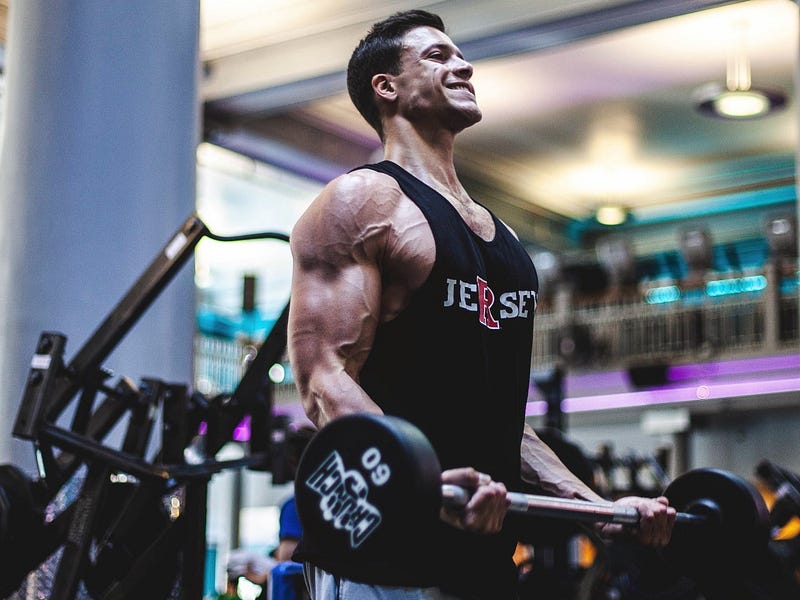
Photo by Total Shape on Unsplash

Have you ever stretched out a rubber band? The most tension is at the maximum stretch, right? The fibres are stretched out to their capabilities and almost ready to break.

The same concept applies to our muscles. The difference is that the rubber band grows weaker, but our muscles recover and grow back stronger. This stress on our muscle fibres created by this deep stretch forces an adaption, which is ultimately how our muscles grow.

The process of building muscle is referred to in the scientific community as hypertrophy.

In previous articles, I broke down hypertrophy and how it works. In part one, we explore the science behind muscle hypertrophy. Part two covers key considerations to optimise a workout for maximal muscle growth. Part 3 provides a guide to programming workouts that prioritise hypertrophy.

These three articles are a comprehensive guide to muscle growth. However, there is a lot to discuss when it comes to the science and methodology behind training to build muscle.

This article will focus on perhaps the most vital component of building muscle, the “stretch”.

What is the stretch component of an exercise?

We are not talking about stretching in the traditional context of exercise here.

An exercise has four distinct portions, which we explain as four types of muscle contractions. Two of these contractions are stationary, the isometric and isotonic, and two are moving, called eccentric and concentric. The concentric portion is also known as the positive, and the eccentric portion is the negative.

The eccentric is when the target muscle lengthens because the force of our contraction is less than that of the resistance as we release tension. For example, when you lower the weight back to the floor in a set of deadlifts or towards your chest on the bench press.

This is the stretch.

During the concentric, the muscle shortens under load.

An isometric contraction is at the end of the eccentric, and the isotonic is when the muscle is fully shortened, such as when flexing your bicep.

“The inclusion of eccentric loads not constrained by concentric strength appears to be superior to traditional resistance training in improving variables associated with strength, power and speed performance.” — Douglas et al., 2017

Photo by Matthew Sichkaruk on Unsplash

Benefits of the eccentric contraction: the science

The exercise science literature widely concludes (for example, here and here) that the eccentric contraction of an exercise has physiological advantages over concentric and stationary contractions for stimulating an adaptive hypertrophic response.

In basic terms, the eccentric has more influence on building muscle than the concentric. This goes against the widespread practice of most gymgoers who put all their effort into the concentric and neglect to control the eccentric. Unfortunately for them, this reduces their potential to progress their results by doing this.

Studies identify various reasons eccentric contractions have more potential for muscle growth than the concentric portion of an exercise.

A 2017 meta-analysis from Schoenfeld and colleagues identified that a controlled eccentric provides significant muscle damage through an increased absolute load/force and mechanical tension that overloads the targeted muscle. This leads to increased fascicle and muscle length and enhanced muscle girth potential. The eccentric contraction having more impact on increasing muscle length is likely because of the increased localised muscle damage along muscle fibres “produced by non-uniform muscle activation of eccentric contractions”.

“…Mechanical stress placed on the eccentrically contracted muscles triggers a progressive activation of genes responsible for cellular growth and development, which is not possible by concentric or isometric actions.” — Hody et al., 2019

Eccentric contractions preferentially recruit high-threshold motor units. These motor units contain a higher proportion of type II fibres, also known as fast-twitch muscle fibres, which support speed and powerful movements like weightlifting and sprinting.

Another result of the increased muscle damage from eccentric contractions is improved protein synthesis and increased anabolic signalling, enhancing our ability to recover from intense physical activity.

Concentrating on eccentric contractions could also have lower physiological demand than traditional resistance training, which often uses heavier loads. This makes it more metabolically efficient, crucial for minimising fatigue and maximising stimulus. Systemic fatigue will reduce our ability to progress with our training, sometimes even reducing our performance.

“The increase in time under tension by extending the eccentric contraction is thought to be an important factor for promoting muscular hypertrophy and indirectly affecting strength.” — Wilk et al., 2021

Finally, by extending the time of each eccentric rep, we’re increasing the time under tension and the potential for metabolic stress of the target muscle, which is a crucial driver of hypertrophic adaption. When our muscles adapt to a stimulus, they grow bigger and stronger.

Photo by Alora Griffiths on Unsplash

How to maximise the hypertrophy benefits of a stretched muscle

We have just learnt why the eccentric contraction is so crucial to muscle growth. In this section, I will outline some tips to optimise your training to recieved the full benefits of exaggerated eccentric contractions.

Control all repetitions

This is a big mistake many people make with their training — do not let the weight drop on the eccentric! Your technique is so important here.

Provide some force against the weight/load to control each repetition as your muscles lengthen to resist gravity/the resistance.

Rep range

Use a moderate rep range of 10 to 20 reps on most sets. This is because it provides the best trade-off between variables such as stimulus, fatigue, the risk of injury, type I and II (slow/fast) fibre specificity, and the mind-muscle connection. Aim to have around 25 percent of your sets in the heavy (5–10 reps) or light rep ranges (20–30 reps).

Tempo

How long each repetition/set takes often depends on the exercise, but we can set a general guide.

A set is split into four portions: it has the moving parts of the concentric and eccentric, and then the isometric and isotonic pauses. Aim for 3–5 second eccentrics and an ‘explosive’ concentric of around 1 second. We pause between each of these contractions for a second or two.

For an exercise starting with the eccentric, such as a squat or bench press, this tempo would be written like 3/1/1/2 to indicate a slow descent (eccentric), pause, explosive concentric, and pause before the next rep. For an exercise that starts at the bottom (stretched) position, like a deadlift or bicep curl, this would be written 1/1/4/2.
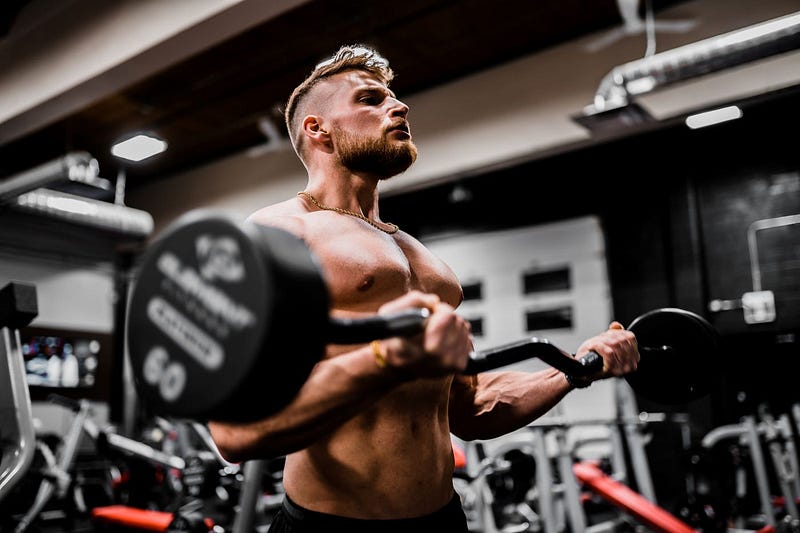
Photo by Anastase Maragos on Unsplash

Use less weight

It is far more difficult to actively resist the force and slow the eccentric portion of an exercise to 3–5 seconds than to let gravity/ machine do the work.

To maximise the potential of the eccentric, You must use less weight to perform the same number of repetitions as you usually would. Put your ego aside, friend.

Exercise selection

Not all exercises will be appropriate for slow eccentric repetitions, such as some strength-focused exercises like the deadlift. This is because the emphasis is a quick and efficient concentric to lift a heavy load.

It is asking for a back injury by trying to lower 300-plus pounds slowly for multiple repetitions. Isolation exercises and machines are far better to stretch out each eccentric contraction.

Variation

It is beneficial for progression to include some variation in our training. One way we can do this is through eccentric-only training. We are typically stronger during the eccentric portion, meaning we can control more weight when lowering it than when pushing/pulling it back up.

Therefore, only doing the eccentric portion allows us to load more weight than usual. However, we need spotters to help bring the weight to the top position after each rep.

By using spotters, we can use more load than usual to really stretch and damage our muscle fibres for these eccentric-only repetitions.

Benefits of a restricted range of motion — lengthened partials

Emerging research now suggests that the shortened portion of an exercise (like flexing your bicep) has less influence on stimulating muscle growth than previously thought. A full range of motion is widely considered optimal for muscle growth. However, this might not be the case according to a recent study comparing partial reps to a full range of motion. Furthermore, Dr Milo Wolf just completed his PhD on this topic, and you can check out the subsequent systematic review and meta-analysis here.

The researchers found that the group who did a partial range of motion with lengthened muscles built more muscle than those who did a full range of motion and those who did partial reps with a shortened muscle.

In the below article, I explore using partial reps for hypertrophy.

Final Thoughts

In conclusion, the stretch is the eccentric portion of an exercise. this article explores the positive relationship between the eccentric and building muscle.

Slower eccentric movements paired with faster concentric movements are most effective for building muscle.

I discuss the scientific evidence and provide best practice tips to maximise the stretch on exercises and increase their hypertrophy potential.

I hope you found the information in this article informative.

If you follow these tips, they should provide a foundation for you to improve your exercise technique to promote better muscle gains in the gym.

Thank you for reading.

If you enjoyed the article, you could subscribe to be notified when I publish new content.

You can find more articles about fitness from the link below.

Gym
Exercise
Workout
Fitness
Bodybuilding
Recommended from ReadMedium