
Marvel Comics Ditches Creativity To Appeal To The Woke Crowd
Watch out, DC — Marvel has unleashed their Social Justice League!
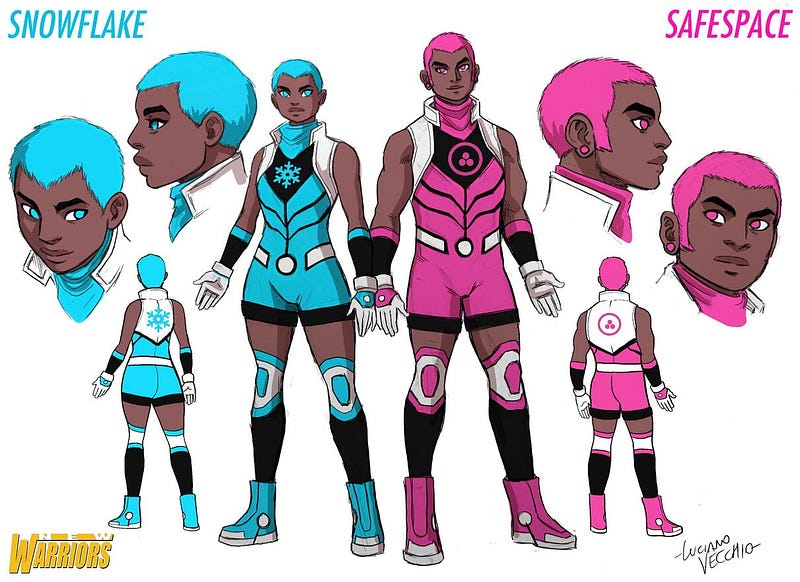
Marvel has just released the details of their upcoming series, The New Warriors, another reboot of a team book that premiered in 1990, and the comic book community is in an uproar about it, as the new lineup consists of characters ripped straight from woke culture…and apparently nothing else.
The characters who are receiving the most attention are Snowflake, Marvel’s first nonbinary character, with the ability to produce snowflake-shaped shurikens, and Safespace, who can materialize pink forcefields but can’t inhabit them himself. Writer Daniel Kibblesmith states that the names are “a post-ironic meditation on using violence to combat bullying”.
Kibblesmith elaborates further on his creatively bankrupt thought process:
“…It’s this idea that these are terms that get thrown around on the internet that they don’t see as derogatory. [They] take those words and kind of wear them as badges of honor.”
Check out the trailer below, which, as of this writing, has garnered over 149,000 downvotes compared to its 3,000 upvotes:
It’s painful for me, a lifelong Marvel fan, to see a company that was once renowned for bucking comic book trends and creating new ones, so eagerly cater to the SJW Twitter crowd.
When Jack Kirby and Stan Lee introduced Black Panther, their first black superhero, in Fantastic Four in 1966 (during the height of the Civil Rights Movement), the character wasn’t merely a mouthpiece for disenfranchised blacks at the time; he came equipped with a rich history and defined traits; he was a scientist from a technologically advanced African nation, a far cry from the way blacks were normally portrayed in pop culture during that period.
When Chris Claremont fleshed out existing female characters and created new ones during the women’s liberation movement in the 1970s and ’80s, he didn’t simply make them advertisements for feminism; he made characters like Storm, Jean Grey, Rogue, Psylocke, Mariko Yashida, Kitty Pryde, and Mystique strong, flawed, funny, insecure, determined, and conflicted, making them feminist without making them “feminist”.
Despite plenty of questionable creative choices over the years, Marvel has actually done a great job creating characters from underrepresented populations, and making them transcend their stereotypes by treating them with the same respect given to all of their other characters.
They proved that a character’s superficial characteristics — their race, gender, sexuality, etc. — didn’t matter. It was their personalities, their values, their choices, their abilities that mattered.
Today, however, it seems that whenever Marvel tries to introduce characters that represent a group currently considered marginalized, they produce a product that’s little more than an embodiment of the talking points surrounding that group. There’s no art, no subtlety applied in their admittance into the Marvel universe.
How can comic book fans trust a company that gets its series ideas from scanning the headlines of Jezebel, Teen Vogue, and Vox?
On the surface, this latest move by Marvel seems like a cynical attempt to placate the Twitter mobs who’ve made it their raison d’etre to constantly bitch about the lack of “diversity”, “inclusion”, and “representation” in every new piece of pop culture, and it may very well be.
But I think the problem is deeper and more troubling than that.
It’s the sign of a once-innovative company that has given up on taking risks with an originality firmly planted in the future, and has taken up staying just behind the times as its new standard practice. Despite being only a few years old, the terms “safe space” and “snowflake” are already tired cliches in the lightspeed momentum of social media culture. Their use here is too late for relevance, too soon for nostalgia, and right on time for absurdity.
Marvel has put out some heavy-handed books in recent years, but this is their most obvious attempt yet at attracting the approval of the hyper-progressive clique. It positively reeks of an editorial and corporate interference that’s designed to put the millennials’ perception of them first, and the freedom of writers who strive for narrative derring-do second.
Comic book creators have more freedom to let their fiction run wild than even Hollywood filmmakers backed with $250 million dollar budgets, so it’s a sad day when their imaginations are tethered to the ideology of a movement that’s known for eating itself to survive.